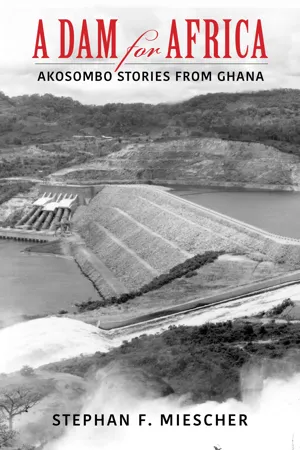
A Dam for Africa
eBook - ePub

A Dam for Africa

Akosombo Stories from Ghana

  1. 598 pages
  2. English
  3. ePUB (mobile friendly)
  4. Available on iOS & Android
eBook - ePub

A Dam for Africa

Akosombo Stories from Ghana

About this book

Since its construction in the early 1960s, the hydroelectric Akosombo Dam across the Volta River has exemplified the possibilities and challenges of development in Ghana. Drawing upon a wealth of sources, A Dam for Africa investigates contrasting stories about how this dam has transformed a West African nation, while providing a model for other African countries.

The massive Akosombo Dam is the keystone of the Volta River Project that includes a large manmade lake 250 miles long, the VALCO aluminum smelter, new cities and towns, a deep-sea harbor, and an electrical grid. On the local level, Akosombo has meant access to electricity for people in urban and industrial areas across southern Ghana. For others, Akosombo inflicted tremendous social and environmental costs. The dam altered the ecology of the Lower Volta, displaced 80,000 people in the Volta Basin, and affected the livelihoods of hundreds of thousands of Ghanaians.

In A Dam for Africa, Stephan Miescher explores four intersecting narratives: Ghanaian debates and aspirations about modernization in the context of decolonization and Cold War; international efforts of the US aluminum industry to benefit from Akosombo through cheap electricity for their VALCO smelter; local stories of upheaval and devastation in resettlement towns; and a nation-wide quest toward electrification and energy justice during times of economic crises, droughts, and climate change.

Frequently asked questions

Yes, you can cancel anytime from the Subscription tab in your account settings on the Perlego website. Your subscription will stay active until the end of your current billing period. Learn how to cancel your subscription.
No, books cannot be downloaded as external files, such as PDFs, for use outside of Perlego. However, you can download books within the Perlego app for offline reading on mobile or tablet. Learn more here.
Perlego offers two plans: Essential and Complete
  • Essential is ideal for learners and professionals who enjoy exploring a wide range of subjects. Access the Essential Library with 800,000+ trusted titles and best-sellers across business, personal growth, and the humanities. Includes unlimited reading time and Standard Read Aloud voice.
  • Complete: Perfect for advanced learners and researchers needing full, unrestricted access. Unlock 1.4M+ books across hundreds of subjects, including academic and specialized titles. The Complete Plan also includes advanced features like Premium Read Aloud and Research Assistant.
Both plans are available with monthly, semester, or annual billing cycles.
We are an online textbook subscription service, where you can get access to an entire online library for less than the price of a single book per month. With over 1 million books across 1000+ topics, we’ve got you covered! Learn more here.
Look out for the read-aloud symbol on your next book to see if you can listen to it. The read-aloud tool reads text aloud for you, highlighting the text as it is being read. You can pause it, speed it up and slow it down. Learn more here.
Yes! You can use the Perlego app on both iOS or Android devices to read anytime, anywhere — even offline. Perfect for commutes or when you’re on the go.
Please note we cannot support devices running on iOS 13 and Android 7 or earlier. Learn more about using the app.
Yes, you can access A Dam for Africa by Stephan F. Miescher in PDF and/or ePUB format, as well as other popular books in History & African History. We have over one million books available in our catalogue for you to explore.

Information

Table of contents

  1. Cover
  2. Title Page
  3. Copyright
  4. Dedication
  5. Contents
  6. Acknowledgments
  7. List of Abbreviations
  8. Prologue
  9. Introduction
  10. Part I. The Volta River Project
  11. Part II. The Volta Aluminum Company
  12. Part III. Settlements of Modernization
  13. Part IV. Power Struggles
  14. Epilogue
  15. Notes
  16. Bibliography
  17. Index
  18. About the Author