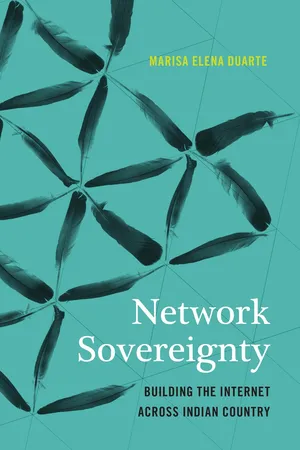
In 2012, the United Nations General Assembly determined that affordable Internet access is a human right, critical to citizen participation in democratic governments. Given the significance of information and communication technologies (ICTs) to social and political life, many U.S. tribes and Native organizations have created their own projects, from streaming radio to building networks to telecommunications advocacy. In Network Sovereignty, Marisa Duarte examines these ICT projects to explore the significance of information flows and information systems to Native sovereignty, and toward self-governance, self-determination, and decolonization. By reframing how tribes and Native organizations harness these technologies as a means to overcome colonial disconnections, Network Sovereignty shifts the discussion of information and communication technologies in Native communities from one of exploitation to one of Indigenous possibility.
- 192 pages
- English
- ePUB (mobile friendly)
- Available on iOS & Android
eBook - ePub
About this book
Information
CHAPTER 1
Network Thinking
Information Flows Like Water
Indigenous revival cannot be understood without reference to the technology, power, and legitimacy of states.
—Ronald Niezen, The Origins of Indigenism
HOW DOES THE CONCEPT OF TECHNOLOGY RELATE TO THE CONCEPT of Indigeneity? How are the technical devices that shape contemporary day-to-day life woven into those moments that define what it means to be Indigenous? The sleek look and discreet design of many contemporary digital devices—mobile phones, laptops, tablets—invite us to imagine these objects as neutral and futuristic, devoid of historical legacies. Ironically, tribal peoples are also imagined as beings without histories: prehistoric, precolonial, and pretechnological subjects of a techno-scientific American empire. How do these parallel imaginaries weave together? How does thinking in terms of networks and relationships help us understand the way the divide between the technical and the social manifests in Indigenous contexts? Understanding the concepts of technology, Indigeneity, and networks requires an understanding of the functions that communications technology and Native peoples—Indians—completed in the formation of the modern technically advancing nation-state.
We can consider the lineage of the wireless mobile phone, before the landline telephone, before wireless telegraphy, when the railroad barons were competing in the race to build a transcontinental railroad. In the United States and parts of Canada, the late nineteenth century spelled the beginning of an increasingly industrial era of modernity, as well as a century of campaigns against Indigenous peoples. Entrepreneurs inspired by the presentations of scientists and ethnographers at the world’s fairs seized on global visions of industrial, economic, and political largesse. Dreams of transcontinental transportation, communication, and shipping seemed very possible with the inventions of the steam engine and telegraphy, as well as Frederick Jackson Turner’s burgeoning vision of Manifest Destiny.1 For the landed entrepreneur, it seemed as though land and labor were there for the taking. As the railroad barons pushed westward, the US government sent agents and military backup to push tribal peoples of the western prairies, deserts, and plains from their homelands, freeing property for American settlement. By the mid-1860s, communications entrepreneurs had set up wire-line telegraph posts at many military base camps and at established train stations. Telegraphy was an important medium for transmitting messages about Indian mobilization. In the summer of 1865, a young US Army corporal assigned to guard the telegraph wire in Dakota Territory was writing a letter to his sister about Indians cutting the wires when he received a dispatch that Indians had killed the telegraph operator at nearby Sweetwater and ten military men were sent to repair the damaged line.2 This was only a few years after Little Crow’s War.3 Stories of Indian raids were fresh in the settler imaginary, particularly in areas where the only way to achieve speedy delivery across vast western expanses had been the recently defunct Pony Express.
A decade later, and thousands of miles away, during the winter of 1874, a teenage Nikola Tesla escaped Austrian military conscription by hiding in the mountains of Croatia, hunting, hiking, and imagining the conditions under which he might be able to shoot mail through a pressurized tube under the Atlantic Ocean. Later, during the Spanish-American War (1898) and the US acquisition of a divided Samoa (1899), Tesla would set up and work in a lab in Colorado Springs, experimenting with wireless communications and envisioning invisible systems of currents transmitting whole sentences around the globe.4 Yet, in 1901, Guglielmo Marconi, an Italian engineer, beat him to the punch, transmitting the first transatlantic radio signal from Saint John’s, Newfoundland, to Poldhu, Cornwall. The race to wireless communications was in full swing, enchanting business investors and inventors alike. For Marconi, Tesla, and many others, the dream of wireless communications included hopes for an invention that would change the very nature of international politics, commerce, and human interaction with the natural world.
Meanwhile, south of Colorado Springs, the US cavalry chased Apaches along the recently settled US-Mexico border. While the world was opening up for many American immigrants, the mechanisms of national expansion were cutting short ancient proven ways of life for Native peoples in the Americas. The general rule was that for Americans to prosper, Indians had to die. In the summer of 1905, Geronimo, semi-detained by the US Army, hopped into an automobile at the Miller Brothers’ 101 Ranch Show and chased and shot a buffalo, both shocking and entertaining nouveau Americans.5 Forty years later, a contingent of Navajo (Diné) soldiers would innovate a Diné-inspired cipher for transmitting military surveillance intelligence across radio waves in the World War II Pacific theater. Phil Deloria (Dakota) described these Indigenous encounters with technology in the American settler imaginary as “unexpected.” During World War II, and for years afterward, the general US approach to tribes was termination of federal assistance to Indians, even as the United States prospered on multiple illegal claims to sovereign Indian land.6 The practice of subjugating the land—and the Indigenous peoples of those lands—to serve the pursuit of wealth by industrialization bloomed fully throughout the Americas. In the modern settler imaginary, any Native or Indigenous use of modern technologies was unexpected precisely because Native and Indigenous peoples themselves were unexpected in the subjugated, mediated landscape. They were expected to have faded away along with shrinking herds of buffalo, made illegible by their supposed illiteracy and perceived inability to adapt to a modern industrial, and eventually techno-scientific, path to progress.
Understanding technology—and, in particular, digital technology—requires understanding the conditions under which innovation occurs. At this moment in the tapestry of world histories, digital technology is fascinating precisely because, in the technically advanced places, there remains a memory as well as some judgment of what everyday life was like before the precision, efficacy, immediacy, and interoperability of ubiquitous computing. Read against the century of US anti-Indian campaigns and imperial expansion, narratives of technological advancement function to satisfy societal desires for Enlightenment-era values of progress and scientific evolution in spite of the colonial fabric of Indian eradication.7
Indeed, Enlightenment-era values very much shape the concept of information itself. In 1432, the term was used to indicate matters of surveillance and accusation, and the subsequent need for adjudication, by English authorities.8 It was a term dependent on the machinations of power politics, useful only—as all “information” is—when pieced into a greater strategy, formula, or design. With regard to the politics of sovereign authority, it was the nascent notions of empire, conquest, and saltwater colonialism that shaded the Enlightenment project as much more than state making but as part of a greater strategy of economic war making through the occupation, removal, and settlement of Indigenous bodies, lands, and waters. The military, ethnographic, cartographic, and economic visions of the known world—even the notion that it might be possible for noble elites to know the shape and characteristics of places all over the world—depend on stores of transferrable information: maps, compendiums, libraries, and, now, databases, sites, and search algorithms. Through witnessing the rise of European fascism and alienation shaped by industrialization, French Christian anarchist Jacques Ellul critiqued the human capacity to reduce, particularize, and technologize all aspects of the life-world—to rely on manufactured information—until the technician could no longer separate himself from the machinery routinizing the day’s labor.9 During the Cold War, the concept of information played an important role in the development of international intelligence and security work, as well as in the innovation of the bit—the binary digit—that underlies modern computing and communications theories. Indigenous thinkers should not imagine that notions of binary mathematics, categorization, classification, accounting, cartography, technique, and literacy were unknown in places such as the pre-Columbian Americas. There were the codices of Tenochtitlán, pictographic and woven systems for inscribing and calculating trade histories and outcomes, Incan quipu, bas-relief, astronomy, and, of course, the Mayan calendar and the continuing work of the Daykeepers. Information now signifies any bits of data that can be removed from the whole, broken into pieces, refined, put back together, parsed, communicated or transmitted, and reformed for the purpose of generating new products bearing meaning.10 It is, in itself, a practice and ideology accumulated out of the recurring need to organize strategies for knowing across competing global epistemologies.11
In the present communications era, in which US Army corporals guard telegraph wires far less than techno-entrepreneurs lobby around Net Neutrality, privacy acts, and nondisclosure agreements, there is a language for orienting oneself in the world of information.12 Data, parsed through systems of devices, become information. Information accumulates in myriad ways to form the basis of knowledge. Humans, aided by institutions that sanction and distinguish information from knowledge, canonize, so to speak, what is knowledge. Individuals working through libraries, churches, the free press and the state-run press, schools, universities, hospitals, the state, research labs, and think tanks separate the wheat from the chaff, and the products of their parsing, synthesis, and reformulation emerge most often in the tangible and visible form of documents. The data that describe these documents—books, papers, and, nowadays, sound files, websites, and databases—are known as metadata.
If we were to reenvision the world as a series of ones and zeros, machine-readable and system-compatible, we might tend toward a view of the universe in which changes occur not as an outcome of social forces or great heroes and institutions but rather due to the algorithmic accumulation of information through interlaced networks of humans and devices. Data gain in value insofar as they are relevant to a whole. Information gains in value based on its increasing circulation within greater circuits of meaning. Knowledge is negotiated, sanctioned, agreed upon by authorities, guarded by authorities, and priced by authorities. Did Marconi really outwit Tesla, or was Marconi affiliated within networks of individuals, institutions, and devices that created the conditions for speedier project completion? (After his death, investigators found that many of Marconi’s patents were dependent on Tesla’s original inventions.) Did the Code Talkers really develop a completely new cipher, or did they simply bring their knowledge of their homelands to bear, bringing a fresh perspective based in ancient ways of knowing into a hierarchical military unit that had not before imagined—that had not expected—that critical information about enemy movements could be inscribed in such a way?
When most people speak about technology, it is most often in reference to a specific device: an object, like an Xbox, iPhone, or tablet, for example. Many times individuals speak about technology as if it were an object that could be removed from the immediate environment with no effect. Consider the mother who does not allow her teenage daughter to own a smartphone. Yet when this same teenager goes to her high school lunchroom in Palo Alto, California, she finds herself surrounded by friends and perceived enemies, who all own smartphones attached to Facebook, Twitter, and Snapchat accounts. Suddenly, the world of teenage relationship building and identity formation is mediated, even in unmediated places, such as beneath the shade tree just outside the lunchroom doors.13 Earlier information scientists imagined terms and languages for describing this digital overlay in everyday life, in which the individual’s distance from a device does not compel an existence free of technological conditions and the social power abetted through the continual circulation of digital information.14 A technical device and the information flows that abet its use are predicated on layers of human relationships and are imbued with power.
While it is possible to frame technology as a societal condition, an environment of industry and innovation, a social scientific mechanism, or even, popularly, a kind of machine, as an information scientist I think of technology more often as a system of devices through which information—legible, respectively, to humans and machines—circulates to give depth or add meaning to orchestrated human goals. Designers create devices based on previous innovations, and for specific work purposes. These work goals are laden with human values—values about human interactions, the environment, approaches to work, and so on—and these in turn shape the design and uses of devices. The interfaces—that is, the surfaces of the devices that make digital information legible to humans—function like sieves, filtering noise from experience.
Through the design of interfaces, there is something to be learned about human interaction with information, across affective, cognitive, behavioral, and sensory domains. Smartphone designers create interesting new interfaces and test human interaction with these interfaces across groups of users. The language is at once both hopeful and predictive: the human who approaches this device—whether or not he or she has ever seen it before—is already socially conditioned to tune in to the nature of its purpose, functionality, and utility and so is termed a “user.” Indeed, the user is already a participant within a greater technological social order, in which the concept of data and information—the concept of the parsing and generalizability of meaning—exists, and in which this process of parsing and reformulation is at once both valuable and fairly free-flowing.
Indeed, it is helpful to think of information like water. At the molecular level, it is invisible and imperceptible to the human eye, yet as beings made in large part of water, we are literally swimming in dilutions of it every day, through our breath, the daily ablutions, and cups of coffee and tea. Like water, information takes the shape of its container. The job of the interface designer is to create the container in anticipation of human desires. Like water, information circulates through human-made networks oriented to fulfill communal needs. Like water, information is measured, dammed, bought and sold, regulated, and recycled. Like water, information has a value in global circuits of trade.
Yet though the idea of information flowing like water is helpful, it does not go far enough to depict the complete malleability of information, nor does it accurately reflect what Manuel Castells has articulated as the power of information flowing through networks.15 As an Indigenous thinker, nourished from before birth by a sensitivity to the lutu’uria, my people’s orientation to our spiritual and historical Truth, and what Subcomandante Marcos refers to as an Otherly reading of histories, I am interested in what the experiences of Native and Indigenous peoples teach us about information, technology, and the power of information flowing through sociotechnical networks.16 More specifically, I am interested in how Native and Indigenous peoples leverage information and technology to subvert the legacies and processes of colonization as it manifests over time across communities in many forms.
Here is where the scientific understanding of networks clashes with the Indigenous experience of networks. A scientist may be able to look at a network map of, for example, the Internet service providers across the western United States in 1998 and observe features such as the asymmetry of distribution of service across regions or the density of connections in cities. A tribal person residing outside Tuba City, Arizona, in 1998 has a personal experience of the depth of that asymmetry. She races to get her asthmatic mother to the hospital in time because there is no 911 phone service out where they live, and when she tries to deal with the emergency medical team, they have no way of obtaining the necessary medical records because the Indian Health Service clinic does not have the records in digital form, ready to transmit online. She is told by the billing professional that she and her mother are “out of network.” The clinical health experience becomes laden with all kinds of information asymmetries, from language barriers, to credit challenges, to misinformation, and perhaps even to racist stereotypes of the kind that occur in reservation border towns. Being able to visually map networks and flows of information—and even to strategize the construction of clinics, telecommunications infrastructure, roadways, and wide area networks on this basis—depends on an empirical experience...
Table of contents
- Cover
- Title Page
- Copyright
- Dedication
- Contents
- Preface
- Acknowledgments
- Introduction
- Chapter 1. Network Thinking
- Chapter 2. Reframing ICTs in Indian Country
- Chapter 3. The Overlap between Technology and Sovereignty
- Chapter 4. Sociotechnical Landscapes
- Chapter 5. Internet for Self-Determination
- Chapter 6. Network Sovereignty
- Chapter 7. Decolonizing the Technological
- Conclusion
- Notes
- Glossary
- Bibliography
- Index
Trusted by 375,005 students
Access to over 1.5 million titles for a fair monthly price.
Study more efficiently using our study tools.
Frequently asked questions
Yes, you can cancel anytime from the Subscription tab in your account settings on the Perlego website. Your subscription will stay active until the end of your current billing period. Learn how to cancel your subscription
No, books cannot be downloaded as external files, such as PDFs, for use outside of Perlego. However, you can download books within the Perlego app for offline reading on mobile or tablet. Learn how to download books offline
Perlego offers two plans: Essential and Complete
- Essential is ideal for learners and professionals who enjoy exploring a wide range of subjects. Access the Essential Library with 800,000+ trusted titles and best-sellers across business, personal growth, and the humanities. Includes unlimited reading time and Standard Read Aloud voice.
- Complete: Perfect for advanced learners and researchers needing full, unrestricted access. Unlock 1.5M+ books across hundreds of subjects, including academic and specialized titles. The Complete Plan also includes advanced features like Premium Read Aloud and Research Assistant.
We are an online textbook subscription service, where you can get access to an entire online library for less than the price of a single book per month. With over 1.5 million books across 990+ topics, we’ve got you covered! Learn about our mission
Look out for the read-aloud symbol on your next book to see if you can listen to it. The read-aloud tool reads text aloud for you, highlighting the text as it is being read. You can pause it, speed it up and slow it down. Learn more about Read Aloud
Yes! You can use the Perlego app on both iOS and Android devices to read anytime, anywhere — even offline. Perfect for commutes or when you’re on the go.
Please note we cannot support devices running on iOS 13 and Android 7 or earlier. Learn more about using the app
Please note we cannot support devices running on iOS 13 and Android 7 or earlier. Learn more about using the app
Yes, you can access Network Sovereignty by Marisa Elena Duarte in PDF and/or ePUB format, as well as other popular books in Social Sciences & Political Process. We have over 1.5 million books available in our catalogue for you to explore.