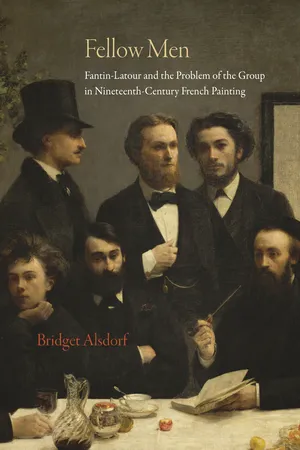
Focusing on the art of Henri Fantin-Latour (1836-1904) and his colleagues Gustave Courbet, Edgar Degas, Edouard Manet, Frédéric Bazille, and Pierre-Auguste Renoir, Fellow Men argues for the importance of the group as a defining subject of nineteenth-century French painting. Through close readings of some of the most ambitious paintings of the realist and impressionist generation, Bridget Alsdorf offers new insights into how French painters understood the shifting boundaries of their social world, and reveals the fragile masculine bonds that made up the avant-garde.
A dedicated realist who veered between extremes of sociability and hermetic isolation, Fantin-Latour painted group dynamics over the course of two decades, from 1864 to 1885. This was a period of dramatic change in French history and art--events like the Paris Commune and the rise and fall of impressionism raised serious doubts about the power of collectivism in art and life. Fantin-Latour's monumental group portraits, and related works by his friends and colleagues from the 1850s through the 1880s, represent varied visions of collective identity and test the limits of association as both a social and an artistic pursuit. By examining the bonds and frictions that animated their social circles, Fantin-Latour and his cohorts developed a new pictorial language for the modern group: one of fragmentation, exclusion, and willful withdrawal into interior space that nonetheless presented individuality as radically relational.
eBook - ePub
Fellow Men
Fantin-Latour and the Problem of the Group in Nineteenth-Century French Painting
- 352 pages
- English
- ePUB (mobile friendly)
- Available on iOS & Android
eBook - ePub
Fellow Men
Fantin-Latour and the Problem of the Group in Nineteenth-Century French Painting
About this book
Information
Topic
ArtSubtopic
Art Theory & CriticismTable of contents
- Cover Page
- Title Page
- Copyright Page
- Dedication
- Contents
- Acknowledgments
- Introduction
- Chapter 1: The Self in Group Portraiture
- Chapter 2: A Crisis of Pride
- Chapter 3: Studio of the Self
- Chapter 4: Deviance and Disappearance
- Chapter 5: The Irregularists
- Conclusion
- Notes
- Selected Bibliography
- Index
Trusted by 375,005 students
Access to over 1.5 million titles for a fair monthly price.
Study more efficiently using our study tools.
Frequently asked questions
Yes, you can cancel anytime from the Subscription tab in your account settings on the Perlego website. Your subscription will stay active until the end of your current billing period. Learn how to cancel your subscription
No, books cannot be downloaded as external files, such as PDFs, for use outside of Perlego. However, you can download books within the Perlego app for offline reading on mobile or tablet. Learn how to download books offline
Perlego offers two plans: Essential and Complete
- Essential is ideal for learners and professionals who enjoy exploring a wide range of subjects. Access the Essential Library with 800,000+ trusted titles and best-sellers across business, personal growth, and the humanities. Includes unlimited reading time and Standard Read Aloud voice.
- Complete: Perfect for advanced learners and researchers needing full, unrestricted access. Unlock 1.5M+ books across hundreds of subjects, including academic and specialized titles. The Complete Plan also includes advanced features like Premium Read Aloud and Research Assistant.
We are an online textbook subscription service, where you can get access to an entire online library for less than the price of a single book per month. With over 1.5 million books across 990+ topics, we’ve got you covered! Learn about our mission
Look out for the read-aloud symbol on your next book to see if you can listen to it. The read-aloud tool reads text aloud for you, highlighting the text as it is being read. You can pause it, speed it up and slow it down. Learn more about Read Aloud
Yes! You can use the Perlego app on both iOS and Android devices to read anytime, anywhere — even offline. Perfect for commutes or when you’re on the go.
Please note we cannot support devices running on iOS 13 and Android 7 or earlier. Learn more about using the app
Please note we cannot support devices running on iOS 13 and Android 7 or earlier. Learn more about using the app
Yes, you can access Fellow Men by Bridget Alsdorf in PDF and/or ePUB format, as well as other popular books in Art & Art Theory & Criticism. We have over 1.5 million books available in our catalogue for you to explore.