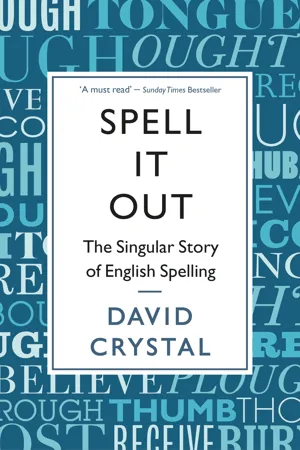
Why is there an 'h' in ghost? William Caxton, inventor of the printing press and his Flemish employees are to blame: without a dictionary or style guide to hand in fifteenth century Bruges, the typesetters simply spelled it the way it sounded to their foreign ears, and it stuck. Seventy-five per cent of English spelling is regular but twenty-five per cent is complicated, and in Spell It Out our foremost linguistics expert David Crystal extends a helping hand to the confused and curious alike.
He unearths the stories behind the rogue words that confound us, and explains why these peculiarities entered the mainstream, in an epic journey taking in sixth century monks, French and Latin upstarts, the Industrial Revolution and the internet. By learning the history and the principles, Crystal shows how the spellings that break all the rules become easier to get right.
- 254 pages
- English
- ePUB (mobile friendly)
- Available on iOS & Android
eBook - ePub
About this book
Information
Topic
Personal DevelopmentSubtopic
Writing & Presentation SkillsTable of contents
- Cover Page
- Title Page
- Copyright Page
- Contents
- Introduction
- Chapter 1: The nature of the problem
- Chapter 2: The beginning
- Chapter 3: The size of the problem
- Chapter 4: Building the alphabet
- Chapter 5: The basic weaknesses
- Chapter 6: Keeping things long
- Chapter 7: Keeping things short
- Chapter 8: The first exceptions
- Chapter 9: Seeing the link
- Chapter 10: Know your Latin and French
- Chapter 11: New letters for old
- Chapter 12: Old letters in new words
- Chapter 13: Old sounds in new positions
- Chapter 14: New sounds in old places
- Chapter 15: More exceptions
- Chapter 16: Showing the difference
- Chapter 17: Noting the similarity
- Chapter 18: New sounds in old letters
- Chapter 19: A printer’s practice
- Chapter 20: The urge to reform
- Chapter 21: Remembering Latin
- Chapter 22: More etymologies
- Chapter 23: Famous spellings
- Chapter 24: Spelling ‘rules’
- Chapter 25: The role of personalities
- Chapter 26: Another personality
- Chapter 27: Printers and publishers
- Chapter 28: Changing practices
- Chapter 29: The Internet
- Chapter 30: Showing identity
- Chapter 31: Unpredictability
- Chapter 32: Exotic vowels
- Chapter 33: Exotic consonants
- Chapter 34: Spelling noises
- Chapter 35: Abbreviating
- Chapter 36: Learning the system
- Chapter 37: The future of English spelling
- A teaching appendix
- Further reading
- Illustration credits
- Index of words
- General index
Trusted by 375,005 students
Access to over 1.5 million titles for a fair monthly price.
Study more efficiently using our study tools.
Frequently asked questions
Yes, you can cancel anytime from the Subscription tab in your account settings on the Perlego website. Your subscription will stay active until the end of your current billing period. Learn how to cancel your subscription
No, books cannot be downloaded as external files, such as PDFs, for use outside of Perlego. However, you can download books within the Perlego app for offline reading on mobile or tablet. Learn how to download books offline
We are an online textbook subscription service, where you can get access to an entire online library for less than the price of a single book per month. With over 1.5 million books across 990+ topics, we’ve got you covered! Learn about our mission
Look out for the read-aloud symbol on your next book to see if you can listen to it. The read-aloud tool reads text aloud for you, highlighting the text as it is being read. You can pause it, speed it up and slow it down. Learn more about Read Aloud
Yes! You can use the Perlego app on both iOS and Android devices to read anytime, anywhere — even offline. Perfect for commutes or when you’re on the go.
Please note we cannot support devices running on iOS 13 and Android 7 or earlier. Learn more about using the app
Please note we cannot support devices running on iOS 13 and Android 7 or earlier. Learn more about using the app
Yes, you can access Spell It Out by David Crystal in PDF and/or ePUB format, as well as other popular books in Personal Development & Writing & Presentation Skills. We have over 1.5 million books available in our catalogue for you to explore.