A revisionist reading of modern art that examines how artworks are captured as property to legitimize power
In this provocative new account, David Joselit shows how art from the nineteenth to the twenty-first centuries began to function as a commodity, while the qualities of the artist, nation, or period themselves became valuable properties. Joselit explores repatriation, explaining that this is not just a contemporary conflict between the Global South and Euro-American museums, noting that the Louvre, the first modern museum, was built on looted works and faced demands for restitution and repatriation early in its history. Joselit argues that the property values of white supremacy underlie the ideology of possessive individualism animating modern art, and he considers issues of identity and proprietary authorship.
Joselit redefines art’s politics, arguing that these pertain not to an artwork’s content or form but to the way it is “captured,” made to represent powerful interests—whether a nation, a government, or a celebrity artist collected by oligarchs. Artworks themselves are not political but occupy at once the here and now and an “elsewhere”—an alterity—that can’t ever be fully appropriated. The history of modern art, Joselit asserts, is the history of transforming this alterity into private property.
Narrating scenes from the emergence and capture of modern art—touching on a range of topics that include the Byzantine church, French copyright law, the 1900 Paris Exposition, W.E.B. Du Bois, the conceptual artist Adrian Piper, and the controversy over Dana Schutz’s painting Open Casket—Joselit argues that the meaning of art is its infinite capacity to generate experience over time.
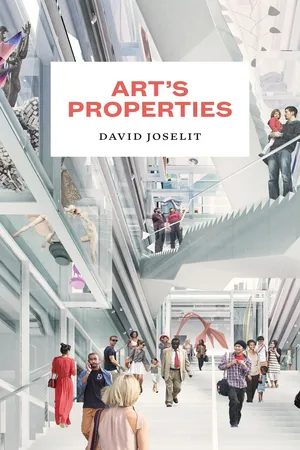
- 176 pages
- English
- ePUB (mobile friendly)
- Available on iOS & Android
eBook - ePub
Art’s Properties
About this book
Information
Publisher
Princeton University PressYear
2023Print ISBN
9780691237176
9780691236049
eBook ISBN
9780691236056
Topic
ArtSubtopic
Théorie et critique de l'artTable of contents
- Cover
- Title Page
- Copyright
- Dedication
- Contents
- Prologue
- Alienability and Alterity
- Constituent Moments: 1793–1815
- Modern Art Was Always Conceptual
- Color Plates
- The Burden of Representation
- Witness
- The Object as Witness
- Afterword
- Acknowledgments
- Notes
- Index
- Image Credits
Trusted by 375,005 students
Access to over 1.5 million titles for a fair monthly price.
Study more efficiently using our study tools.
Frequently asked questions
Yes, you can cancel anytime from the Subscription tab in your account settings on the Perlego website. Your subscription will stay active until the end of your current billing period. Learn how to cancel your subscription
No, books cannot be downloaded as external files, such as PDFs, for use outside of Perlego. However, you can download books within the Perlego app for offline reading on mobile or tablet. Learn how to download books offline
Perlego offers two plans: Essential and Complete
- Essential is ideal for learners and professionals who enjoy exploring a wide range of subjects. Access the Essential Library with 800,000+ trusted titles and best-sellers across business, personal growth, and the humanities. Includes unlimited reading time and Standard Read Aloud voice.
- Complete: Perfect for advanced learners and researchers needing full, unrestricted access. Unlock 1.5M+ books across hundreds of subjects, including academic and specialized titles. The Complete Plan also includes advanced features like Premium Read Aloud and Research Assistant.
We are an online textbook subscription service, where you can get access to an entire online library for less than the price of a single book per month. With over 1.5 million books across 990+ topics, we’ve got you covered! Learn about our mission
Look out for the read-aloud symbol on your next book to see if you can listen to it. The read-aloud tool reads text aloud for you, highlighting the text as it is being read. You can pause it, speed it up and slow it down. Learn more about Read Aloud
Yes! You can use the Perlego app on both iOS and Android devices to read anytime, anywhere — even offline. Perfect for commutes or when you’re on the go.
Please note we cannot support devices running on iOS 13 and Android 7 or earlier. Learn more about using the app
Please note we cannot support devices running on iOS 13 and Android 7 or earlier. Learn more about using the app
Yes, you can access Art’s Properties by David Joselit in PDF and/or ePUB format, as well as other popular books in Art & Théorie et critique de l'art. We have over 1.5 million books available in our catalogue for you to explore.