Shortlisted for the Nayef Al-Rodhan Book Prize.
A leading scholar explores what it means to dehumanize others—and how and why we do it.
"I wouldn't have accepted that they were human beings. You would see an infant who's just learning to smile, and it smiles at you, but you still kill it." So a Hutu man explained to an incredulous researcher, when asked to recall how he felt slaughtering Tutsis in Rwanda in 1994. Such statements are shocking, yet we recognize them; we hear their echoes in accounts of genocides, massacres, and pogroms throughout history. How do some people come to believe that their enemies are monsters, and therefore easy to kill?
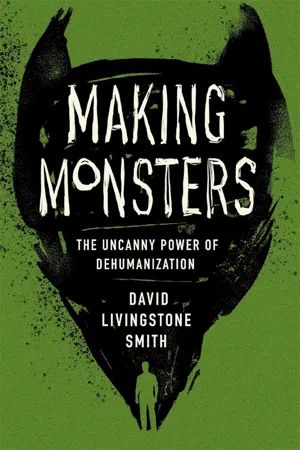
In Making Monsters David Livingstone Smith offers a poignant meditation on the philosophical and psychological roots of dehumanization. Drawing on harrowing accounts of lynchings, Smith establishes what dehumanization is and what it isn't. When we dehumanize our enemy, we hold two incongruous beliefs at the same time: we believe our enemy is at once subhuman and fully human. To call someone a monster, then, is not merely a resort to metaphor—dehumanization really does happen in our minds. Turning to an abundance of historical examples, Smith explores the relationship between dehumanization and racism, the psychology of hierarchy, what it means to regard others as human beings, and why dehumanizing others transforms them into something so terrifying that they must be destroyed.
Meticulous but highly readable, Making Monsters suggests that the process of dehumanization is deeply seated in our psychology. It is precisely because we are all human that we are vulnerable to the manipulations of those trading in the politics of demonization and violence.
- 353 pages
- English
- PDF
- Available on iOS & Android
eBook - PDF
About this book
Information
Topic
PhilosophySubtopic
Ethics & Moral PhilosophyTable of contents
- Cover
- Title Page
- Copyright
- Dedication
- Epigraph
- Contents
- Preface: Something Like a Darkness
- 1. What Is Dehumanization?
- 2. Dehumanization Is Real
- 3. In the Blood
- 4. Essential Differences
- 5. The Logic of Race
- 6. Hierarchy
- 7. The Order of Things
- 8. Being Human
- 9. Ideology
- 10. Dehumanization as Ideology
- 11. Ambivalence
- 12. Making Monsters
- 13. Last Words and Loose Ends
- Notes
- Index
Trusted by 375,005 students
Access to over 1.5 million titles for a fair monthly price.
Study more efficiently using our study tools.
Frequently asked questions
Yes, you can cancel anytime from the Subscription tab in your account settings on the Perlego website. Your subscription will stay active until the end of your current billing period. Learn how to cancel your subscription
No, books cannot be downloaded as external files, such as PDFs, for use outside of Perlego. However, you can download books within the Perlego app for offline reading on mobile or tablet. Learn how to download books offline
Perlego offers two plans: Essential and Complete
- Essential is ideal for learners and professionals who enjoy exploring a wide range of subjects. Access the Essential Library with 800,000+ trusted titles and best-sellers across business, personal growth, and the humanities. Includes unlimited reading time and Standard Read Aloud voice.
- Complete: Perfect for advanced learners and researchers needing full, unrestricted access. Unlock 1.5M+ books across hundreds of subjects, including academic and specialized titles. The Complete Plan also includes advanced features like Premium Read Aloud and Research Assistant.
We are an online textbook subscription service, where you can get access to an entire online library for less than the price of a single book per month. With over 1.5 million books across 990+ topics, we’ve got you covered! Learn about our mission
Look out for the read-aloud symbol on your next book to see if you can listen to it. The read-aloud tool reads text aloud for you, highlighting the text as it is being read. You can pause it, speed it up and slow it down. Learn more about Read Aloud
Yes! You can use the Perlego app on both iOS and Android devices to read anytime, anywhere — even offline. Perfect for commutes or when you’re on the go.
Please note we cannot support devices running on iOS 13 and Android 7 or earlier. Learn more about using the app
Please note we cannot support devices running on iOS 13 and Android 7 or earlier. Learn more about using the app
Yes, you can access Making Monsters by David Livingstone Smith in PDF and/or ePUB format, as well as other popular books in Philosophy & Ethics & Moral Philosophy. We have over 1.5 million books available in our catalogue for you to explore.