Prospect Top 50 Thinker of 2021
British Academy Book Prize Finalist
PROSE Award Finalist
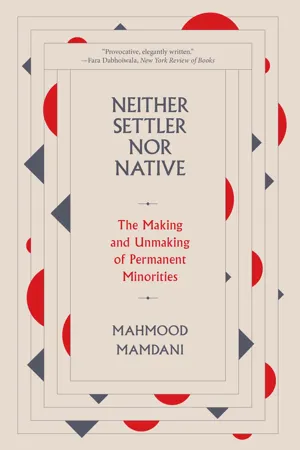
"Provocative, elegantly written."
—Fara Dabhoiwala, New York Review of Books
"Demonstrates how a broad rethinking of political issues becomes possible when Western ideals and practices are examined from the vantage point of Asia and Africa."
—Pankaj Mishra, New York Review of Books
In case after case around the globe—from Israel to Sudan—the colonial state and the nation-state have been constructed through the politicization of a religious or ethnic majority at the expense of an equally manufactured minority. The model emerged in America, where genocide and internment on reservations created a permanent native minority. In Europe, this template would be used both by the Nazis and the Allies.
Neither Settler nor Native offers a vision for arresting this process. Mahmood Mamdani points to inherent limitations in the legal solution attempted at Nuremberg. Political violence demands political solutions: not criminal justice but a rethinking of the political community to include victims and perpetrators, bystanders and beneficiaries. Making the radical argument that the nation-state was born of colonialism, he calls on us to delink the nation from the state so as to ensure equal political rights for all who live within its boundaries.
"A deeply learned account of the origins of our modern world…Mamdani rejects the current focus on human rights as the means to bring justice to the victims of this colonial and postcolonial bloodshed. Instead, he calls for a new kind of political imagination…Joining the ranks of Hannah Arendt's Imperialism, Frantz Fanon's The Wretched of the Earth, and Edward Said's Orientalism, this book is destined to become a classic text of postcolonial studies and political theory."
—Moustafa Bayoumi, author of How Does It Feel to Be a Problem?
"A masterwork of historical comparison and razor-sharp political analysis, with grave lessons about the pitfalls of forgetting, moralizing, or criminalizing this violence. Mamdani also offers a hopeful rejoinder in a revived politics of decolonization."
—Karuna Mantena, Columbia University
"A powerfully original argument, one that supplements political analysis with a map for our political future."
—Faisal Devji, University of Oxford
eBook - ePub
Neither Settler nor Native
The Making and Unmaking of Permanent Minorities
- 401 pages
- English
- ePUB (mobile friendly)
- Available on iOS & Android
eBook - ePub
About this book
Information
Table of contents
- Cover
- Title Page
- Copyright
- Dedication
- Contents
- Introduction
- 1. The Indian Question in the United States
- 2. Nuremberg: The Failure of Denazification
- 3. Settlers and Natives in Apartheid South Africa
- 4. Sudan: Colonialism, Independence, and Secession
- 5. The Israel / Palestine Question
- 6. Decolonizing the Political Community
- Notes
- Acknowledgements
- Index
Trusted by 375,005 students
Access to over 1.5 million titles for a fair monthly price.
Study more efficiently using our study tools.
Frequently asked questions
Yes, you can cancel anytime from the Subscription tab in your account settings on the Perlego website. Your subscription will stay active until the end of your current billing period. Learn how to cancel your subscription
No, books cannot be downloaded as external files, such as PDFs, for use outside of Perlego. However, you can download books within the Perlego app for offline reading on mobile or tablet. Learn how to download books offline
We are an online textbook subscription service, where you can get access to an entire online library for less than the price of a single book per month. With over 1.5 million books across 990+ topics, we’ve got you covered! Learn about our mission
Look out for the read-aloud symbol on your next book to see if you can listen to it. The read-aloud tool reads text aloud for you, highlighting the text as it is being read. You can pause it, speed it up and slow it down. Learn more about Read Aloud
Yes! You can use the Perlego app on both iOS and Android devices to read anytime, anywhere — even offline. Perfect for commutes or when you’re on the go.
Please note we cannot support devices running on iOS 13 and Android 7 or earlier. Learn more about using the app
Please note we cannot support devices running on iOS 13 and Android 7 or earlier. Learn more about using the app
Yes, you can access Neither Settler nor Native by Mahmood Mamdani in PDF and/or ePUB format, as well as other popular books in Politics & International Relations & Modern History. We have over 1.5 million books available in our catalogue for you to explore.