"In most accounts of the tumultuous 1960s, Robert Kennedy plays a supporting role…Sullivan corrects this and puts RFK near the center of the nation's struggle for racial justice."
—Richard Thompson Ford, Washington Post
"A profound and uplifting account of Robert F. Kennedy's brave crusade for racial equality. This is narrative history at its absolute finest."
—Douglas Brinkley, author of Rosa Parks
"A sobering analysis of the forces arrayed against advocates of racial justice. Desegregation suits took years to move through the courts. Ballot access was controlled by local officials…Justice Rising reminds us that although he was assassinated over 50 years ago, Kennedy remains relevant."
—Glenn C. Altschuler, Florida Courier
"A groundbreaking book that reorients our understanding of a surprisingly underexplored aspect of Robert Kennedy's life and career—race and civil rights—and sheds new light on race relations during a pivotal era of American history."
—Kenneth Mack, author of Representing the Race
"Brilliant and beautifully written…could hardly be more timely."
—Daniel Geary, Irish Times
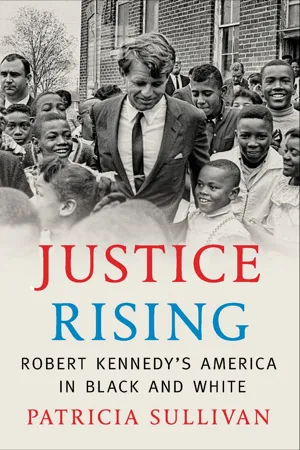
Race and politics converged in the 1960s in ways that indelibly changed America. This landmark reconsideration of Robert Kennedy's life and legacy reveals how, as the nation confronted escalating demands for racial justice, RFK grasped the moment to emerge as a transformational leader.
Intertwining Kennedy's story with the Black freedom struggles of the 1960s, Justice Rising provides a fresh account of the changing political alignments that marked the decade. As Attorney General, Kennedy personally interceded to enforce desegregation rulings and challenge voter restrictions in the South. Morally committed to change, he was instrumental in creating the bipartisan coalition essential to passing the 1964 Civil Rights Act. After his brother's assassination, his commitment took on a new urgency when cities emerged as the major front in the long fight for racial justice. On the night of Martin Luther King's assassination, two months before he would himself be killed, his anguished appeal captured the hopes of a turbulent decade: "In this difficult time for the United States, it is perhaps well to ask what kind of nation we are and what direction we want to move in." It is a question that remains urgent and unanswered.
- 561 pages
- English
- PDF
- Available on iOS & Android
eBook - PDF
About this book
Information
Table of contents
- Cover
- Title Page
- Copyright
- Dedication
- Contents
- Preface: “The Best a White America Has to Offer”
- 1 · Misfit
- 2 · Along the Color Line: The 1950s
- 3 · Faith, Hope, and Politics
- 4 · Black Votes
- 5 · Simple Justice
- 6 · The Challenge of a Decade
- 7 · Freedom Now
- 8 · “A Great Change Is at Hand”
- 9 · On His Own
- 10 · Transitions
- 11 · Beyond Civil Rights
- 12 · Suppose God Is Black
- 13 · Reckoning
- 14 · The Gravest Crisis since the Civil War
- 15 · Our Country’s Future
- 16 · A Time of Danger and Questioning
- 17 · The Last of the Great Believables
- Epilogue
- Notes
- Acknowledgments
- Index
- Photographs 1
- Photographs 2
Trusted by 375,005 students
Access to over 1.5 million titles for a fair monthly price.
Study more efficiently using our study tools.
Frequently asked questions
Yes, you can cancel anytime from the Subscription tab in your account settings on the Perlego website. Your subscription will stay active until the end of your current billing period. Learn how to cancel your subscription
No, books cannot be downloaded as external files, such as PDFs, for use outside of Perlego. However, you can download books within the Perlego app for offline reading on mobile or tablet. Learn how to download books offline
We are an online textbook subscription service, where you can get access to an entire online library for less than the price of a single book per month. With over 1.5 million books across 990+ topics, we’ve got you covered! Learn about our mission
Look out for the read-aloud symbol on your next book to see if you can listen to it. The read-aloud tool reads text aloud for you, highlighting the text as it is being read. You can pause it, speed it up and slow it down. Learn more about Read Aloud
Yes! You can use the Perlego app on both iOS and Android devices to read anytime, anywhere — even offline. Perfect for commutes or when you’re on the go.
Please note we cannot support devices running on iOS 13 and Android 7 or earlier. Learn more about using the app
Please note we cannot support devices running on iOS 13 and Android 7 or earlier. Learn more about using the app
Yes, you can access Justice Rising by Patricia Sullivan in PDF and/or ePUB format, as well as other popular books in Politics & International Relations & Political Biographies. We have over 1.5 million books available in our catalogue for you to explore.