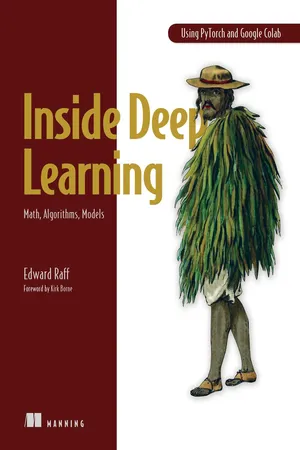
Journey through the theory and practice of modern deep learning, and apply innovative techniques to solve everyday data problems.
In Inside Deep Learning, you will learn how to:
Implement deep learning with PyTorch
Select the right deep learning components
Train and evaluate a deep learning model
Fine tune deep learning models to maximize performance
Understand deep learning terminology
Adapt existing PyTorch code to solve new problems
Inside Deep Learning is an accessible guide to implementing deep learning with the PyTorch framework. It demystifies complex deep learning concepts and teaches you to understand the vocabulary of deep learning so you can keep pace in a rapidly evolving field. No detail is skipped—you’ll dive into math, theory, and practical applications. Everything is clearly explained in plain English.
About the technology
Deep learning doesn’t have to be a black box! Knowing how your models and algorithms actually work gives you greater control over your results. And you don’t have to be a mathematics expert or a senior data scientist to grasp what’s going on inside a deep learning system. This book gives you the practical insight you need to understand and explain your work with confidence.
About the book
Inside Deep Learning illuminates the inner workings of deep learning algorithms in a way that even machine learning novices can understand. You’ll explore deep learning concepts and tools through plain language explanations, annotated code, and dozens of instantly useful PyTorch examples. Each type of neural network is clearly presented without complex math, and every solution in this book can run using readily available GPU hardware!
What's inside
Select the right deep learning components
Train and evaluate a deep learning model
Fine tune deep learning models to maximize performance
Understand deep learning terminology
About the reader
For Python programmers with basic machine learning skills.
About the author
Edward Raff is a Chief Scientist at Booz Allen Hamilton, and the author of the JSAT machine learning library.
Table of Contents
PART 1 FOUNDATIONAL METHODS
1 The mechanics of learning
2 Fully connected networks
3 Convolutional neural networks
4 Recurrent neural networks
5 Modern training techniques
6 Common design building blocks
PART 2 BUILDING ADVANCED NETWORKS
7 Autoencoding and self-supervision
8 Object detection
9 Generative adversarial networks
10 Attention mechanisms
11 Sequence-to-sequence
12 Network design alternatives to RNNs
13 Transfer learning
14 Advanced building blocks
- 600 pages
- English
- ePUB (mobile friendly)
- Available on iOS & Android
eBook - ePub
About this book
Information
Table of contents
- inside front cover
- Inside Deep Learning
- Copyright
- dedication
- contents
- front matter
- Part 1. Foundational methods
- 1 The mechanics of learning
- 2 Fully connected networks
- 3 Convolutional neural networks
- 4 Recurrent neural networks
- 5 Modern training techniques
- 6 Common design building blocks
- Part 2. Building advanced networks
- 7 Autoencoding and self-supervision
- 8 Object detection
- 9 Generative adversarial networks
- 10 Attention mechanisms
- 11 Sequence-to-sequence
- 12 Network design alternatives to RNNs
- 13 Transfer learning
- 14 Advanced building blocks
- Appendix. Setting up Colab
- Index
- inside back cover
Trusted by 375,005 students
Access to over 1.5 million titles for a fair monthly price.
Study more efficiently using our study tools.
Frequently asked questions
Yes, you can cancel anytime from the Subscription tab in your account settings on the Perlego website. Your subscription will stay active until the end of your current billing period. Learn how to cancel your subscription
No, books cannot be downloaded as external files, such as PDFs, for use outside of Perlego. However, you can download books within the Perlego app for offline reading on mobile or tablet. Learn how to download books offline
Perlego offers two plans: Essential and Complete
- Essential is ideal for learners and professionals who enjoy exploring a wide range of subjects. Access the Essential Library with 800,000+ trusted titles and best-sellers across business, personal growth, and the humanities. Includes unlimited reading time and Standard Read Aloud voice.
- Complete: Perfect for advanced learners and researchers needing full, unrestricted access. Unlock 1.5M+ books across hundreds of subjects, including academic and specialized titles. The Complete Plan also includes advanced features like Premium Read Aloud and Research Assistant.
We are an online textbook subscription service, where you can get access to an entire online library for less than the price of a single book per month. With over 1.5 million books across 990+ topics, we’ve got you covered! Learn about our mission
Look out for the read-aloud symbol on your next book to see if you can listen to it. The read-aloud tool reads text aloud for you, highlighting the text as it is being read. You can pause it, speed it up and slow it down. Learn more about Read Aloud
Yes! You can use the Perlego app on both iOS and Android devices to read anytime, anywhere — even offline. Perfect for commutes or when you’re on the go.
Please note we cannot support devices running on iOS 13 and Android 7 or earlier. Learn more about using the app
Please note we cannot support devices running on iOS 13 and Android 7 or earlier. Learn more about using the app
Yes, you can access Inside Deep Learning by Edward Raff in PDF and/or ePUB format, as well as other popular books in Computer Science & Neural Networks. We have over 1.5 million books available in our catalogue for you to explore.