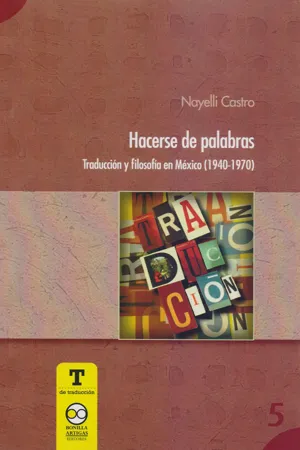
Entre la traducción y la filosofía prevalece una larga y difícil relación. Por un lado, la traducción de filosofía, entendida como su multiplicación ad infinitum en diferentes lenguas, se opone a un corpus filosófico ideal, en el cual de Platón a Derrida, la tarea de escribir y pensar sería independiente de la materialidad lingüística. Por el otro, un corpus filosófico real, esto es, desperdigado en múltiples traducciones siempre parciales y provisionales, más que proyectar un corpus unificado, refracta la actividad intelectual de las comunidades en que se inscribe. Este libro busca arrojar luz sobre una región de ese corpus filosófico real, esto es, aquella que contribuyó a la construcción de un discurso filosófico en español, desde México en las tres décadas comprendidas entre 1940 y 1970. En ese contexto, traducir filosofía fue también involucrarse en la producción de formas de ser, decir y hacer. La traducción sirvió de objeto de polémica, punto de partida, de encuentro y de llegada a múltiples trayectorias intelectuales. Su papel en la importación y recepción de corrientes filosóficas estuvo inevitablemente ligado a la influencia de sus artífices, los traductores, quienes, a su vez, aprovecharon la palestra para expresar distintas concepciones del quehacer filosófico. En suma, entre un hacerse con las palabras de otros, apropiándoselas, y un hacerse de palabras con otros, en abierta disputa, en México, la vocación del filósofo echó mano y se definió en ese punto ciego de la escritura que es la traducción
- 254 pages
- English
- ePUB (mobile friendly)
- Available on iOS & Android
eBook - ePub
Hacerse de Palabra: Traducción y Filosofía en México (1940-1970)
About this book
Information
Subtopic
Translating & InterpretingTable of contents
- 1ª de forros
- Portadilla y página legal
- Contenido
- Agradecimientos
- Bibliografía
- Sobre la autora
Trusted by 375,005 students
Access to over 1.5 million titles for a fair monthly price.
Study more efficiently using our study tools.
Frequently asked questions
Yes, you can cancel anytime from the Subscription tab in your account settings on the Perlego website. Your subscription will stay active until the end of your current billing period. Learn how to cancel your subscription
No, books cannot be downloaded as external files, such as PDFs, for use outside of Perlego. However, you can download books within the Perlego app for offline reading on mobile or tablet. Learn how to download books offline
Perlego offers two plans: Essential and Complete
- Essential is ideal for learners and professionals who enjoy exploring a wide range of subjects. Access the Essential Library with 800,000+ trusted titles and best-sellers across business, personal growth, and the humanities. Includes unlimited reading time and Standard Read Aloud voice.
- Complete: Perfect for advanced learners and researchers needing full, unrestricted access. Unlock 1.5M+ books across hundreds of subjects, including academic and specialized titles. The Complete Plan also includes advanced features like Premium Read Aloud and Research Assistant.
We are an online textbook subscription service, where you can get access to an entire online library for less than the price of a single book per month. With over 1.5 million books across 990+ topics, we’ve got you covered! Learn about our mission
Look out for the read-aloud symbol on your next book to see if you can listen to it. The read-aloud tool reads text aloud for you, highlighting the text as it is being read. You can pause it, speed it up and slow it down. Learn more about Read Aloud
Yes! You can use the Perlego app on both iOS and Android devices to read anytime, anywhere — even offline. Perfect for commutes or when you’re on the go.
Please note we cannot support devices running on iOS 13 and Android 7 or earlier. Learn more about using the app
Please note we cannot support devices running on iOS 13 and Android 7 or earlier. Learn more about using the app
Yes, you can access Hacerse de Palabra: Traducción y Filosofía en México (1940-1970) by Nayelli Castro in PDF and/or ePUB format, as well as other popular books in Languages & Linguistics & Translating & Interpreting. We have over 1.5 million books available in our catalogue for you to explore.