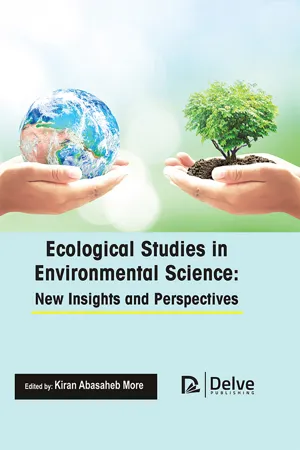
Ecology is a well-established biocentric interdisciplinary field that investigates the complex connections between all different kinds of organisms, ranging from bacteria to humans, as well as how these relationships evolve over time and in a variety of spatial and temporal dimensions. This field focuses on the study of ecology, evolution, and biodiversity. The majority of theresearch on ecology focuses on the intricate interactions that occur between different species, as well as how these relationships evolve over the course of time. It is only in recent times that ecology has been considered to comprise the "heart and spine" of environmental research. This viewpoint is entirely anthropocentric. The expansion of human populations has a deleterious effect on the natural environment, which has led to the deterioration of the biological and physical components of ecosystems. This is a problem that will only become worse as human populations continue to expand. Environmental management is required because natural resources are being depleted, biodiversity is being lost, and the environment (land, air, and water) are being polluted. It is essential to take corrective action in order to repair or rehabilitate the natural environment in the future. This should be seen as a preventative strategy. Regardless of the amount of work that has been put into maintaining the ecosystem's current state, the destruction of the environment continues unabated. This book provides a comprehensive look at a number of the most significant issues affecting the environment, as well as an investigation of the reasons why ecology has been unable to address these issues. In the conclusion of the book, it is underlined how important it is for human goals to be accomplished in a manner that is both sustainable and takes into account the social, economic, and political aspects of environmental concerns. This is very necessary for us to do in order to accomplish our goals as a species in a manner that is sustainable.
eBook - PDF
Ecological studies in environmental science: New insights and perspectives
- 274 pages
- English
- PDF
- Available on iOS & Android
eBook - PDF
Ecological studies in environmental science: New insights and perspectives
About this book
Information
Subtopic
EcologyIndex
Biological SciencesTable of contents
- Cover
- Title Page
- Copyright
- ABOUT THE EDITOR
- TABLE OF CONTENTS
- List of Figures
- Preface
- Chapter 1 Ecology
- Chapter 2 What is the Meaning of Environmental Science?
- Chapter 3 Types of Ecologic Study Designs
- Chapter 4 Ecological Survey
- Chapter 5 Important Concept of Species
- Chapter 6 How Do Different Populations Interact In An Ecosystem
- Chapter 7 Case Studies: Conserving Ecological Corridors in Ecological Networks
- Chapter 8 Case Studies: Green Roof And Water Management to Increase City Resilience
- Chapter 9 Case Studies: Measuring and Improving Urban Tree Vitality
- Chapter 10 Limitations of Ecological Studies
- References
- Index
- Back Cover
Trusted by 375,005 students
Access to over 1.5 million titles for a fair monthly price.
Study more efficiently using our study tools.
Frequently asked questions
Yes, you can cancel anytime from the Subscription tab in your account settings on the Perlego website. Your subscription will stay active until the end of your current billing period. Learn how to cancel your subscription
No, books cannot be downloaded as external files, such as PDFs, for use outside of Perlego. However, you can download books within the Perlego app for offline reading on mobile or tablet. Learn how to download books offline
Perlego offers two plans: Essential and Complete
- Essential is ideal for learners and professionals who enjoy exploring a wide range of subjects. Access the Essential Library with 800,000+ trusted titles and best-sellers across business, personal growth, and the humanities. Includes unlimited reading time and Standard Read Aloud voice.
- Complete: Perfect for advanced learners and researchers needing full, unrestricted access. Unlock 1.5M+ books across hundreds of subjects, including academic and specialized titles. The Complete Plan also includes advanced features like Premium Read Aloud and Research Assistant.
We are an online textbook subscription service, where you can get access to an entire online library for less than the price of a single book per month. With over 1.5 million books across 990+ topics, we’ve got you covered! Learn about our mission
Look out for the read-aloud symbol on your next book to see if you can listen to it. The read-aloud tool reads text aloud for you, highlighting the text as it is being read. You can pause it, speed it up and slow it down. Learn more about Read Aloud
Yes! You can use the Perlego app on both iOS and Android devices to read anytime, anywhere — even offline. Perfect for commutes or when you’re on the go.
Please note we cannot support devices running on iOS 13 and Android 7 or earlier. Learn more about using the app
Please note we cannot support devices running on iOS 13 and Android 7 or earlier. Learn more about using the app
Yes, you can access Ecological studies in environmental science: New insights and perspectives by Kiran Abasaheb More in PDF and/or ePUB format, as well as other popular books in Biological Sciences & Ecology. We have over 1.5 million books available in our catalogue for you to explore.