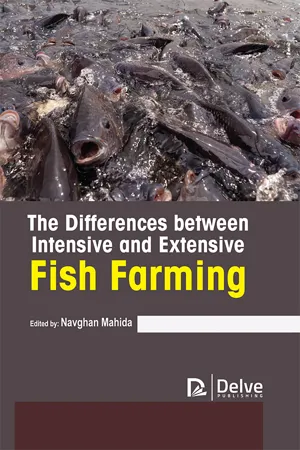
The book encompasses the extensive fish farming system which is the least managed form of fish farming, in which little care is taken. This system involves large ponds measuring 1 to 5 ha in area with stocking density limited to only less than 5000 fishes/ha. No supplemental feeding or fertilisation is provided. Fish depends only on natural foods. Yield is poor (500 to 2 ton/ha), and survival is low. The labour and investment costs are low, and this system results in minimum income. An intensive fish farming system is the well-managed form of fish farming, in which all attempts are made to achieve maximum production of fish from a minimum quantity of water. This system involves small ponds/tanks/raceways with very high stocking density (10-50 fish/m3 of water). Fish are fed wholly formulated feed. Proper management is undertaken to control water quality by use of aerators and nutrition by use of highly nutritious feed. The yield obtained ranges from 15 to 100 ton/ha or more. Although the cost of investment is high, the return from the yield of fish exceeds to ensure the profit. The financial management in the intensive and extensive fish farming must be monitored by the farmers to forecast the yields. This book provide an insight on mitigation measures to be planned in advanced to minimize the losses incurred due to uneven growth rates or natural calamities. This book provides an introduction to intensive and extensive fish farming and it can be used by the undergraduates, postgraduates and research students who wish to work in the fish farming sector.
- 240 pages
- English
- PDF
- Available on iOS & Android
eBook - PDF
The Differences between intensive and extensive fish farming
About this book
Information
Subtopic
Fisheries & AquacultureTable of contents
- Cover
- Title Page
- Copyright
- ABOUT THE EDITOR
- TABLE OF CONTENTS
- List of Figures
- List of Abbreviations
- Introduction
- Preface
- Chapter 1 Introduction to Intensive and Extensive Fish Farming
- Chapter 2 Intensive Fish Farming
- Chapter 3 Financial Management and Economics of Fish Farming
- Chapter 4 Extensive Fish Farming
- Chapter 5 Best Management Practices in Fish Farming
- Chapter 6 Sustainable Fish Farming
- Chapter 7 Impact of Climate Change on Fish Farming
- Chapter 8 Recirculating Fish Farming
- Chapter 9 Reproductive Aquaculture
- Index
- Back Cover
Trusted by 375,005 students
Access to over 1.5 million titles for a fair monthly price.
Study more efficiently using our study tools.
Frequently asked questions
Yes, you can cancel anytime from the Subscription tab in your account settings on the Perlego website. Your subscription will stay active until the end of your current billing period. Learn how to cancel your subscription
No, books cannot be downloaded as external files, such as PDFs, for use outside of Perlego. However, you can download books within the Perlego app for offline reading on mobile or tablet. Learn how to download books offline
Perlego offers two plans: Essential and Complete
- Essential is ideal for learners and professionals who enjoy exploring a wide range of subjects. Access the Essential Library with 800,000+ trusted titles and best-sellers across business, personal growth, and the humanities. Includes unlimited reading time and Standard Read Aloud voice.
- Complete: Perfect for advanced learners and researchers needing full, unrestricted access. Unlock 1.5M+ books across hundreds of subjects, including academic and specialized titles. The Complete Plan also includes advanced features like Premium Read Aloud and Research Assistant.
We are an online textbook subscription service, where you can get access to an entire online library for less than the price of a single book per month. With over 1.5 million books across 990+ topics, we’ve got you covered! Learn about our mission
Look out for the read-aloud symbol on your next book to see if you can listen to it. The read-aloud tool reads text aloud for you, highlighting the text as it is being read. You can pause it, speed it up and slow it down. Learn more about Read Aloud
Yes! You can use the Perlego app on both iOS and Android devices to read anytime, anywhere — even offline. Perfect for commutes or when you’re on the go.
Please note we cannot support devices running on iOS 13 and Android 7 or earlier. Learn more about using the app
Please note we cannot support devices running on iOS 13 and Android 7 or earlier. Learn more about using the app
Yes, you can access The Differences between intensive and extensive fish farming by Navghan Mahida in PDF and/or ePUB format, as well as other popular books in Technology & Engineering & Fisheries & Aquaculture. We have over 1.5 million books available in our catalogue for you to explore.