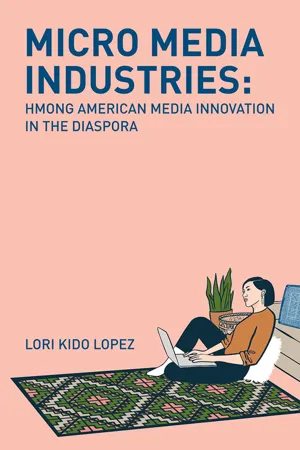
With the rise of digital tools used for media entrepreneurship, media outlets staffed by only one or two individuals and targeted to niche and super-niche audiences are developing across a wide range of platforms. Minority communities such as immigrants and refugees have long been pioneers in this space, operating ethnic media outlets with limited staff and funding to produce content that is relevant and accessible to their specific community. Micro Media Industries explores the specific case of Hmong American media, showing how an extremely small population can maintain a robust and thriving media ecology in spite of resource limitations and an inability to scale up. Based on six years of fieldwork in Hmong American communities in Wisconsin, Minnesota, and California, it analyzes the unique opportunities and challenges facing Hmong newspapers, radio, television, podcasts, YouTube, social media, and other emerging platforms. It argues that micro media industries, rather than being dismissed or trivialized, ought to be held up as models of media innovation that can counter the increasing power of mainstream media.
- 194 pages
- English
- ePUB (mobile friendly)
- Available on iOS & Android
eBook - ePub
About this book
Information
Publisher
Rutgers University PressYear
2021Print ISBN
9781978823341
9781978823358
eBook ISBN
9781978823365
Table of contents
- Cover
- Title Page
- Copyright
- Dedication
- Contents
- 1. Introduction: The Significance of Micro Media Industries
- 2. Without a Newsroom: Journalism and the Micro Media Empire
- 3. TV without Television: YouTube and Digital Video
- 4. Global Participatory Networks: Teleconference Radio Programs
- 5. Queer Sounds: Podcasting and Audio Archives
- 6. Alternative Aspirational Labor: Influencers and Social Media Producers
- 7. Conclusion: Beyond Hmong American Media
- Acknowledgments
- Notes
- References
- Index
- About the Author
Trusted by 375,005 students
Access to over 1.5 million titles for a fair monthly price.
Study more efficiently using our study tools.
Frequently asked questions
Yes, you can cancel anytime from the Subscription tab in your account settings on the Perlego website. Your subscription will stay active until the end of your current billing period. Learn how to cancel your subscription
No, books cannot be downloaded as external files, such as PDFs, for use outside of Perlego. However, you can download books within the Perlego app for offline reading on mobile or tablet. Learn how to download books offline
Perlego offers two plans: Essential and Complete
- Essential is ideal for learners and professionals who enjoy exploring a wide range of subjects. Access the Essential Library with 800,000+ trusted titles and best-sellers across business, personal growth, and the humanities. Includes unlimited reading time and Standard Read Aloud voice.
- Complete: Perfect for advanced learners and researchers needing full, unrestricted access. Unlock 1.5M+ books across hundreds of subjects, including academic and specialized titles. The Complete Plan also includes advanced features like Premium Read Aloud and Research Assistant.
We are an online textbook subscription service, where you can get access to an entire online library for less than the price of a single book per month. With over 1.5 million books across 990+ topics, we’ve got you covered! Learn about our mission
Look out for the read-aloud symbol on your next book to see if you can listen to it. The read-aloud tool reads text aloud for you, highlighting the text as it is being read. You can pause it, speed it up and slow it down. Learn more about Read Aloud
Yes! You can use the Perlego app on both iOS and Android devices to read anytime, anywhere — even offline. Perfect for commutes or when you’re on the go.
Please note we cannot support devices running on iOS 13 and Android 7 or earlier. Learn more about using the app
Please note we cannot support devices running on iOS 13 and Android 7 or earlier. Learn more about using the app
Yes, you can access Micro Media Industries by Lori Kido Lopez in PDF and/or ePUB format, as well as other popular books in Social Sciences & Asian American Studies. We have over 1.5 million books available in our catalogue for you to explore.