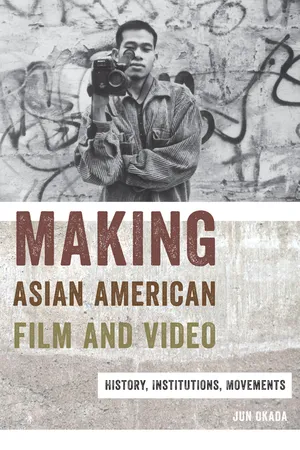
The words “Asian American film” might evoke a painfully earnest, low-budget documentary or family drama, destined to be seen only in small film festivals or on PBS (Public Broadcasting Service). In her groundbreaking study of the past fifty years of Asian American film and video, Jun Okada demonstrates that although this stereotype is not entirely unfounded, a remarkably diverse range of Asian American filmmaking has emerged. Yet Okada also reveals how the legacy of institutional funding and the “PBS style” unites these filmmakers, whether they are working within that system or setting themselves in opposition to its conventions.
Making Asian American Film and Video explores how the genre has served as a flashpoint for debates about what constitutes Asian American identity. Tracing a history of how Asian American film was initially conceived as a form of public-interest media, part of a broader effort to give voice to underrepresented American minorities, Okada shows why this seemingly well-intentioned project inspired deeply ambivalent responses. In addition, she considers a number of Asian American filmmakers who have opted out of producing state-funded films, from Wayne Wang to Gregg Araki to Justin Lin.
Okada gives us a unique behind-the-scenes look at the various institutions that have bankrolled and distributed Asian American films, revealing the dynamic interplay between commercial and state-run media. More than just a history of Asian Americans in film, Making Asian American Film and Video is an insightful meditation on both the achievements and the limitations of institutionalized multiculturalism.
- 180 pages
- English
- ePUB (mobile friendly)
- Available on iOS & Android
eBook - ePub
Making Asian American Film and Video
About this book
Information
1
“Noble and Uplifting and Boring as Hell”
Asian American Film and Video, 1971–1982
In his book Identities in Motion, the film scholar Peter X Feng marks the unexpected box office popularity of Chan Is Missing (Wayne Wang, 1982) as the beginning of a recognizable genre: Asian American film and video. The film “announced that Asian Americans could be artists, could be commercial filmmakers, and could support Asian American filmmaking, as well as successfully market Asian American films to wider audiences.”1 What this particular origin point elides is the fact that Chan Is Missing, a neo-noir film nominally about a search for a missing Chinese immigrant and more symbolically about Chinese American identity, began in the world of independent Asian American film as an avant-garde, “dialectical” work, originally called Fire Over Water. Wang reedited that version, which bewildered audiences at small Asian American film festivals, into the realist, narrative fiction feature that heralded the birth of a genre.
Yet another moment poses as an origin point of Asian American film and video: its sponsorship by public television. At around the same time in the early 1980s, filmmakers and activists formed the National Asian American Telecommunications Association (NAATA), which, with major funding from the Corporation for Public Broadcasting, supported filmmakers, set up an educational distribution catalog, and most importantly, programmed documentaries to air on national public television.2 Both Chan Is Missing and NAATA gave greater mainstream visibility to Asian American film and video and exposed the subsequent need to conform the creative, filmmaking enterprise to the function of narrating the politics of Asian American identity. Yet, prior to institutionalization by the CPB and the growing indie film movement, Asian American film and video was imbued with much greater formal diversity, especially in experimental works. This chapter analyzes the complex history that led up to these apocryphal origin points of the genre. In comparing the diverse films and discourse produced by the original Asian American film collectives, Visual Communications and Asian CineVision, it demonstrates that the fundamental debate of Asian American film and video was over its function as a primarily ideological cinema. Contrary to the received notion that its function has always been to narrate a politics of identity, discursive analysis of Asian American film and video in its formative years reveals that it was also strongly shaped by questions of form and aesthetics.
Asian American Film and Video in Context
This chapter extrapolates from extant scholarship on Asian American film and video, which has focused on either the textual strategies or the production histories of the genre.3 Whereas Feng theorizes Asian American film narratives by looking at how “Asian American makers construct Asian American cinematic identity by locating their subjectivities in relation to dominant cinematic discourses,” David E. James understands the first Asian American film collective, Visual Communications, in the larger history of underground, “popular” cinemas, in which Asian Americans created “narratives of their own history, and participate[d] in the production of their own self-consciousness and public identity.”4 By contrast, this chapter examines Asian American cinematic self-representation and its cursory history through discursive context, specifically, how Asian American filmmakers and critics perceived its direction and the shaping of its underlying purpose. In particular, it attempts to reveal the important yet forgotten historical debate over the place of abstraction, experimentation, and the aesthetic in a putatively “political” minority moving image culture.
Crucial to this discursive debate is the role that material factors have played in determining the predominance of the “positive image” in Asian American film and video. In other words, before “Asian Americans could be artists,” they had to exist as subjects. In 1978, through pressure from independent producers regarding the lack of representation, both by and about minorities in public television, as well as within the management ranks of public broadcasting stations across the country, the Corporation for Public Broadcasting commissioned a Task Force on Minorities in Public Broadcasting. Its report, A Formula for Change, predictably found a systematic lack of representation both in minority content and in personnel in the PBS world and made recommendations, the most important being the creation and funding of the Minority Consortia—strategic, ethnicity-specific groups of producers and media activists advocating for Asian American, Native American, Chicano, and African American interests. Today, each of the members of the consortia exists to support minority interests in public broadcasting. Since 1980, NAATA, the Asian American consortium, has continued to serve the interests of CPB’s minority task force report, particularly in its educational distribution and public broadcasting divisions, that is, primarily to increase the representation of Asian Americans in public broadcasting.
By funding the production of independent films through a competitive grant called the Media Fund, NAATA was instrumental in the encouragement and growth of Asian American films that follow the ideological social change mission that can be traced back to the first films made by Visual Communications in the early seventies. Although NAATA and PBS have provided crucial support for Asian American film and video, they also brought about one of its underlying problems. Because of the PBS-NAATA mandate that Asian American film and video be explicitly “Asian American”—that is, narrative fiction and nonfiction films about Asian American history, culture, and politics—they have imposed on it what Wendy Brown has termed a “politics of injury” that has become the hallmark of its output.5 Therefore, the material history of a necessarily political “cinema of ethnic identity” is the precondition of Asian American film and video.
Despite these preconditions, a debate still ensued about the direction of Asian American film and video, especially regarding the importance of aesthetics. Specifically this disagreement was between the emphasis on ideological filmmaking and one that embraced overt formal experimentation. On the one hand, the Los Angeles collective Visual Communications pursued a greater social change orientation in filmmaking, establishing the genre by making the first Asian American films, Manzanar and Wong Sinsaang, both ideologically charged documentaries about, respectively, the Japanese American internment and a Chinese American laundry worker, in 1971. Although these documentaries could in some ways be described as experimental, particularly in their creative juxtaposition of sound and image as an expression of the importance of uncovering a lost history and of critiquing historically embedded racist assumptions, they are resolutely ideological in their single-minded pursuit of the “positive image” for and of Asian Americans.
On the other end of the spectrum, people associated with the New York media organization Asian CineVision in the late 1970s and the 1980s, including the critic Daryl Chin, were adamant about the possibility of a more purely aesthetic inclination in Asian American film and video, particularly in its connection to American and international avant-garde cinema. Chin, one of the founders of ACV’s Asian American International Film Festival and a longtime, outspoken art critic, curator, performance artist, and New Yorker, championed experimental video art. Specifically, he encouraged artists like Janice Tanaka and Bruce and Norman Yonemoto, whose earlier works have not traditionally been associated with Asian American film and video because they question the terms of realism as a style and the realist text as an ideological strategy.6 Tanaka’s early video art—for example, Superhuman Flights of Submoronic Fancies (1982), Ontogenesis (1981), and Beaver Valley (1980)—lay at the extremes of the formally abstract, a kind of “structural video” that uses varying degrees of degraded video images layered together to achieve the look of painting with electronic signals. The Yonemotos’ work, which is more superficially narrative, is highly self-reflexive, finding its source material in the larger-than-life realism found in the cinematic codes of American film melodramas of the 1950s. In their video melodrama Green Card, the Yonemotos use video to deconstruct spatial continuity, among other conventions of realist Hollywood cinema. The works of all of these filmmakers—Wong, Yonemoto, and Tanaka—exist in a nuanced continuum of identity politics and art that was part of a vigorous Asian American film and video culture of the 1970s and 1980s.
Visual Communications
Visual Communications (VC) was formed in the early 1970s to instill an Asian American filmmaking practice with ideas about collectivity, social change, and, particularly, opposition to Hollywood cinema and the mainstream art world. Begun by UCLA students Duane Kubo, Robert Nakamura, Alan Ohashi, and Eddie Wong in the early 1970s, VC produced posters, leaflets, and photographs for groups such as the Japanese American Citizens League (JACL), the national cultural and political organization for Japanese Americans in Los Angeles. Incorporating as an independent nonprofit organization in 1971, VC became a full-service, grassroots organization that produced various media to promote awareness of issues in the various Asian-descent communities of Los Angeles. The majority of VC’s founding members were students of UCLA’s alternative film school, EthnoCommunications.
EthnoCommunications, which David E. James calls the “chief crucible” of ethnic cinema in the United States, emerged as a response to the Watts Rebellion in Los Angeles in 1965 and the civil rights movement and in “immediate response to student complaints about racial exclusivity” of the UCLA School of Film and Television, renowned for graduating white, male directors, some of whom have become a part of the Hollywood elite.7 Addressing the issue of racial and ethnic marginalization in the film school, Ethno was organized by the four ethnic studies centers at UCLA and admitted and graduated some of the most important independent filmmakers of the 1970s and 1980s including Julie Dash, Charles Burnett, and Haile Gerima. For the Asian American student body of EthnoCommunications—in particular, Bob Nakamura and Eddie Wong—the goal was to find a new approach toward filmmaking that wasn’t based on the notion of individual authorship and instead addressed the importance of community and group collaboration. In addition to making their thesis films at EthnoCommunications, Nakamura and Wong founded VC, based on some of the same ideology that forged Ethno, as an independent collective with the purpose of making social change films in and for the Asian American community. Through funding that they would receive from varied local and national sources, including the Comprehensive Employment and Training Act, VC made several documentaries with the goal of educating the local community, schools, and other audiences specifically about issues facing Asian Americans, such as racism, cultural preservation, economic hardship, and the possibility for social change.
The problems of racial and social inequality that VC was committed to help solve naturally inclined it to clash with prevailing notions of film as art in the early 1970s. As their overriding goal was social change, “VC’s films were almost all documentaries, cheaply made and screened in schools and other community centers, and the filmmakers understood their function in terms of their community origin and relevance.”8 As James correctly concludes, VC was ultimately engaged in an ideological, anticapitalist, populist worker’s cinema, like other social change film movements in history. VC’s “anti-art” stance was practiced through its ideological intervention in conventional notions of commercial and art cinema, especially that of authorship. Nakamura found that “on a larger scale . . . it’s not that we rejected art, but we really felt, at least some of us, I know Eddie, and we had long talks or discussions sometimes about art and being a very Eurocentric part of a system of elitism and very irrelevant to community and to what we were. I don’t want to say we were philistines, but in our examination that art wasn’t very relevant to what we were about, what our communities were about.”9 Though Nakamura resisted the artistic enterprise as the main purpose of Asian American filmmaking, VC’s Project 1 and Project 2, otherwise known as Manzanar and Wong Sinsaang, exhibit an interest in formal experimentation, particularly as they straddle the overlapping distinction between an expository documentary, which “frequently builds a sense of dramatic involvement around the need for a solution,”10 and an “essay film,” which Jonas Mekas, in his review of the new nonfiction cinema of the 1960s, describes thusly:
It tries new steps. It is not afraid to look ugly. It dares turn its back to art. There is not a single “composed” frame anywhere within it. No “nice” stills to put on your wall. No editing of ideas. Everything comes from the subject matter. The truth is what matters. The new film-maker is a child of his times: He has had enough of prefabrication, false intelligence. Even the mistakes, the out-of-focus shots, the shaky shots, the unsure steps, the hesitant movements, the overexposed and underexposed bits are part of the vocabulary. The doors to the spontaneous are opening; the foul air of stale and respectable professionalism is oozing out.11

Fig. 1. Visual Communications members (left to right) Bob Nakamura, Lawson Inada, Alan Kondo, Duane Kubo, and Eddie Wong preparing to shoot a scene from the VC film I Told You So (1973). (Courtesy of Visual Communications.)
Both Manzanar and Wong Sinsaang are, according to James, “student films, technically and formally rudimentary,”12 but they make “truth what matters” with nonsynchronous, autobiographical voiceovers that give access to a history and a representation that had hitherto been invisible—the internment and the Asian American immigrant experience. However, I would argue that regardless of what one finds in their aesthetic manipulation of sound and image, the two films are primarily concerned with the underlying ideological project of resisting racist imagery and historical marginalization. As expository documentaries, first and foremost, the two films “take shape around the solution to a problem or puzzle: . . . tracing the history of an event or the biography of a person.”13 In this case, the early films of VC sought a solution to the problem of racism, and their primary strategy was to provide the content for the exploration and experience of Asian American identity in the moving image.
Manzanar (1971)
Manzanar opens with present-day, 16mm, color footage of the former site of the Manzanar Relocation Center in the Owens Valley desert of southeastern California, where Nakamura was imprisoned, at the age of six, with his family and where he returns to film what remains. Opening on an image of the white stone pillar monument that commemorates the camps at Manzanar, the footage goes on to reveal an innocuous scene of nature—fields of desert flora surrounded by dark, rugged mountains and no trace of current human habitation. The first sign of life is a shot of a line of barbed wire that comes into sharp focus against tumbleweeds. Also abandoned in this location are signs of a long-lost domestic life: archaeological remnants such as shards of pottery, rusted car parts, and building foundations, which contrast with the harshness of the environment. Then, cut in with the forlorn shots of mountains and grass of present-day Manzanar are archival images of newspaper headlines and black-and-white photographs of events leading up to and during the internment, images of adults and children standing or sitting outside with their belongings, which are shown in increasingly rapid sequence to match the austere musical score of traditional Japanese flute. Then, over a long montage of still images, which occupies most of the film, a first-person voiceover by Nakamura narrates the memory of first learning what forced relocation meant, and leaving his home for Manzanar as a six-year-old, saying, “I really can’t remember anything—just vague impressions, feelings, smells, and sounds.” Deceptively simple, Manzanar directly and guilelessly “summon[s] an elegiac wistfulness to hallow the historical memory that the Japanese American community shares but had so long repressed.14
The central concern...
Table of contents
- Title Page
- Copyright Page
- Dedication
- Contents
- Acknowledgments
- Introduction: The Shared History of Asian American Film and Video and Public Interest Media
- Chapter 1. “Noble and Uplifting and Boring as Hell”: Asian American Film and Video, 1971–1982
- Chapter 2. The Center for Asian American Media and the Televisual Public Sphere
- Chapter 3. Pathology as Authenticity: ITVS, Terminal USA, and the Televisual Struggle over Positive/Negative Images
- Chapter 4. Dismembered from History: Racial Ambivalence in the Films of Gregg Araki
- Chapter 5. Better Luck Tomorrow and the Transnational Reframing of Asian American Film and Video
- Chapter 6. The Post–Asian American Feature Film: The Persistence of Institutionality in Finishing the Game: The Search for a New Bruce Lee and American Zombie
- Afterword
- Notes
- Bibliography
- Index
- About the Author
Trusted by 375,005 students
Access to over 1.5 million titles for a fair monthly price.
Study more efficiently using our study tools.
Frequently asked questions
Yes, you can cancel anytime from the Subscription tab in your account settings on the Perlego website. Your subscription will stay active until the end of your current billing period. Learn how to cancel your subscription
No, books cannot be downloaded as external files, such as PDFs, for use outside of Perlego. However, you can download books within the Perlego app for offline reading on mobile or tablet. Learn how to download books offline
Perlego offers two plans: Essential and Complete
- Essential is ideal for learners and professionals who enjoy exploring a wide range of subjects. Access the Essential Library with 800,000+ trusted titles and best-sellers across business, personal growth, and the humanities. Includes unlimited reading time and Standard Read Aloud voice.
- Complete: Perfect for advanced learners and researchers needing full, unrestricted access. Unlock 1.5M+ books across hundreds of subjects, including academic and specialized titles. The Complete Plan also includes advanced features like Premium Read Aloud and Research Assistant.
We are an online textbook subscription service, where you can get access to an entire online library for less than the price of a single book per month. With over 1.5 million books across 990+ topics, we’ve got you covered! Learn about our mission
Look out for the read-aloud symbol on your next book to see if you can listen to it. The read-aloud tool reads text aloud for you, highlighting the text as it is being read. You can pause it, speed it up and slow it down. Learn more about Read Aloud
Yes! You can use the Perlego app on both iOS and Android devices to read anytime, anywhere — even offline. Perfect for commutes or when you’re on the go.
Please note we cannot support devices running on iOS 13 and Android 7 or earlier. Learn more about using the app
Please note we cannot support devices running on iOS 13 and Android 7 or earlier. Learn more about using the app
Yes, you can access Making Asian American Film and Video by Jun Okada in PDF and/or ePUB format, as well as other popular books in Social Sciences & Film & Video. We have over 1.5 million books available in our catalogue for you to explore.