- 322 pages
- English
- ePUB (mobile friendly)
- Available on iOS & Android
eBook - ePub
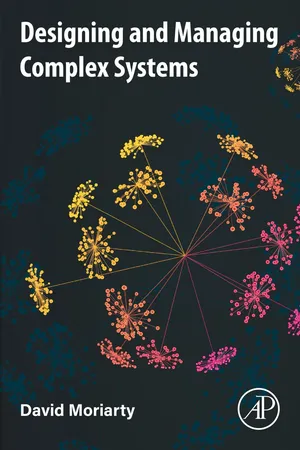
Designing and Managing Complex Systems
About this book
The systems that surround us are often multidimensional, and complex, consisting of a large collection of networked components with convoluted connections between them. Designing and managing such systems can be challenging, particularly in organizations. Designing and Managing Complex Systems introduces readers to the theory of complex systems, examining the role of human within larger systems, the factors that affect system performance, and how such systems can be optimized. The first section reviews the history of one particularly fruitful approach to complexity, one based on knowledge of the human nervous system. Next, the author discusses the current understanding of complex systems in a variety of domains including physical, biological, mechanical, and organizational. Within these chapters the author also introduces the idea that there are marked similarities in how complexity is successfully managed across these different domains and how the ideas from one domain can be useful in other domains. Next, these ideas are synthesized into a framework for successfully designing and managing complex systems. The fourth section focuses on case studies concerning failures and successes within complex systems.
- Provides an overview of the background and scope of complexity science
- Reviews current understanding of complex systems in a variety of domains (physical, biological, mechanical, and organizational)
- Introduces the idea of using successful techniques from one domain to help design and manage complex systems in other domains
- Includes case studies analysing failures and successes within complex systems
Information
Topic
PsicologíaSubtopic
Comportamiento del consumidorTable of contents
- Designing and Managing Complex Systems
- Chapter 1.1 Control and communication
- Chapter 2.1 The simplification imperative
- Chapter 2.2 The language of systems
- Chapter 2.3 Classes of systems
- Chapter 2.4 Neurobiological systems
- Chapter 2.5 Sociotechnical systems
- Chapter 2.6 Consilient dynamics across scales
- Chapter 3.1 Introduction to part 3
- Chapter 3.2 Structure and function
- Chapter 3.3 Capability and adaptive capacity
- Chapter 3.4 Engineering resilience
- Chapter 3.5 Assessing the system properties of your organization
- Chapter 4.1 Challenger and Columbia1,212
- Chapter 4.2 Walmart, FEMA, and Hurricane Katrina1–41234
- Chapter 4.3 Lake Peigneur1,212
- Chapter 4.4 The water temples of Bali1–, 3
- Chapter 4.5 The global financial crisis1–3123
- Chapter 4.6 Continental Airlines1
- Chapter 4.7 Three Mile Island1–3123
- Chapter 4.8 Cybersyn and the trucking strike1–3123
- Chapter 4.9 Biological and informational viruses
- Chapter 4.10 Netflix1
- Chapter 4.11 Fukushima1–512345
- Chapter 4.12 The Mumbai Dabbawalas1,212
- Chapter 4.13 Flash Crash1–41234
- Chapter 4.14 Alphafold 21,212
- Chapter 5.1 Consilience with the arts
- Chapter 5.2 Conclusion
- References
- Index
Trusted by 375,005 students
Access to over 1.5 million titles for a fair monthly price.
Study more efficiently using our study tools.
Frequently asked questions
Yes, you can cancel anytime from the Subscription tab in your account settings on the Perlego website. Your subscription will stay active until the end of your current billing period. Learn how to cancel your subscription
No, books cannot be downloaded as external files, such as PDFs, for use outside of Perlego. However, you can download books within the Perlego app for offline reading on mobile or tablet. Learn how to download books offline
Perlego offers two plans: Essential and Complete
- Essential is ideal for learners and professionals who enjoy exploring a wide range of subjects. Access the Essential Library with 800,000+ trusted titles and best-sellers across business, personal growth, and the humanities. Includes unlimited reading time and Standard Read Aloud voice.
- Complete: Perfect for advanced learners and researchers needing full, unrestricted access. Unlock 1.5M+ books across hundreds of subjects, including academic and specialized titles. The Complete Plan also includes advanced features like Premium Read Aloud and Research Assistant.
We are an online textbook subscription service, where you can get access to an entire online library for less than the price of a single book per month. With over 1.5 million books across 990+ topics, we’ve got you covered! Learn about our mission
Look out for the read-aloud symbol on your next book to see if you can listen to it. The read-aloud tool reads text aloud for you, highlighting the text as it is being read. You can pause it, speed it up and slow it down. Learn more about Read Aloud
Yes! You can use the Perlego app on both iOS and Android devices to read anytime, anywhere — even offline. Perfect for commutes or when you’re on the go.
Please note we cannot support devices running on iOS 13 and Android 7 or earlier. Learn more about using the app
Please note we cannot support devices running on iOS 13 and Android 7 or earlier. Learn more about using the app
Yes, you can access Designing and Managing Complex Systems by David Moriarty in PDF and/or ePUB format, as well as other popular books in Psicología & Comportamiento del consumidor. We have over 1.5 million books available in our catalogue for you to explore.