eBook - PDF
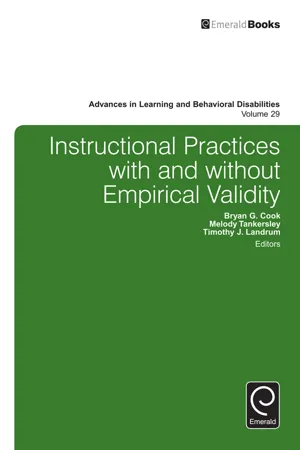
Instructional Practices with and without Empirical Validity
- 228 pages
- English
- PDF
- Available on iOS & Android
eBook - PDF
Instructional Practices with and without Empirical Validity
About this book
It is important that stakeholders are aware of practices supported as effective for students with learning and behavioral disabilities in order to provide instruction that results in improved learner outcomes. Perhaps equally important, stakeholders should also know which practices have been shown by research to be ineffective (e.g., have no, small, or inconsistent effects on learner outcomes). Special education has a long history of using practices that, though appealing in some ways, have little or no positive impact on learner outcomes. In order to bridge the gap between research and practice, educators must be aware of which practices work (and prioritize their use) and which do not (and avoid their use). In this volume, each chapter describes two practices one supported as effective by research and one shown by research to be ineffective in critical areas of education for students with learning and behavioral disabilities. Chapter authors will provide readers guidance in how to do this for each effective practices and provide concrete reasons to not do this for each ineffective practice.
Information
Topic
EducationSubtopic
Learning DisabilitiesTable of contents
- Front Cover
- Instructional Practices with and without Empirical Validity
- Copyright Page
- Contents
- List of Contributors
- Chapter 1 Instructional Practices with and without Empirical Validity: An Introduction
- Chapter 2 Two Approaches for Improving Reading Fluency: Research Supports Repeated Reading But Not Colored Filters
- Chapter 3 Developing Mathematical Problem Solving through Strategic Instruction: Much More Than a Keyword
- Chapter 4 Effective and Ineffective Writing Practices for Students with Disabilities
- Chapter 5 Picture Exchange Communication System and Facilitated Communication: Contrasting an Evidence-Based Practice with ...
- Chapter 6 Movement as Behavioral Moderator: What Does the Research Say?⤀
- Chapter 7 Learning Styles, Learning Preferences, and Student Choice: Implications for Teaching
- Chapter 8 Never Say Never: The Appropriate and Inappropriate Use of Praise and Feedback for Students with Learning and Beha...
- Chapter 9 Do School-Wide Positive Behavioral Interventions and Supports, Not Exclusionary Discipline Practices
- Chapter 10 Deep Pressure Therapy Doesn’t Reduce Stereotypical Behavior, Function-Based Interventions Do
Trusted by 375,005 students
Access to over 1.5 million titles for a fair monthly price.
Study more efficiently using our study tools.
Frequently asked questions
Yes, you can cancel anytime from the Subscription tab in your account settings on the Perlego website. Your subscription will stay active until the end of your current billing period. Learn how to cancel your subscription
No, books cannot be downloaded as external files, such as PDFs, for use outside of Perlego. However, you can download books within the Perlego app for offline reading on mobile or tablet. Learn how to download books offline
Perlego offers two plans: Essential and Complete
- Essential is ideal for learners and professionals who enjoy exploring a wide range of subjects. Access the Essential Library with 800,000+ trusted titles and best-sellers across business, personal growth, and the humanities. Includes unlimited reading time and Standard Read Aloud voice.
- Complete: Perfect for advanced learners and researchers needing full, unrestricted access. Unlock 1.5M+ books across hundreds of subjects, including academic and specialized titles. The Complete Plan also includes advanced features like Premium Read Aloud and Research Assistant.
We are an online textbook subscription service, where you can get access to an entire online library for less than the price of a single book per month. With over 1.5 million books across 990+ topics, we’ve got you covered! Learn about our mission
Look out for the read-aloud symbol on your next book to see if you can listen to it. The read-aloud tool reads text aloud for you, highlighting the text as it is being read. You can pause it, speed it up and slow it down. Learn more about Read Aloud
Yes! You can use the Perlego app on both iOS and Android devices to read anytime, anywhere — even offline. Perfect for commutes or when you’re on the go.
Please note we cannot support devices running on iOS 13 and Android 7 or earlier. Learn more about using the app
Please note we cannot support devices running on iOS 13 and Android 7 or earlier. Learn more about using the app
Yes, you can access Instructional Practices with and without Empirical Validity by Bryan G. Cook,Melody Tankersley,Timothy J. Landrum in PDF and/or ePUB format, as well as other popular books in Education & Learning Disabilities. We have over 1.5 million books available in our catalogue for you to explore.