eBook - PDF
About this book
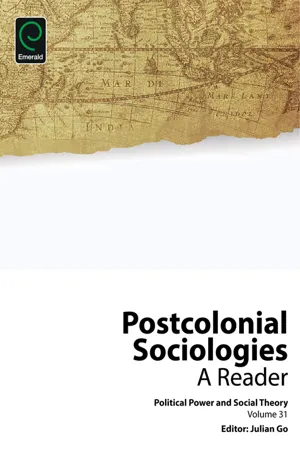
Postcolonial theory has mostly been confined to literary studies and the humanities, but it has been slowly making its way into social science. This is a welcome development but poses new challenges. How can postcolonial thought be most fruitfully translated and incorporated into sociology? This special volume brings together leading sociologists to offer some answers and examples. The chapters offer new postcolonial readings of canonical thinkers like Karl Marx, Max Weber, Emile Durkheim and Robert Park; consider whether or not postcolonial theory is compatible with sociology; explore the relationship between knowledge and colonial power; offer critical perspectives on the sociology of race; ponder the implications of postcolonial theory for global sociology; creatively employ postcolonial concepts such as hybridity; and excavate the social theories of occluded thinkers in India. This volume will be an important guide for scholars and students in the social sciences who are interested in what postcolonial thought has to offer.
Information
Table of contents
- Front Cover
- Postcolonial Sociologies: A Reader
- Copyright Page
- Contents
- List of Contributors
- Senior Editorial Board
- Student Editorial Board
- Editorial Statement
- Introduction: Sociology and Postcoloniality
- The colonial unconscious of classical sociology
- ‘‘From the standpoint of Germanism’’: A postcolonial critique of Weber’s theory of race and ethnicity
- Common skies and divided horizons? sociology, race, and postcolonial studies
- The Violences of Knowledge: Edward Said, Sociology, and Post-Orientalist Reflexivity
- Neo-Bourdieusian Theory and the Question of Scientific Autonomy: German Sociologists and Empire, 1890s–1940s
- ‘‘Provincializing’’ sociology: The case of a premature postcolonial sociologist
- Hybrid habitus: Toward a post-colonial theory of practice
- The possibilities of, and for, global sociology: A postcolonial perspective
- Parameters of a postcolonial sociology of the Ottoman Empire
Trusted by 375,005 students
Access to over 1.5 million titles for a fair monthly price.
Study more efficiently using our study tools.
Frequently asked questions
Yes, you can cancel anytime from the Subscription tab in your account settings on the Perlego website. Your subscription will stay active until the end of your current billing period. Learn how to cancel your subscription
No, books cannot be downloaded as external files, such as PDFs, for use outside of Perlego. However, you can download books within the Perlego app for offline reading on mobile or tablet. Learn how to download books offline
Perlego offers two plans: Essential and Complete
- Essential is ideal for learners and professionals who enjoy exploring a wide range of subjects. Access the Essential Library with 800,000+ trusted titles and best-sellers across business, personal growth, and the humanities. Includes unlimited reading time and Standard Read Aloud voice.
- Complete: Perfect for advanced learners and researchers needing full, unrestricted access. Unlock 1.5M+ books across hundreds of subjects, including academic and specialized titles. The Complete Plan also includes advanced features like Premium Read Aloud and Research Assistant.
We are an online textbook subscription service, where you can get access to an entire online library for less than the price of a single book per month. With over 1.5 million books across 990+ topics, we’ve got you covered! Learn about our mission
Look out for the read-aloud symbol on your next book to see if you can listen to it. The read-aloud tool reads text aloud for you, highlighting the text as it is being read. You can pause it, speed it up and slow it down. Learn more about Read Aloud
Yes! You can use the Perlego app on both iOS and Android devices to read anytime, anywhere — even offline. Perfect for commutes or when you’re on the go.
Please note we cannot support devices running on iOS 13 and Android 7 or earlier. Learn more about using the app
Please note we cannot support devices running on iOS 13 and Android 7 or earlier. Learn more about using the app
Yes, you can access Postcolonial Sociologies by Julian Go in PDF and/or ePUB format, as well as other popular books in Social Sciences & Social Theory. We have over 1.5 million books available in our catalogue for you to explore.