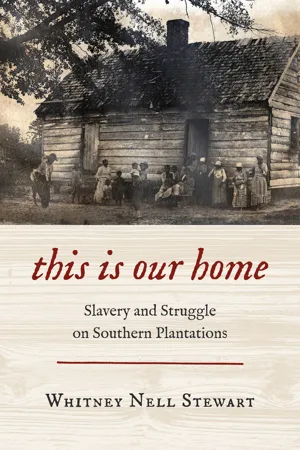
The cultural memory of plantations in the Old South has long been clouded by myth. A recent reckoning with the centrality of slavery to the US national story, however, has shifted the meaning of these sites. Plantations are no longer simply seen as places of beauty and grandiose hospitality; their reality as spaces of enslavement, exploitation, and violence is increasingly at the forefront of our scholarly and public narratives. Yet even this reckoning obscures what these sites meant to so many forced to live and labor on them: plantations were Black homes as much as white.
Insightfully reading the built environment of plantations, considering artifact fragments found in excavations of slave dwellings, and drawing on legal records and plantation owners' papers, Whitney Nell Stewart illuminates how enslaved people struggled to make home amid innumerable constraints and obstacles imposed by white southerners. By exploring the material remnants of the past, Stewart demonstrates how homemaking was a crucial part of the battle over slavery and freedom, a fight that continues today in consequential confrontations over who has the right to call this nation home.
- 288 pages
- English
- ePUB (mobile friendly)
- Available on iOS & Android
eBook - ePub
About this book
Information
Table of contents
- Cover
- Title Page
- Copyright Page
- Epigraph
- Contents
- List of Illustrations
- Acknowledgments
- Note on Language
- Introduction. Home in Slavery
- Chapter One. Demarcating Home and Labor: Montpelier Plantation, Virginia
- Chapter Two. Concealing for Privacy and Protection: Stagville Plantation, North Carolina
- Chapter Three. Rooting One’s People: Chatham Plantation, Alabama
- Chapter Four. Projecting Domestic Authority: Patton Place, Texas
- Chapter Five. Building Stability and Legacy: Redcliffe Plantation, South Carolina
- Conclusion. Home in Freedom
- Appendix. Why, What, and How: A Note on Material Culture Theory, Sources, and Method
- Notes
- Bibliography
- Index
Trusted by 375,005 students
Access to over 1.5 million titles for a fair monthly price.
Study more efficiently using our study tools.
Frequently asked questions
Yes, you can cancel anytime from the Subscription tab in your account settings on the Perlego website. Your subscription will stay active until the end of your current billing period. Learn how to cancel your subscription
No, books cannot be downloaded as external files, such as PDFs, for use outside of Perlego. However, you can download books within the Perlego app for offline reading on mobile or tablet. Learn how to download books offline
Perlego offers two plans: Essential and Complete
- Essential is ideal for learners and professionals who enjoy exploring a wide range of subjects. Access the Essential Library with 800,000+ trusted titles and best-sellers across business, personal growth, and the humanities. Includes unlimited reading time and Standard Read Aloud voice.
- Complete: Perfect for advanced learners and researchers needing full, unrestricted access. Unlock 1.5M+ books across hundreds of subjects, including academic and specialized titles. The Complete Plan also includes advanced features like Premium Read Aloud and Research Assistant.
We are an online textbook subscription service, where you can get access to an entire online library for less than the price of a single book per month. With over 1.5 million books across 990+ topics, we’ve got you covered! Learn about our mission
Look out for the read-aloud symbol on your next book to see if you can listen to it. The read-aloud tool reads text aloud for you, highlighting the text as it is being read. You can pause it, speed it up and slow it down. Learn more about Read Aloud
Yes! You can use the Perlego app on both iOS and Android devices to read anytime, anywhere — even offline. Perfect for commutes or when you’re on the go.
Please note we cannot support devices running on iOS 13 and Android 7 or earlier. Learn more about using the app
Please note we cannot support devices running on iOS 13 and Android 7 or earlier. Learn more about using the app
Yes, you can access This Is Our Home by Whitney Nell Stewart in PDF and/or ePUB format, as well as other popular books in Social Sciences & North American History. We have over 1.5 million books available in our catalogue for you to explore.