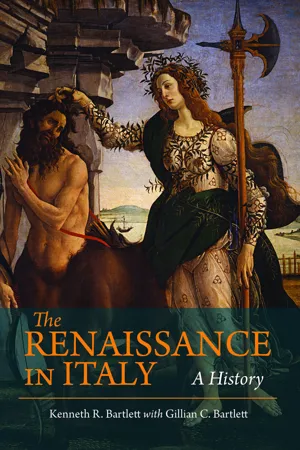
The Italian Renaissance has come to occupy an almost mythical place in the popular imagination. The outsized reputations of the best-known figures from the period—Michelangelo, Niccolo Machiavelli, Lorenzo the Magnificent, Pope Julius II, Isabella d'Este, and so many others—engender a kind of wonder. How could so many geniuses or exceptional characters be produced by one small territory near the extreme south of Europe at a moment when much of the rest of the continent still labored under the restrictions of the Middle Ages? How did so many of the driving principles behind Western civilization emerge during this period—and how were they defined and developed? And why is it that geniuses such as Leonardo, Raphael, Petrarch, Brunelleschi, Bramante, and Palladio all sustain their towering authority to this day? To answer these questions, Kenneth Bartlett delves into the lives and works of the artists, patrons, and intellectuals—the privileged, educated, influential elites—who created a rarefied world of power, money, and sophisticated talent in which individual curiosity and skill were prized above all else. The result is a dynamic, highly readable, copiously illustrated history of the Renaissance in Italy—and of the artists that gave birth to some of the most enduring ideas and artifacts of Western civilization.
- 416 pages
- English
- ePUB (mobile friendly)
- Available on iOS & Android
eBook - ePub
About this book
Information
Topic
HistoriaTable of contents
- Front Cover
- Half Title
- Title Page
- Copyright
- Titles of Related Interest Available from Hackett Publishing
- Acknowledgments
- Contents
- Introduction
- Part I: The Dawn of Humanism
- Part II: Florence: The Humanist Republic
- Part III: Princes, Patronage, and Power
- Part IV: The Renaissance at the Edges
- Part V: Rome in the Renaissance
- Conclusion
- Bibliography
- Image Credits
- Index
- Back Cover
Trusted by 375,005 students
Access to over 1.5 million titles for a fair monthly price.
Study more efficiently using our study tools.
Frequently asked questions
Yes, you can cancel anytime from the Subscription tab in your account settings on the Perlego website. Your subscription will stay active until the end of your current billing period. Learn how to cancel your subscription
No, books cannot be downloaded as external files, such as PDFs, for use outside of Perlego. However, you can download books within the Perlego app for offline reading on mobile or tablet. Learn how to download books offline
Perlego offers two plans: Essential and Complete
- Essential is ideal for learners and professionals who enjoy exploring a wide range of subjects. Access the Essential Library with 800,000+ trusted titles and best-sellers across business, personal growth, and the humanities. Includes unlimited reading time and Standard Read Aloud voice.
- Complete: Perfect for advanced learners and researchers needing full, unrestricted access. Unlock 1.5M+ books across hundreds of subjects, including academic and specialized titles. The Complete Plan also includes advanced features like Premium Read Aloud and Research Assistant.
We are an online textbook subscription service, where you can get access to an entire online library for less than the price of a single book per month. With over 1.5 million books across 990+ topics, we’ve got you covered! Learn about our mission
Look out for the read-aloud symbol on your next book to see if you can listen to it. The read-aloud tool reads text aloud for you, highlighting the text as it is being read. You can pause it, speed it up and slow it down. Learn more about Read Aloud
Yes! You can use the Perlego app on both iOS and Android devices to read anytime, anywhere — even offline. Perfect for commutes or when you’re on the go.
Please note we cannot support devices running on iOS 13 and Android 7 or earlier. Learn more about using the app
Please note we cannot support devices running on iOS 13 and Android 7 or earlier. Learn more about using the app
Yes, you can access The Renaissance in Italy by Kenneth Bartlett in PDF and/or ePUB format, as well as other popular books in Historia & Historia del Renacimiento europeo. We have over 1.5 million books available in our catalogue for you to explore.