In the fifteenth-century republic of Florence, political power resided in the hands of middle-class merchants, a few wealthy families, and powerful craftsmen's guilds. The intensity of Florentine factionalism and the frequent alterations in its political institutions gave Renaissance thinkers ample opportunities to inquire into the nature of political legitimacy and the relationship between authority and its social context.
This volume provides a selection of texts that describes the language, conceptual vocabulary, and issues at stake in Florentine political culture at key moments in its development during the Renaissance. Rather than presenting Renaissance political thought as a static set of arguments, Florentine Political Writings from Petrarch to Machiavelli instead illustrates the degree to which political thought in the Italian City revolved around a common cluster of topics that were continually modified and revised—and the way those common topics could be made to serve radically divergent political purposes.
Editors Mark Jurdjevic, Natasha Piano, and John P. McCormick offer readers the opportunity to appreciate how Renaissance political thought, often expressed in the language of classical idealism, could be productively applied to pressing civic questions. The editors expand the scope of Florentine humanist political writing by explicitly connecting it with the sixteenth-century realist turn most influentially exemplified by Niccolò Machiavelli and Francesco Guicciardini. Presenting nineteen primary source documents, including lesser known texts by Machiavelli and Guicciardini, several of which are here translated into English for the first time, this useful compendium shows how the Renaissance political imagination could be deployed to think through methods of electoral technology, the balance of power between different social groups, and other practical matters of political stability.
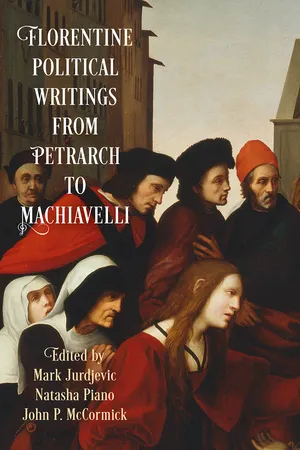
eBook - ePub
Florentine Political Writings from Petrarch to Machiavelli
- 336 pages
- English
- ePUB (mobile friendly)
- Available on iOS & Android
eBook - ePub
Florentine Political Writings from Petrarch to Machiavelli
About this book
Information
PART I

On Monarchy
and Tyranny
Chapter 1
PETRARCH
How a Ruler Ought to Govern His State
(1373)
Born in Arezzo, Tuscany, and raised in Avignon, France, Francesco Petrarca (Petrarch) (1304–74) was a leading figure—indeed, perhaps the father—of Italian humanism. A prodigiously prolific composer of romantic poetry and scholar of Latin letters, and promoter of Italian culture, Petrarch undertook intellectual efforts that are said to have bridged the medieval Christian and the modern secular world. His writings revived the importance of pagan authors such as Cicero, Virgil, and Seneca for contemporary readers, while he continued to engage substantively with Christian authorities like St. Augustine. Petrarch’s greatest works include the poetry collection Canzoniere; his unfinished compendium of profiles of exemplary Italian statesmen, De viris illustribus; De vita solitaria, which praises the contemplative life; and the unfinished epic Africa, devoted to the exploits of the ancient Roman general Scipio Africanus. Late in life Petrarch composed “How a Ruler Ought to Govern His State,” dedicated to his patron, Lord Francesco da Carrara of Padua. A paradigmatic example of the widespread mirror-for-princes genre (speculum principis), Petrarch’s advice epistle demonstrates how late medieval Italians understood good government under princely rule.
The text is a reprint of Francesco Petrarch, “How a Ruler Ought to Govern His State,” trans. B. G. Kohl, in B. G. Kohl and R. G. Witt, eds., The Earthly Republic: Italian Humanists on Government and Society (Philadelphia: University of Pennsylvania Press, 1978), 35–78.

How a Ruler Ought to Govern His State
For a long time now, distinguished sir, I have been meaning to write to you. And you have, in your usual way, gently reproved me, so that I am now aware that I have omitted your name from among the names of the many great men and men of middle rank to whom I have addressed letters. This omission is especially disgraceful when I consider the patronage that I have received from you and your father. Indeed, it would be an enormous act of ingratitude if I should let myself forget the thanks and affection that I should always hold for you. Therefore, I have decided to write to you even though I am still undecided where I ought to begin and on what topic. This indecision does not derive from the lack of a suitable subject matter, but rather from a perplexing abundance of material, so that I feel like a traveler poised at a crossroads. On the one hand, your great and constant generosity compels me to tender you my deepest thanks. Indeed, it is a time-honored custom to give thanks to friends and especially to princes for their gifts, and I have done so to you many times. On the other hand, you have so daily and continually laden me with gifts and honors that I, weighted down with the number and magnitude of your gifts, cannot ever hope to repay you adequately with mere words. Rather, I think that it would be better to pass over such generosity in respectful silence than to try and repay it with inadequate words.
So I leave aside this matter of gratitude and turn to the vast and easy task of singing your praises. Now and again it has been the custom of many men to praise princes (and indeed I have done so myself occasionally), not in order to gain favors from those who are praised as much as to pay homage to the truth and to spur the prince on to greatness with the very stimulus of praise to a generous mind, which is a spur more powerful than anything else. For in these matters of giving praise I find nothing more offensive than adulation or an inconstant attitude. There are those indeed who would praise unworthy men and there are others who, having praised their subjects, promptly begin to vituperate them with an incredible turn of mind. I know of nothing more dishonorable, more base, than this. And in this matter so especially notorious was Cicero (whom I esteem and admire more than any other ancient author) that I feel almost compelled to hate him. Cicero did this to many people, but, most significantly, he ladened and honored Julius Caesar with a wealth of praise and then subjected Caesar to insults and abuse. Read Cicero’s letters to his brother Quintus, in which everything said there about Caesar is friendly and complimentary. But then turn to his letters to Atticus, in which you first will find mixed feelings toward Caesar and finally even hatred and reproach. Read Cicero’s orations, spoken before Caesar alone or before him when he was present in the Senate; so great are these praises of Caesar that they seem unmerited by any mortal and beyond the capacity of a mortal genius to compose. But read further in the book On Duties and in the Philippic orations and you will find expressions of hatred equal to the former affection and base abuse comparable to earlier praise. What makes these great changes in Cicero’s attitude even worse is that Cicero gave Caesar nothing but praise while he was alive and nothing but vituperation after he was dead. I would have been able to tolerate this much more easily if Cicero had criticized Caesar when he was alive and praised him after he was dead, because usually death either diminishes or extinguishes altogether hatred and envy. However, Julius Caesar had a companion in this situation (as he did in many things) in the person of his nephew and adopted son Caesar Augustus, who was inferior to Julius Caesar in his military prowess but surely superior in his ability to rule. Cicero, likewise, at first praised Augustus immoderately, but then he began to criticize him strongly while still alive and even wrote fierce censures of him.1 I am reluctant to speak thus of a man whom I esteem so much, but truth is stronger than admiration. I regret that it must be this way, but it is. And I do not doubt that if Cicero were present he would answer me easily with his overpowering eloquence, but the truth is not altered by mere words.
I think I shall never turn with a diseased mind from praise to vituperation. Now, as I return to my theme, this occurred to me at the very outset of my discussion with you: While true virtue does not reject merited glory, glory should follow it even if virtue is unwilling, just as the shadow follows the body. I said to myself: This man, you can easily see, prefers to be criticized rather than praised, and it is easier to acquire favor with him by finding fault than by giving him due praise. What, therefore, shall I do? What course shall I take? A man whom I do not hesitate to praise I would not fear to criticize if he would be as fine a subject for criticism as for praise. I confess that it is the condition of mortals that no one is entirely above reproach. A person who has a few small defects can be called perfect and very good. Therefore, give thanks to God who made you what you are, so that if your detractor and your praiser were of equal ability the praiser would naturally be more eloquent. This is like the case of the two farmers who are of equal ability and energy; the one who has the luck to own the more fertile land will appear to be the better farmer. Likewise, in the case of two ship captains equal in every other way, he will be the more fortunate who sails on more tranquil seas and is propelled by more favorable breezes.
But after I had decided to criticize you and selected this topic for my epistolary discussion, I had found nothing in you worthy of blame except for that one thing concerning which I had a private discussion with you some time ago. If in this matter you will be so kind as to pay heed to my humble and faithful advice, there is scarcely any doubt that you will soon derive healthy nourishment for mind and body and for the greatness of your present fame and future glory. So I will express it to you with the same words that Crastinus used with Caesar on the battlefield of Thessaly: “You will thank me either dead or alive.”2 I shall not speak of this any more. For what is the use of words to those who already understand and know? You know what I want, and I ought not to want, nor am I able to want, anything but your good. I do not doubt that you know this.
Since things are this way, I feel that I am relieved from telling at this point the long story that, as I have said, is not in the least pleasant for you and, in any case, is well known to everyone. I am referring to the fact that in the very flower of your young manhood you were deprived of your worthy and magnanimous father, by whose example and erudition you were able to learn everything that is noble and magnificent.3 At the time when it seemed especially fitting for you to have your own mentor, you took up the reins of government and, with the city of Padua under your control, overcame the difficulties created by your youth. You ruled with such competence and such maturity that no rumor, no hint of rebellion, disturbed the city in that time of great change. Next, after a short time, you transformed into a large surplus the enormous deficit that debts to foreign powers had left in your treasury. And now the years and experience in government have so matured you that you are esteemed as an outstanding lord, not only by your own citizens but also by the lords of many other cities, who hold you up as a model. As a result, I have often heard neighboring peoples express the wish that they could be governed by you and nurture envy for your subjects. You have never devoted yourself to either the arrogance of pompous display or to the idleness of pleasure, but you have devoted yourself to just rule so that everyone acknowledges that you are peaceful without being feckless and dignified without being prideful. As a result, modesty coexists with magnanimity in your character. You are thus full of dignity. Although, because of your incredible humanity, you permit easy access to yourself even to the most humble, still one of your most outstanding acts is to have at the same time contracted for your daughters very advantageous marriages with noble families in distant lands.4 And you have been, above all other rulers, a lover of public order and peace—a peace that was never thought possible by the citizen-body when Padua was ruled by a communal regime or by any of your family, no matter how long they held the power-you alone constructed many strong fortresses at suitable points along the Paduan frontiers. Thus you acted in every way so that the citizens felt free and secure with you as a ruler, and no innocent blood was spilled. You also have pacified all your neighbors either by fear or by love or by admiration for your excellence, so that for many years now you have ruled a flourishing state with serene tranquility and in continual peace. But at last that adversary of the human race, that enemy of peace [the Devil], suddenly stirred up a dangerous war with that power you never feared. Consequently, although you still loved peace, you fought with Venice bravely and with great determination over a long time, even though you lacked the aid from allies that you had hoped for. And when it seemed most advantageous to do so, you skillfully concluded peace so that at one stroke you won twofold praise both for your bravery and your political wisdom.5 From these facts and from many others I shall omit, you have been viewed as vastly superior to all other rulers of your state and to all rulers of other cities, not only in the judgment of your own subjects but indeed in the opinion of the whole world as well.
But praising you in detail when the facts speak so clearly for themselves would be only a pleasant exercise, and it is a useless chore to try and criticize you. Besides, because of the lack of material my speech would end in unbecoming silence as soon as I began to talk. So I shall tell you what I have decided to speak about, a topic which I am sure is well known to you even without any further elaboration but which may be sometimes useful even to someone like yourself who has already been made aware of it. For even though the mind has grasped something well and learned it thoroughly and used that knowledge frequently, it can recall that thing when stimulated by another and, urged on by another’s words, it follows more readily a path it would still take by itself. I shall discuss, therefore, something that almost everyone knows but that people often neglect, namely, what should be the character of a man to whom the task of governing a state has been entrusted. I am not unaware that such a subject could easily fill many volumes, and that I am content to write only one letter. Yet for some people a single word is more useful than a long speech is for others, and, moreover, the quality of the mind of the listener is much more important than the eloquence of the writer, whoever he may be. Indeed, let me repeat what I have often said: There must be within you a tiny spark that can be increased by fanning and will eventually burst into flame. Without this one will have only fanned dead ashes for no good purpose. I hope (or indeed I am certain) that in you there are not just faint embers but bright and burning coals or even an excellent flame of virtue and an able mind that is accustomed to utilize all it hears. I can recall how much one letter—a great one because it was the product of a great mind, namely the letter from Marcus Brutus to Marcus Tullius Cicero—stimulated you to excellence, so that for a long time you could scarcely speak of anything else.6 And I often used to say to myself about you: If he were not such a true friend of virtue he would never have been stimulated so strongly by such a brief, though admittedly excellent, piece of writing. Moreover, it has often been a great source of pleasure to me that I had procured this letter for you, and thus rescued from oblivion and neglect a letter that had been previously lost for a long time.
But before I begin to discuss this subject that I have just proposed, I wish to recall for you a passage from Cicero that, I suspect, is not unknown to you. Surely a man like yourself, who wants to be a good ruler, will listen eagerly to this passage as soon as you know that a good ruler is as dear to God as the state itself is dear to God. Here, therefore, is the passage from the sixth book of On the Commonwealth: “But, Africanus, be assured of this, so that you may be even more eager to defend the commonwealth: all these who have preserved, aided or enlarged their fatherland have a special place prepared for them in the heavens, where they may enjoy an eternal life of happiness. For nothing of all that is done on earth is more pleasing to that supreme god who rules the whole universe in justice, which is called the State. Their rulers and preservers come from heaven and to that place they return.”7
Moreover, it is imagined that this conversation took place in Heaven. Who, therefore, could be so completely hardhearted, so opposed to excellence, and so contemptuous of true happiness that he would not seek out the task of governing and strive after such rewards? For although it is a pagan who speaks, yet his thought is not opposed to Christian truth or religious belief, even though our way of thinking and theirs are quite different when it comes to such doctrines as the creation of man and the soul.
But now at last I shall do what I have promised, and I shall discuss those things that the lord of a state ought to do. And I want you to look at yourself in this letter as though you were gazing in a mirror. If you see yourself in what I am describing (as no doubt you will quite often), enjoy it. And may you become every day more devoted and more faithful to God, who has bestowed upon us every good and perfect gift and virtue; and may you, albeit with enormous effort, overcome every difficulty and rise to that degree of holiness beyond which you cannot at the present moment ascend. On the other hand, if sometimes you feel that it is difficult for you to meet the standards I describe, I advise you to put your hands to your face and polish the countenance of your great reputation written there, so that you might become more attractive, and certainly more illustrious, as a result of this experience.
The first quality is that a lord should be friendly, never terrifying, to the good citizens, even though it is inevitable that he be terrifying to evil citizens if he is to be a friend to justice. “For he does not carry a sword without good cause, since he is a minister of God,” as the Apostle says.8 Now nothing is more foolish, nothing is more destructive to the stability of the state, than to wish to be dreaded by everyone. Many princes, both in antiquity and in modern times, have wanted nothing more than to be feared and have believed that nothing is more useful than fear and cruelty in maintaining their power. Concerning this belief we have an example in the case of the barbaric emperor named Maximinus.9 In fact, nothing is farther from the truth than these opinions; rather, it is much more advantageous to be loved than to be feared, unless we are speaking of the way in which a devoted child fears a good father. Any other kind of fear is diametrically opposed to what a ruler should desire. Rulers in general want to reign for a long ...
Table of contents
- Cover
- Half title
- Title
- Copyright
- Dedication
- Contents
- Introduction
- Part I. On Monarchy and Tyranny
- Part II. On Civic Republicanism
- Part III. On Florence Between Republic and Principate
- Notes
- Index
- Acknowledgments
Trusted by 375,005 students
Access to over 1.5 million titles for a fair monthly price.
Study more efficiently using our study tools.
Frequently asked questions
Yes, you can cancel anytime from the Subscription tab in your account settings on the Perlego website. Your subscription will stay active until the end of your current billing period. Learn how to cancel your subscription
No, books cannot be downloaded as external files, such as PDFs, for use outside of Perlego. However, you can download books within the Perlego app for offline reading on mobile or tablet. Learn how to download books offline
Perlego offers two plans: Essential and Complete
- Essential is ideal for learners and professionals who enjoy exploring a wide range of subjects. Access the Essential Library with 800,000+ trusted titles and best-sellers across business, personal growth, and the humanities. Includes unlimited reading time and Standard Read Aloud voice.
- Complete: Perfect for advanced learners and researchers needing full, unrestricted access. Unlock 1.5M+ books across hundreds of subjects, including academic and specialized titles. The Complete Plan also includes advanced features like Premium Read Aloud and Research Assistant.
We are an online textbook subscription service, where you can get access to an entire online library for less than the price of a single book per month. With over 1.5 million books across 990+ topics, we’ve got you covered! Learn about our mission
Look out for the read-aloud symbol on your next book to see if you can listen to it. The read-aloud tool reads text aloud for you, highlighting the text as it is being read. You can pause it, speed it up and slow it down. Learn more about Read Aloud
Yes! You can use the Perlego app on both iOS and Android devices to read anytime, anywhere — even offline. Perfect for commutes or when you’re on the go.
Please note we cannot support devices running on iOS 13 and Android 7 or earlier. Learn more about using the app
Please note we cannot support devices running on iOS 13 and Android 7 or earlier. Learn more about using the app
Yes, you can access Florentine Political Writings from Petrarch to Machiavelli by Mark Jurdjevic, Natasha Piano, John P. McCormick, Mark Jurdjevic,Natasha Piano,John P. McCormick in PDF and/or ePUB format, as well as other popular books in Politics & International Relations & European Renaissance History. We have over 1.5 million books available in our catalogue for you to explore.