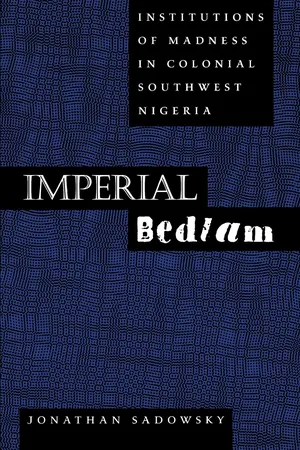
The colonial government of southern Nigeria began to use asylums to confine the allegedly insane in 1906. These asylums were administered by the British but confined Africans. Yet, as even many in the government recognized, insanity is a condition that shows cultural variation. Who decided the inmates were insane and how? This sophisticated historical study pursues these questions as it examines fascinating source material—writings by African patients in these institutions and the reports of officials, doctors, and others—to discuss the meaning of madness in Nigeria, the development of colonial psychiatry, and the connections between them. Jonathan Sadowsky's well-argued, concise study provides important new insights into the designation of madness across cultural and political frontiers. Imperial Bedlam follows the development of insane asylums from their origins in the nineteenth century to innovative treatment programs developed by Nigerian physicians during the transition to independence. Special attention is given to the writings of those considered "lunatics, " a perspective relatively neglected in previous studies of psychiatric institutions in Africa and most other parts of the world. Imperial Bedlam shows how contradictions inherent in colonialism were articulated in both asylum policy and psychiatric theory. It argues that the processes of confinement, the labeling of insanity, and the symptoms of those so labeled reflected not only cultural difference but also political divides embedded in the colonial situation. Imperial Bedlam thus emphasizes not only the cultural background to madness but also its political and experiential dimensions.
- 182 pages
- English
- PDF
- Available on iOS & Android
eBook - PDF
About this book
Information
Publisher
University of California PressYear
2023Print ISBN
9780520216174
Edition
1eBook ISBN
9780520921856
Table of contents
- Contents
- Preface
- Acknowledgments
- CHAPTER 1. Introduction
- CHAPTER 2. The Nineteenth Century
- CHAPTER 3. Material Conditions and the Politics of Care
- CHAPTER 4. "Proper Subjects for Confinement"
- CHAPTER 5. The Confinements of Isaac O.
- CHAPTER 6. Psychiatry and Colonial Ideology
- CHAPTER 7. Conclusion
- Notes
- Bibliography
- INDEX
Trusted by 375,005 students
Access to over 1.5 million titles for a fair monthly price.
Study more efficiently using our study tools.
Frequently asked questions
Yes, you can cancel anytime from the Subscription tab in your account settings on the Perlego website. Your subscription will stay active until the end of your current billing period. Learn how to cancel your subscription
No, books cannot be downloaded as external files, such as PDFs, for use outside of Perlego. However, you can download books within the Perlego app for offline reading on mobile or tablet. Learn how to download books offline
Perlego offers two plans: Essential and Complete
- Essential is ideal for learners and professionals who enjoy exploring a wide range of subjects. Access the Essential Library with 800,000+ trusted titles and best-sellers across business, personal growth, and the humanities. Includes unlimited reading time and Standard Read Aloud voice.
- Complete: Perfect for advanced learners and researchers needing full, unrestricted access. Unlock 1.5M+ books across hundreds of subjects, including academic and specialized titles. The Complete Plan also includes advanced features like Premium Read Aloud and Research Assistant.
We are an online textbook subscription service, where you can get access to an entire online library for less than the price of a single book per month. With over 1.5 million books across 990+ topics, we’ve got you covered! Learn about our mission
Look out for the read-aloud symbol on your next book to see if you can listen to it. The read-aloud tool reads text aloud for you, highlighting the text as it is being read. You can pause it, speed it up and slow it down. Learn more about Read Aloud
Yes! You can use the Perlego app on both iOS and Android devices to read anytime, anywhere — even offline. Perfect for commutes or when you’re on the go.
Please note we cannot support devices running on iOS 13 and Android 7 or earlier. Learn more about using the app
Please note we cannot support devices running on iOS 13 and Android 7 or earlier. Learn more about using the app
Yes, you can access Imperial Bedlam by Jonathan Sadowsky in PDF and/or ePUB format, as well as other popular books in History & African History. We have over 1.5 million books available in our catalogue for you to explore.