Rethinking Psychiatry
eBook - ePub

Rethinking Psychiatry

  1. 237 pages
  2. English
  3. ePUB (mobile friendly)
  4. Available on iOS & Android
eBook - ePub

Rethinking Psychiatry

About this book

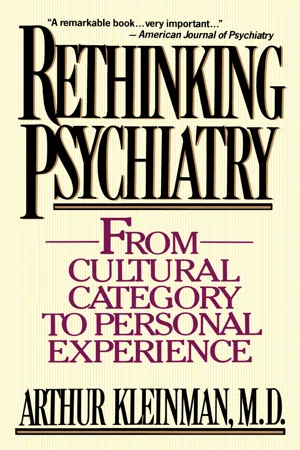
In this book, Kleinman proposes an international view of mental illness and mental care. Arthur Kleinman, M.D., examines how the prevalence and nature of disorders vary in different cultures, how clinicians make their diagnoses, and how they heal, and the educational and practical implications of a true understanding of the interplay between biology and culture.
Frequently asked questions

Yes, you can cancel anytime from the Subscription tab in your account settings on the Perlego website. Your subscription will stay active until the end of your current billing period. Learn how to cancel your subscription.
At the moment all of our mobile-responsive ePub books are available to download via the app. Most of our PDFs are also available to download and we're working on making the final remaining ones downloadable now. Learn more here.
Perlego offers two plans: Essential and Complete
  • Essential is ideal for learners and professionals who enjoy exploring a wide range of subjects. Access the Essential Library with 800,000+ trusted titles and best-sellers across business, personal growth, and the humanities. Includes unlimited reading time and Standard Read Aloud voice.
  • Complete: Perfect for advanced learners and researchers needing full, unrestricted access. Unlock 1.4M+ books across hundreds of subjects, including academic and specialized titles. The Complete Plan also includes advanced features like Premium Read Aloud and Research Assistant.
Both plans are available with monthly, semester, or annual billing cycles.
We are an online textbook subscription service, where you can get access to an entire online library for less than the price of a single book per month. With over 1 million books across 1000+ topics, we’ve got you covered! Learn more here.
Look out for the read-aloud symbol on your next book to see if you can listen to it. The read-aloud tool reads text aloud for you, highlighting the text as it is being read. You can pause it, speed it up and slow it down. Learn more here.
Yes! You can use the Perlego app on both iOS or Android devices to read anytime, anywhere — even offline. Perfect for commutes or when you’re on the go.
Please note we cannot support devices running on iOS 13 and Android 7 or earlier. Learn more about using the app.
Yes, you can access Rethinking Psychiatry by Arthur Kleinman in PDF and/or ePUB format, as well as other popular books in Psychology & History & Theory in Psychology. We have over one million books available in our catalogue for you to explore.

Information

Chapter 1 What Is a Psychiatric Diagnosis?

Disease is not a fact, but a relationship and the relationship is the product of classificatory process….
Bryan S. Turner, The Body and Society
What other taxonomies might revolutionize our view—for taxonomies are theories of order?
Stephen Jay Gould, Animals and us
Individuals are types of themselves and enslavement to conventional names and their associations is only too apt to blind the student to the facts before him. The purely symptomatic forms of our classifications are based on the expressive appearances that insanity assumes according to the temper and pattern of the subject whom it affects. In short, individual subjects operate like so many lenses, each of which refracts in a different angular direction one and the same ray of light.
William James, cited in Eugene Taylor: William James on Exceptional Mental States, The 1896 Lowell Lectures
I am sitting in a small interview room at the Hunan Medical College in south central China. It is August 1980 and the temperature is over 100 degrees. I am sweating profusely and so is the patient I am interviewing, a thin, pallid, 28-year-old teacher at a local primary school in Changsha whose name is Lin Xiling.1 Mrs. Lin, who has suffered from chronic headaches for the past six years, is telling me about her other symptoms: dizziness, tiredness, easy fatigue, weakness, and a ringing sound in her ears. She has been under the treatment of doctors in the internal medicine clinic of the Second Affiliated Hospital of the Hunan Medical College for more than half a year with increasing symptoms. They have referred her to the psychiatric clinic, though against her objections, with the diagnosis of neurasthenia.2 Gently, sensing a deep disquiet behind the tight lips and mask-like squint, I ask Mrs. Lin if she feels depressed. “Yes, I am unhappy,” she replies. “My life has been difficult,” she quickly adds as a justification. At this point Mrs. Lin looks away. Her thin lips tremble. The brave mask dissolves into tears. For several minutes she continues sobbing; the deep inhalations reverberate as a low wail.
After regaining her composure (literally reforming her “face”), Mrs. Lin explains that she is the daughter of intellectuals who died during the Cultural Revolution while being abused by the Red Guards.3 She and her four brothers and sisters were dispersed to different rural areas. Mrs. Lin, then a teenager, was treated harshly by both the cadres and peasants in the impoverished commune in the far north to which she was sent. She could not adapt to the very cold weather and the inadequate diet. After a year she felt that she was starving, and indeed had decreased in weight from 110 to 90 pounds. She felt terribly lonely; in five miserable years her only friend was a fellow middle school student with a similar background from her native city, who shared her complaints. Finally, in the mid-seventies she returned to Changsha. She then learned that one of her sisters had committed suicide while being “struggled” by the Red Guards, and a brother had become paralyzed in a tractor accident. Three times Mrs. Lin took the highly competitive entrance examinations for university education, and each time, to her great shame, she failed to achieve a mark high enough to gain admission.4 Two years before our interview, she married an electrician in her work unit. The marriage was arranged by the unit leaders. Mrs. Lin did not know her husband well before their marriage, and afterward she discovered that both he and his mother had difficult, demanding, irascible personalities. Their marriage has been characterized by frequent arguments which end at times with her husband beating her, and her mother-in-law, with whom they live, attacking her for being an ungrateful daughter-in-law and incompetent wife. Both husband and mother-in-law hold her responsible for the stillbirth of a nearly full-term male fetus one year before.
Over the past two years, Mrs. Lin’s physical symptoms have worsened and she has frequently sought help from physicians of both biomedicine and traditional Chinese medicine. When questioned by me, she admits to more symptoms—difficulty with sleep, appetite, and energy, as well as joylessness, anxiety, and feelings that it would be better to be dead. She has an intense feeling of guilt about the stillbirth and also about not being able to be practically helpful to her paraplegic brother. During the past six months she has developed feelings of hopelessness and helplessness, as well as self-abnegating thoughts. Mrs. Lin regards her life as a failure. She has fleeting feelings that it would be better for all if she took her life, but she has put these suicidal ideas to the side and has made no plans to kill herself.
From Mrs. Lin’s perspective, her chief problem is her “neurasthenia.” She remarks that if only she could be cured of this “physical” problem and the constant headache, dizziness, and fatigue it creates, she would feel more hopeful and would be better able to adapt to her family situation.
For a North American psychiatrist, Mrs. Lin meets the official diagnostic criteria for a major depressive disorder. The Chinese psychiatrists who interviewed her with me did not agree with this diagnosis. They did not deny that she was depressed, but they regarded the depression as a manifestation of neurasthenia, and Mrs. Lin shared this viewpoint. Neurasthenia—a syndrome of exhaustion, weakness, and diffuse bodily complaints believed to be caused by inadequate physical energy in the central nervous system—is an official diagnosis in China; but it is not a diagnosis in the American Psychiatric Association’s latest nosology.
For the anthropologist, the problem seems more that of demoralization as a serious life distress due to obvious social sources than depression as a psychiatric disease. From the anthropological vantage point, demoralization might also be conceived as part of the illness experience associated with the disease, neurasthenia or depression. Here illness refers to the patient’s perception, experience, expression, and pattern of coping with symptoms, while disease refers to the way practitioners recast illness in terms of their theoretical models of pathology.
Thus, a psychiatric diagnosis is an interpretation of a person’s experience. That interpretation differs systematically for those professionals whose orientation is different. And other social factors—such as clinical specialty, institutional setting, and, most notably in Mrs. Lin’s case, the distinctive cultural backgrounds of the psychiatrists—powerfully influence the interpretation. The interpretation is also, of course, constrained by Mrs. Lin’s actual experience. Psychiatric diagnosis as interpretation must meet some resistance in lived experience, whose roots are deeply personal and physiological. The diagnosis does not create experience; mental disorder is part of life itself.
But that experience is perceived and expressed by Mrs. Lin through her own interpretation of bodily symptoms and problems of the self, so that the experience itself is always mediated. Because language, illness beliefs, personal significance of pain and suffering, and socially learned ways of behaving when ill are part of that process of mediation, the experience of illness (or distress) is always a culturally shaped phenomenon (like style of dress, table etiquette, idioms for expressing emotion, and aesthetic judgments). The interpretations of patient and family become part of the experience. Furthermore, professional and lay interpretations of experience are communicated and negotiated in particular relationships of power (political, economic, bureaucratic, and so forth). As a result, illness experiences are enmeshed in and inseparable from social relationships.
When a psychiatric diagnosis is made, these aspects of social reality are implied. Diagnosis is a semiotic act in which the patient’s experienced symptoms are reinterpreted as signs of particular disease states.5 But those reinterpretations only make sense with respect to specific psychiatric categories and the criteria those categories establish. All diagnoses share this characteristic, whether the disorder is asthma, diabetes, hyperthyroidism, or depression. However, the signs of psychiatric disorders are more difficult to interpret for two reasons. They are only in part, and even then only for certain disorders, a result of biological abnormality; and psychiatric complaints overlap with the complaints of other ordinary kinds of human misery, e.g., injustice, bereavement, failure, unhappiness.
A psychiatric diagnosis implies a tacit categorization of some forms of human misery as medical problems. Earlier in Western society, what is now labeled depression, a psychiatric disease, may have been labeled as medical disorder (an imbalance in the body’s humors), a religious problem (guilt or sinfulness), moral weakness (acedia), or fate (Jackson 1985, 1987). In traditional Chinese medicine, only madness and hysteria were viewed as mental disorders; other problems which we would now call psychiatric were reinterpreted as either manifestations of medical disorder or life troubles owing to the malign influence of gods, ghosts, and ancestors.
In brief, then, though medical diagnosis is taught to medical students and sometimes practiced on patients as a “natural” activity—meaning that symptoms are said to match “underlying” physiological processes—it is anything but natural. What we take a symptom to be is a cultural matter, as is the assumption that a symptom mirrors a single defect in physiological processes. That assumption is not only cultural but naive. One of the most dependable occurrences in clinical care is the practitioner’s inability to draw a precise one-to-one correlation between symptom (an experience) and disease diagnosis (an interpretation within a bounded conceptual system). Patients with endoscopic evidence of active ulcer craters in their stomach may have no pain or other symptoms. Conversely, patients with seriously disabling low back pain often have no demonstrable disease. In fact, even when a nerve root is compressed, neurologists cannot say what it is that causes pain (Osterweis et al., eds., 1987, pp. 123-145). There is no direct measurement of pain independent of its subjective experience, and that experience amplifies or dampens or expresses in unpredictable, idiosyncratic ways the symptom pain. The diagnosis of a structural or functional abnormality tells the practitioner little at all about severity of symptoms, functional impairment, or course and treatment response (Feinstein 1987).
Although diagnosis is said to be based on a “hypotheticodeductive” method, in which practitioners test possible diagnostic categories against the patient’s symptom story to determine which diagnosis best explains the account and which can be rejected, McCormick (1986) shows that formal hypothesis testing among competing diagnoses is a great rarity in medical practice. Demystifying diagnosis, this physician reasons that simple recognition—based on knowledge, the conceptual system we have learned to use to order the world, and on practical experience, what we have actually been trained to see and do—is the essence of diagnosis in all branches of medicine. The diagnostic interpretation is a culturally constrained activity (though it is also constrained by brute materiality in experience) in which the practitioner’s professional training in a particular taxonomic system for ordering experience renders that experience and its interpretation “natural.” “What are we missing,” asks the naturalist Stephen Jay Gould (1987, p. 24), “because we must place all we see into slots of our usual taxonomy?” The neophyte clinician frequently demands ever more explicit rules to reliably fit sight into slot; the seasoned practitioner often intuitively knows that the fit is good only insofar as it is therapeutically useful and that what is left out of the slotting of experience may be more useful (and valid) than what is hammered in.
In many societies a psychiatric diagnosis has significance in political and legal arenas. In the former, it may be a reason why someone is judged disabled and found worthy of disability-based welfare support. In the latter, it may alter a citizen’s rights and responsibilities. The power of an official psychiatric diagnosis in the modern state derives from its formal status as the bureaucratic standard for determining everything from competence to revise a will to access to welfare benefits. Increasingly, contemporary society medicalizes social problems (De Vries et al., eds., 1983). Alcoholism, once a sin or moral weakness, is now a disorder. This is not purely arbitrary. Genetic factors and physiological processes are involved. But those factors and processes need to be regarded in a certain way—say, differently from the way we usually regard blue eyes, baldness, an intolerance of strawberries, or an addiction to pasta—before we call them a disease. The same is true of drug abuse, certain kinds of truancy and delinquency for which children and parents were once held legally responsible to school authorities but which are now relabeled as conduct disorder, and a wide range of the experienced problems of daily living, now called stress syndromes, which to a greater or lesser degree have biological antecedents, correlates, and consequents.
Medicalization—whether seemingly scientifically justified or not—is an alternative form of social control, inasmuch as medical institutions come to replace legal, religious, and other community institutions as the arbiters of behavior. This is not always undesirable. In certain societies medicalization may authorize useful social change that is otherwise politically unacceptable. For example, Stone (1984) has shown that the American disability system has come to medicalize problems of poverty, under- and unemployment, and worker alienation. That is to say, economic downturns, rises in unemployment, and job dissatisfaction translate fairly directly into increased numbers of individuals filing disability claims, usually for chronic, low-grade problems such as back pain that they previously did not perceive as impeding physical functioning (see Osterweis et al., eds., 1987). The disability program has thereby functioned to redistribute income—a tacit arrangement that our society would not expressly authorize. Alternatively, medicalization may trivialize and deny social problems (e.g., dealing with Mrs. Lin as if her problem was simply a psychiatric or medical disorder, and not the darker side of major social transformations in modern China). The use of psychiatric diagnoses in the Soviet Union and elsewhere to label dissidents as ill so that they can be isolated and disciplined in prison hospitals is perhaps the most notorious current instance of the abuse of medicalization; but the medicalization of the killing of schizophrenic patients and the mentally retarded, which was the prototype for the killing of Jews, under the Nazis must surely stand as psychiatry’s darkest hour (Lifton 1986).

The Meaning of Psychiatric Diagnosis to the Psychiatrist

In a brilliant volume, McHugh and Slavney (1986), senior psychiatrists at Johns Hopkins Medical School, describe psychiatric diagnosis in a phenomenological idiom that I suspect most psychiatrists would find compelling.6 They refer to psychiatric disorders as naturally occurring forms of mental experience that can be observed in much the same way that the natural scientist observes the stratigraphy of mountains, the structures of the cell, or the forms of diseased arteries, rashes, and cancers. The problem of psychiatric diagnosis then becomes a question of verification. Are the forms present or not? McHugh and Slavney describe the two kinds of verification that psychiatric researchers struggle to establish in studies of the prevalence, manifestations, course, and treatment response of particular psychiatric disorders—namely, reliability and validity. Reliability they define as “verification of observations”; it is “the consistency with which one can make an observation… [it] is demonstrated by the correlation between the results of observers using the same technique to make that observation” (p. 4). Reliability is documented by the inter-rater correlation coefficient for congruence of diagnosis by psychiatrists trained in the same diagnostic methodology and using the same criteria.
Validity, on the other hand, is the “verification of presumptions,” i.e., the verification of the psychiatric categories themselves. McHugh and Slavney correctly note that the “reliability of some psychiatric observations is high”. That is to say, psychiatrists can be trained so as to make the same observations. But reliability reveals only that the measurement of the observations is consistent. It does not tell us if the observations are valid, i.e., whether a patient does or does not have an abnormal mental state such as delusions or hallucinations. After all, diagnosticians can be trained so that they are consistent but wrong.
For example, suppose ten North American psychiatrists are trained in the same diagnostic assessment technique and employ exactly the same diagnostic criteria. They are each asked to interview ten American Indians who are in the first weeks of bereavement following the death of a spouse. They may determine with 90 percent consistency (that is nine out of ten times) that the same seven subjects report hearing the voice of the dead spouse calling to them as the spirit travels to the afterworld. That is a high degree of reliability of observation. But the determination of whether such reports are a sign of an abnormal mental state is an interpretation based on knowledge of this group’s behavioral norms and range of normal experiences of bereavement. Now it just so happens that in many American Indian tribes auditory experiences of the voices of the spirits of the dead calling to the living to join them in the afterworld are an expected and commonly experienced part of the sadness and loss that constitute the process of bereavement. This experience does not portend any dire consequences such as psychosis, protracted depression, or other complications of bereavement. Thus, to systematically interpret these normal auditory experiences in this cultural group as “hallucinations,” with all that term connotes of abnormality, is an example of reliability without validity. Yet this is often done. I myself have been asked on four occasions to diagnose American Indian bereaved who were undergoing this culturally normative experience as psychotic, and thereby certifiable, by physicians who had made this invalid inference of hallucinations from normal sensory experience.7
The problem lies in the positivist bias of most psychiatrists. For McHugh and Slavney, and most of us who have undergone the empiricist training in medical school, observations are direct representations of reality. A word, e.g., “hallucinations” or “delusions,” points to an empirical entity, e.g., “abnormal mental state in the world.” Advances in effective psychiatric treatment of specific disorders and recognition that clusters of symptoms and signs have the same prognosis not surprisingly encourage the view that depression, schizophrenia, and phobias are “things” in the real world. The picture is more complex. A word, after all, is a sign that signifies a meaningful phenomenon. That phenomenon, as noted above, exists in a world mediated by a cultural apparatus of language, values, taxonomies, notions of relevance, and rules for interpretation. Thus, observations of phenomena are judgments whose reliability can be determined by consistency of measurements but whose validity needs to be established by understanding the cultural context. Perception is theory-driven. The voice of a dead spouse is a hallucination (meaning abnormal sensory process) among most North Americans, for whose reference group the experience is not normative (though perhaps this is not true for some bereaved children—see Egdell and Kolven 1972; and Balk 1983). But i...

Table of contents

  1. Cover
  2. Title Page
  3. Dedication
  4. Epigraph
  5. Preface
  6. Prologue: Why Anthropology?
  7. Chapter 1: What Is a Psychiatric Diagnosis?
  8. Chapter 2: Do Psychiatric Disorders Differ in Different Cultures? The Methodological Questions
  9. Chapter 3: Do Psychiatric Disorders Differ in Different Cultures? The Findings
  10. Chapter 4: Do Social Relations and Cultural Meanings Contribute to the Onset and Course of Mental Illness?
  11. Chapter 5: How Do Professional Values Influence the Work of Psychiatrists?
  12. Chapter 6: How Do Psychiatrists Heal?
  13. Chapter 7: What Relationship Should Psychiatry Have to Social Science?
  14. Epilogue
  15. About the Author
  16. Notes
  17. Bibliography
  18. Index
  19. Copyright