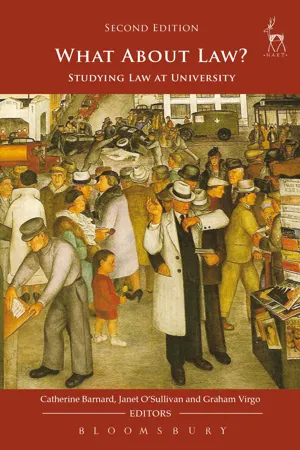
Most young people considering studying law, or pursuing a legal career, have very little idea of what learning law involves and how universities teach law to their students. The new edition of this book, which proved very popular when first published in 2007, provides a 'taster' for the study of law; a short, accessible presentation of law as an academic subject, designed to help 17- and 18-year old students and others decide whether law is the right choice for them as a university subject, or, if they have already made the choice, what to expect when they start their law degree. It helps answer the question 'what should I study at university?' and counters the perception that law is a dry, dull subject.
What About Law? shows how the study of law can be fun, intellectually stimulating, challenging and of direct relevance to students. Using a case study approach, the book introduces prospective law students to the legal system, as well as to legal reasoning, critical thinking and argument.
This is a book that should be in the library of every school with a sixth form, every college and every university, and it is one that any student about to embark on the study of law should read before they commence their legal studies.
All of the authors have long experience in teaching law at Cambridge and elsewhere and all have also been involved, at various times, in advising prospective law students at open days and admissions conferences. Listed as one of the 'Six of the best law books' that a future law student should read by the Guardian Law Online, 8th August 2012.
- 242 pages
- English
- ePUB (mobile friendly)
- Available on iOS & Android
eBook - ePub
About this book
Information
1
Introduction to Law
Catherine Barnard, Graham Virgo and Janet O’Sullivan
STARTING TO THINK ABOUT LAW
Picture this. Laura, who is 17, organises a party at the family home while her parents are away for the weekend. It gets out of hand. For Laura and her parents, it is a nightmare. But for a lawyer, there are as many questions as there are empty bottles strewn the next morning across the prized living-room carpet.
What if the party was very noisy? It might have caused a nuisance to neighbours living nearby and those neighbours might have contacted the local authority, whose noise-prevention officers have powers to close the party down or reduce the noise in some other way. If the party was large enough—and loud enough—to cause a serious nuisance across a wide area, Laura and her guests might even be prosecuted for the crime of public nuisance and eventually punished.
What if the partygoers damaged the house or stole some of the family’s possessions? These are obviously criminal offences, but what happens if the perpetrators can’t be identified? Can guests be forced to give evidence of what happened? Can they get into trouble if they don’t name names? If the perpetrators are easily identified and have lots of money, Laura’s parents might even consider suing them for compensation to cover the cost of all the damage. If the parents choose not to bother, but claim instead on their household insurance policy, can the insurance company recoup some of the money it pays out from those responsible for the damage?
What if one of the invited guests, Mark, was seriously injured when he tripped over a loose paving-stone on the patio—a stone that Laura’s parents knew was dangerous and had been meaning to get fixed? He might want to sue the parents for compensation, but would it make any difference to his chances of success if the parents had expressly banned their daughter from inviting anyone to their home while they were away? And what if Mark was drunk or messing about when he tripped, but the paving stone was sufficiently dangerous that he would, more likely than not, have tripped and suffered the same injury even if he had been perfectly sober? Do people nowadays resort too readily to litigation when injured, unwilling to accept that they have no one to blame but themselves for what happened?
How would the arrival of gate-crashers affect the position? What was their legal status while in the house—were they trespassers? If so, what does that mean? They might be guilty of a crime, such as burglary, if they intended to steal property. Could they be forcibly ejected by the hostess’s friends, even if this requires physical violence? What if the hostess turned a blind eye to their arrival or appeared to welcome them, but later wanted to throw them out? And what if a gatecrasher is injured tripping on that same dodgy paving-stone?
The internet adds a new dimension to the problem. Perhaps Laura publicised the party on an internet chatroom, or maybe some of her so-called friends hacked into her account and publicised the party without her permission. Would this generate any legal liability in itself? What about any responsibility of the company supposed to monitor the chatroom? Is it asking too much to expect a traditional, national legal system to cope with the challenges of an online world?
Did Laura buy alcohol for the party, even though there are supposed to be laws preventing that happening? Or did she raid the parental drinks cabinet? Are there any laws that penalise serving drinks to under-age people at private parties, or any licensing requirements that apply to such private gatherings? We all know about the problem of binge drinking, but some countries have laws imposing ‘social host liability’—this means that if a host has served alcohol and then allows an obviously drunk guest to drive home, the host might be liable to pay compensation if the drunk driver later injures or kills someone on the road. Should the same laws be introduced in the UK and, if so, should they apply just to commercial premises, like pubs, or should they apply to private parties too? And should they apply if the person killed or injured is not an innocent third party but the drunk driver himself?
Meanwhile, back at the party, what if some guests did things they deeply regretted next morning? If a woman consented to sex when drunk, but the man knew that she wouldn’t have consented if she had been sober, is he guilty of rape? And can a drunken consent to sex really be considered consent? What if a man believes a woman is consenting, but only because he is too drunk to realise that she isn’t? The legal age of consent to sex is 16, so what are the criminal law consequences of a 19-year-old man having sex with a 15-year-old girl who said she was 17, or of a 15-year-old boy having consensual sex with a girl his own age? Is it right for the law to attach such overwhelming significance to the age ‘16’ in this context? Is it practicable to have laws that are so difficult to enforce?
As the party descended into chaos, there was a fight and a man was hurt. Can he sue for damages, even though he was a willing participant in the fight? If the fighting spilled out onto the street, can the police arrest the perpetrators for causing a breach of the peace or for drunk and disorderly conduct? Are there any additional protections for under-age suspects?
Finally, the police raided the party and found that illegal drugs were being taken. Is it illegal to take drugs, to share them, or just to supply them? Is it economically and politically sensible to tackle drug-taking using the criminal law?
Laura is clearly going to be in trouble with her parents, but can she be held legally responsible for any of these disastrous events, even if she spent all night cowering in her bedroom, terrified and unable to do anything to bring the party to an end? And should her parents be regarded as legally responsible, even though they were not there and were horrified to discover the chaos when they got home?
* * *
One party, but so many diverse and fascinating legal issues. Some are about what the law is, others about why it is that way. Lawyers have to think in those terms all the time. For many of the questions, there is no obvious ‘right’ answer, because the law is surprisingly open to more than one interpretation and because considerations of policy and fairness do not always point in the same direction. Lawyers and law students need to think about all these issues, and this book will give you a taste of the opinions and arguments that result.
We have taken seven cases—one from each of the core subjects that you must study if you wish to start out on the career path of becoming a lawyer. These subjects are essential building blocks for a proper understanding of law, regardless of whether you go on to pursue a legal career. First, however, we need to provide you with some of the basic tools of the trade to help make sense of the cases that follow. Why not start with a fundamental (and very difficult) question: what is law?
THE TOOLS
What Is Law?
The Oxford English Dictionary describes law as:
The body of rules, whether formally enacted or customary, which a particular State or community recognises as governing the action of its subjects or its members and which it may enforce by imposing penalties.
This definition is perfectly satisfactory as far as it goes, but it does not tell us much about what law really is, either as an academic subject or in the way it works for lawyers and members of the public. So let’s think in detail about where law comes from and the role it plays in different sorts of disputes. (Don’t forget that although this book focuses on court cases, knowing and understanding the law allows lawyers to settle disputes without them ever reaching court or, better still, preventing them from arising in the first place.) We will return to the essential question of what we really mean by ‘law’ in the final chapter, once you have read the rest of the book. It seems simple, but it is actually one of the most difficult and controversial questions raised by the philosophy of law (known as jurisprudence).
The Sources of Law
English law comes from a number of sources. First, because we do not have a written constitution in the United Kingdom, the laws with the highest authority in this country are statutes, passed by Parliament and given ‘royal assent’ by the monarch. Statutes, also known as Acts of Parliament, are referred to as primary sources of law. These primary laws may be supplemented by secondary sources, known as secondary or delegated legislation, usually in the form of Statutory Instruments (SIs). These are the nitty-gritty, detailed, technical rules fleshing out in more detail a provision laid down in a particular Act of Parliament. SIs are subject to less detailed parliamentary scrutiny. To give you an example, the right for parents with children and those with caring responsibilities to request flexible working hours is laid down in general terms in the Employment Rights Act 1996. But you will find all the details in various SIs such as SI 3236/2002 The Flexible Working (Eligibility, Complaints and Remedies) Regulations 2002. However, when adopting Acts of Parliament and SIs, Parliament no longer enjoys the total freedom it once had: it must ensure that the rules do not contravene either European Union law (considered further in chapter 8) or the European Convention on Human Rights.
The statutory rules may also be accompanied by other documents which are not always legally binding but offer guidance to judges and other officials striving to apply these rules. These include planning guidance and codes of practice such as the Advisory and Conciliation Service’s (ACAS) Code of Practice on Disciplinary and Grievance Procedures at Work.
The second source of law is the common law, much of it made a long time ago by judges. It continues to develop as judges have to decide new and different cases. It is all rather mysterious, because strictly speaking judges don’t make new law, they merely declare and apply the existing law when deciding a case (although this is a bit of a chicken-and-egg puzzle because every common law rule must at some point in ancient legal history have been invented for the first time). This declaratory theory is certainly accurate insofar as it relates to judges in the ordinary or lower courts (we will return to the structure of the courts later). These are judges who decide initially which party wins a civil dispute, or who preside over criminal trials. However, when the losing side is unhappy with the result and takes the case further, to the higher or appellate courts, the senior judges who decide the appeal often do things that look very much like making new law, such as deciding to expand a rule to cover a new area or reverse an earlier rule because it is now out of date or didn’t work very well. The appellate judges are adept at being creative with the existing law, managing to respect the declaratory theory while, in reality, changing the law slightly.
The basics of many important areas of law, such as contract, tort and equity (which are considered later in this book), are governed by judge-made law, although even these traditionally common law areas are increasingly being altered by statutory developments. Sometimes this happens when Parliament thinks that the common law is going in the wrong direction. At other times, politicians want to introduce a wholly new law in a particular area. Judges (however creative they are) cannot make major reversals or big changes to the common law—this requires legislation.
A good example of statutory intervention is the Unfair Contract Terms Act, passed by Parliament in 1977, which provided that certain very unreasonable contract terms and notices were no longer to be legally effective. Included among these clauses and notices were those which say that one person is exempt from any liability for negligently causing death or personal injury to another person. The courts had struggled for years to find common law solutions to protect people from onerous exclusion clauses and notices of this kind, but parliamentary intervention was able to do the trick in an instant. From the moment this statute was passed, it replaced all the old common law on the question of the validity of such notices and clauses. When passing the Unfair Contract Terms Act, Parliament had the benefit of guidance from the Law Commission. This body, consisting of judges, barristers, solicitors and academic lawyers, considers whether particular areas of law need reform, puts proposals for change out to consultation with lawyers and other interested parties, and produces reports detailing its final conclusions. Parliament is not obliged to implement the Law Commission’s recommendations, but sometimes does so.
Today, many statutes are also passed to give effect to the UK’s commitments to the European Union. So, for example, in July 1985 the European Community (which is what the European Union used to be called) adopted a Directive on Product Liability requiring Member States to implement domestic legislation providing that manufacturers would be liable, even if not at fault in the traditional sense, for any personal injury or damage to property caused by their defective products. This Directive means the 27 Member States of the European Union all have compatible, harmonised product-liability regimes. The UK government implemented the Directive by passing the Consumer Protection Act 1987.
Most statutes, even those introducing completely new rules, assume and build on the existing common law in some way—they rarely arrive out of a clear blue sky. For example, statutory provisions protect employees from being unfairly dismissed, but the question ‘who is an employee?’ is answered by reference to the common law’s understanding of a contract of employment. In addition, the common law often still has a role to play when a statute is enacted in a particular area. Judges may need to interpret what a particular statutory provision means and, having decided what it means, this interpretation will then become law in its own right and be applied in future cases.
By now, you will have worked out that existing common law cases, and the rules set down in them, are important in deciding new cases. They not only influence the result in the new case, but also dictate what that result will be, because the fundamental basis of the common law system is the doctrine of precedent. To grasp fully the importance of this doctrine, we must first understand the structure of the courts in England.
At its simplest, the structure of the courts (see the diagram on page 10, below) consists of trial judges at the lowest level, then the Court of Appeal and finally the Supreme Court. The doctrine of precedent requires the lower level courts to be bound by the decisions of superior courts on matters of law—they have no choice but to follow the rule set down in those superior decisions. Don’t ignore the words ‘of law’ in the previous sentence—trial judges often have to decide between conflicting pieces of evidence and work out the facts of the case, and in this aspect of their decision-making the doctrine of precedent has no role to play. But where issues of law are concerned, a trial judge is bound by decisions of the Court of Appeal and the Supreme Court, and the Court of Appeal is bound by the decisions of the Supreme Court. In October 2009 the Supreme Court replaced the House of Lords as the highest court. However, decisions of the House of Lords retain their superior status as precedent, a concept that we shall explain later.
In addition, courts of a particular level are generally bound by decisions of other courts at the same level. So, for example, the Court of Appeal is bound by other, earlier, decisions of the Court of Appeal, although on very rare occasions it is possible for the Court of Appeal to overrule one of its own earlier decisions. Likewise, the Supreme Court can in theory overrule its own, earlier decisions, but like the Court of Appeal, it does so only on very rare occasions and for exceptional reasons. On the other hand, higher courts are not bound by decisions of lower courts. So, for example, the Supreme Court can, and frequently does, overrule decisions of the Court of Appeal in earlier cases, just as it can reverse the result in the particular case being appealed to it and allow the appeal.
This book focuses on the law of England, which includes the law of Wales. This system is primarily common law based. Scottish law is different. It is derived from Roman law, which is the tradition which also applies in continental Europe. The Scottish system, also sometimes called the civilian system (not to be confused with the more common meaning of the phrase ‘civil’ law as the opposite of criminal law, which is discussed below), is based on formal written Codes prescribing the detail of the law. In contrast to the common law, civil...
Table of contents
- Cover
- Title
- Copyright
- Foreword
- Preface
- Acknowledgements
- Contents
- List of Contributors
- 1 Introduction to Law
- 2 Criminal Law
- 3 Law of Contract
- 4 Tort
- 5 Land Law
- 6 Equity
- 7 Constitutional Law
- 8 European Union Law
- 9 Conclusions: Drawing Some Threads Together
- Epilogue
- Index
Trusted by 375,005 students
Access to over 1.5 million titles for a fair monthly price.
Study more efficiently using our study tools.
Frequently asked questions
Yes, you can cancel anytime from the Subscription tab in your account settings on the Perlego website. Your subscription will stay active until the end of your current billing period. Learn how to cancel your subscription
No, books cannot be downloaded as external files, such as PDFs, for use outside of Perlego. However, you can download books within the Perlego app for offline reading on mobile or tablet. Learn how to download books offline
Perlego offers two plans: Essential and Complete
- Essential is ideal for learners and professionals who enjoy exploring a wide range of subjects. Access the Essential Library with 800,000+ trusted titles and best-sellers across business, personal growth, and the humanities. Includes unlimited reading time and Standard Read Aloud voice.
- Complete: Perfect for advanced learners and researchers needing full, unrestricted access. Unlock 1.5M+ books across hundreds of subjects, including academic and specialized titles. The Complete Plan also includes advanced features like Premium Read Aloud and Research Assistant.
We are an online textbook subscription service, where you can get access to an entire online library for less than the price of a single book per month. With over 1.5 million books across 990+ topics, we’ve got you covered! Learn about our mission
Look out for the read-aloud symbol on your next book to see if you can listen to it. The read-aloud tool reads text aloud for you, highlighting the text as it is being read. You can pause it, speed it up and slow it down. Learn more about Read Aloud
Yes! You can use the Perlego app on both iOS and Android devices to read anytime, anywhere — even offline. Perfect for commutes or when you’re on the go.
Please note we cannot support devices running on iOS 13 and Android 7 or earlier. Learn more about using the app
Please note we cannot support devices running on iOS 13 and Android 7 or earlier. Learn more about using the app
Yes, you can access What About Law? by Catherine Barnard,Janet O'Sullivan,G J Virgo in PDF and/or ePUB format, as well as other popular books in Law & Law Theory & Practice. We have over 1.5 million books available in our catalogue for you to explore.