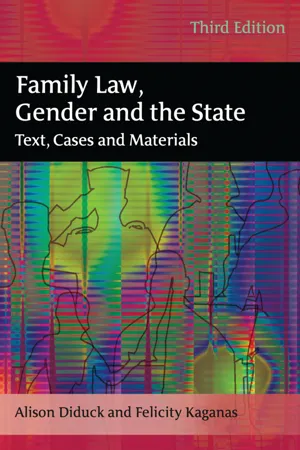
The third edition of this work on family law, comprising text, cases and materials, provides not only an explication of legal principle but also explores, primarily from a feminist perspective, some of the assumptions about, and constructions of, gender, sexual orientation, class and culture that underlie the law. It examines the ideology of the family and, in particular, the role of the law in contributing to and reproducing that ideology. Structured around the themes of equality, welfare, and family privacy, the book aims to offer the benefits of a textbook while also giving students a wide-ranging set of materials for classroom discussion. As well as providing a firm grounding in family law, the text sets the law in its social and historical context and encourages a critical approach by students to the subject. It provides an ideal introduction to family law for undergraduates, but will be equally helpful for postgraduate students of family law for whom it provides a challenging selection of materials set within a theoretical framework rich in ideas and arguments. Review of the second edition: 'Diduck and Kaganas examine legal developments to shed light on society, principally by investigating the ways in which family law constructs and regulates family life and responsibilities. Theirs is an important and ambitious book that aims ultimately at a feminist restatement of family law.....
[T]he [book] is written and referenced in such depth that it is a useful resource for legal as well as social science researchers at all levels, whether looking for theoretical inspiration or drawing up a literature review. The range of diverse sources that Diduck and Kaganas draw on is impressive: they seem to have included every bit of material that helps feminists make sense of family law. There is a well-pitched selection of further reading of such material at the end of each chapter. What's more, they undersell themselves by describing their book as "Text, Cases and Materials", because they have woven by far the largest proportion of the cases and materials into the text.' Helen Reece, Times Higher Education, May 2007. Reviews of first edition:
'A stimulating work which attempts to situate family law in its social, historical and political context. Its appeal should not be confined to family law students, as its commitment to a critical and analytical approach offers insights and ideas with broader significance.'
Mary Childs, Child and Family Law Quarterly, September 2002 'The arguments are provocative, the analysis is stimulating and the materials amassed strongly support the authors' aim to question the "axiomatic status of what is traditionally designated as the family".'
Fiona E Raitt, Infant and Child Development, September 2002 'It is not often that one can say of a textbook in Law that it "makes interesting reading" with quite the enthusiasm that can be expressed for this text. This new publication offers something that few textbooks seem to offer - a book you CAN open up virtually anywhere and find an interesting piece on almost any aspect of the broad family law spectrum.'
Penny Booth, The Law Teacher, September 2002 'All the major themes in feminist and constructionist perspectives in family law are presented together with a wealth of readings and extensive references. As a teaching manual, it is excellent - a coherent feminist perspective across the entire range of family law'
Marty Slaughter, Feminist Legal Studies, July 2003
eBook - ePub
Family Law, Gender and the State
Text, Cases and Materials
- 870 pages
- English
- ePUB (mobile friendly)
- Available on iOS & Android
eBook - ePub
About this book
Information
PART I
FAMILIES AND RELATIONSHIPS
1
Law and ‘The Family’
I. FAMILIES AND SOCIETIES
In the light of recent family law reforms, it may be provocative, if not downright peculiar, to suggest that the idea of the family in English law is dependent for its meaning on the monogamous sexual relationship (either actually or symbolically) between a man and a woman, or to say that much of the law concerning the formation and adjustment of family relationships highlights the importance of this heterosexual union and retains it, at least symbolically, at its core. Yet, despite recent changes to the laws that constitute and give legal meaning to ‘family’, ‘parent’ or ‘spouse’, changes that seem to create alternative bases for family formation, we wish to counsel caution in conceding too quickly the decline of the heterosexual gendered norm in family law. We shall make this case in more detail below, and for now wish simply to make the point, by way of introduction, that despite the variety of connections between people that could make their relationship a familial one, there is a particular type of conjugal unit that remains at the foundation of what law understands to be family.
This legal meaning of family sometimes corresponds with and sometimes contradicts popular or personal meanings of family. If you were asked, for example, to define your family, you might include all those people who live in your household irrespective of whether you are biologically related to them, or you might include some or all biological relatives who live outside your household. Your answer may depend upon the reason for the question. Which members of your family do you think you ought legally to be required to support financially? Which members of your family should be required to support you? Which members of your family provide you with emotional and physical security? For whom would you sacrifice most? It is interesting that when children were asked to identify members of their families they did not refer simply to those who held a formal status in relation to them, but tended to refer to ties of affection as being the essence of family life and they identified love and the quality of the relationship as being crucial to making someone a ‘proper’ parent (Smart, Neale and Wade 2001).
So, can we say then that families are created by affective and emotional ties between people? And if we can say this for some purposes, can we say it for all? What if the idea of the family in English law were dependent for its meaning exclusively upon the existence of a parent–child relationship, or were based solely on the giving of mutual affection and emotional support? On the other hand, what if affection and emotion were irrelevant to creating and sustaining a legal family? What if it were an economic interdependence between two or more people that distinguished families from other groups of people?
US scholar Martha Fineman suggests, from a feminist perspective, that the notion of a family should rest upon a ‘mother–child’ relationship. She is careful to say, however, that men as well as women could perform the ‘mother’ role:
In my newly redefined legal category of family, I would place inevitable dependents [sic] along with their caregivers. The caregiving family would be a protected space, entitled to special, preferred treatment by the state.
The new family line, drawn around dependency, would mark the boundaries of the concept of family privacy. The unit would also have legitimate claims on the resources of society. Specifically, I envision a redistribution or reallocation of social and economic subsidies now given to the natural family that allow it to function ‘independently’ within society. Family and welfare law would be reconceived so as to support caretaking as the family intimacy norm.
(Fineman 1995: 231–32)
I propose Mother/Child as the substitute core of the basic family paradigm. Our laws and policies would be compelled to focus on the needs of this unit. Mother/Child would provide the structural and ideological basis for the transfer of current societal subsidies (both material and ideological) away from the sexual family to nurturing units. (ibid: 233)
Two additional theoretical caveats are necessary. First, I believe that men can and should be Mothers. In fact, if men are interested in acquiring legal rights of access to children (or other dependents) [sic], I argue they must be Mothers in the stereotypical nurturing sense of that term—that is, engaged in caretaking. Second, the Child in my dyad stands for all forms of inevitable dependency—the dependency of the ill, the elderly, the disabled, as well as actual children. (ibid: 234–35)
Mothering should be thought of as an ethical practice, as embodying an ideal of social ‘goodness’. As an idealized notion, motherhood should not be confined to women but be a societal aspiration for all members of the community. (ibid: 235)1
In a later work,2 Fineman argues that a reconceptualisation of family based on the idea of dependency would transform notions about our relationship to the state.
[I]n our political ideology, dependency is considered to be a private matter. It is the family, not the state or the market, that assumes responsibility for both the inevitable dependent [sic]—the child or other biologically or developmentally dependent person—and the derivative dependent [sic]—the caretaker. The institution of the family operates structurally and ideologically to free markets from considering or accommodating dependency. The state is cast as a default institution, providing minimal, grudging and stigmatized assistance should families fail.
(Fineman 2004: 228)
[But] [i]f the existence of a certain type of family is a prerequisite for the coherent development of our concepts of the ‘public’ market and the state, what happens when we are forced to concede that there have been widespread and not easily reversible changes in the way we think about and practice family … ?
What social expectations apply to the relationships among the state, market and man (outside his former category as ‘husband’) or woman (outside her former category as ‘wife’)? How do we begin to decide what is the appropriate set of social relations and expectations to address the child’s claim upon society and its institutions for provision of the goods necessary to meet her or his material, social, and emotional needs? If the family that would have provided the historic answer to this latter question no longer exists, our old reliable background begins to crumble. Further complicating this confrontation is the fact that the family is not isolated in its changes. Transformations in the family were provoked by (and further provoke) changes in other institutions. Therefore, our existing ideology about such matters as the appropriateness of state intervention and regulatory action must also be reconsidered, perhaps shifted, in the context of change. (ibid: 235–36, references omitted)
In the UK, Patricia Morgan (1995) writing from a ‘New Right’ perspective, suggested that a parent–child dyad as the basis of ‘family’ exists already by default, but that the consequences for society are dire. She argues that giving legal recognition as ‘family’ to a single parent and her child contributes to social ills such as juvenile delinquency, unemployment and poverty. The Centre for Social Justice, a Conservative policy centre, agrees:
Politicians and policy makers in Britain have typically shied away from distinguishing between family structures. They have become scared that they may upset someone if they talk of two parent families. Too many hide behind the mantra that it is just about personal choice and that Government has no opinion. Yet it is the government which has to pick up the cost of family breakdown, and not just the direct costs, (£20–24bn) but also the many indirect costs such as increased drug and alcohol abuse, debt, educational underachievement, unemployment and crime.
We reject the notion that policy can or should be wholly neutral. Evidence shows different family structures to have different outcomes, and therefore policy should support that which is in the best interests of society. Committed, in particular married, couple relationships produce the best outcomes for adults and children. Children do best when living with both biological parents. If you have experienced family breakdown as a child you are more likely to experience family breakdown as an adult. (Centre for Social Justice 2010: 8)
Irrespective of one’s political point of view, then, it seems that the idea that the form or organisation of families is integrally related to the shape and organisation of societies is not contentious. Further, this is not a new insight. Frederick Engels wrote many years ago that the rise in dominance of that which we now know as the conjugal or nuclear family was related to the rise of private property and capitalism and the dominance of men over women. Compare his view of this phenomenon, written in 1884, with that of sociologist Talcott Parsons, who makes many of the same points in 1949, although from a very different political perspective.
As regards the legal equality of man and woman in marriage, the position is no better. Their legal inequality, bequeathed to us from earlier social conditions, is not the cause but the effect of the economic oppression of the woman. In the ancient communistic household, which comprised many couples and their children, the task entrusted to the women of managing the household was as much a public, a socially necessary industry as the procuring of food by the men. With the patriarchal family and still more with the single monogamous family, a change came. Household management lost its public character. It no longer concerned society. It became a private service; the wife became the head female servant, excluded from participation in social production. Not until the coming of modern large-scale industry was the road to social production opened to her again—and then only to the proletarian wife. But it was opened in such a manner that, if she carries out her duties in the private service of her family, she remains excluded from public production and unable to earn; and if she wants to take part in public industry and earn independently, she cannot carry out family duties. And the women’s position in the factory is the position of women in all lines of business, right up to medicine and the law. The modern individual family is founded on the open or concealed domestic slavery of women, and modern society is a mass composed of these individual families as its molecules. In the great majority of cases today, at least among the possessing classes, it is the husband who is obliged to earn a living and support his family, and that in itself gives him a position of supremacy without any need for special legal privileges. Within the family he is the bourgeois and the wife represents the proletariat. In the industrial world, however, the specific character of the economic oppression burdening the proletariat is visible in all its sharpness only when all the special legal privileges of the capitalist class have been abolished and the complete legal equality of both classes established … . And in the same way, the peculiar character of the supremacy of the husband over the wife in the modern family, the necessity of creating real social equality between them and the way to do it, will only be seen in the full light of day when both possess complete equality of rights. Then it will be plain that the first condition for the liberation of women is to bring the whole female sex back into public industry, and that this in turn demands the abolition of the monogamous family’s attribute of being the economic unit of society. (Engels 1978: 84–86)
Monogamy arose from the concentration of larger wealth in the hands of a single individual—a man—and from the need to bequeath this wealth to the children of that man and of no other. For this purpose, the monogamy of the woman was required, not that of the man, so this monogamy of the woman did not in any way interfere with open or concealed polygamy on the part of the man … .
… With the transfer of the means of production into common ownership, the monogamous family ceases to be the economic unit of society. Private housekeeping is transformed into a social industry. The care and education of the children becomes a public affair; society looks after all children alike, whether they are born of wedlock or not. (ibid: 87–88)
Talcott Parsons writes:
What a crucially important structural role is played by the marriage relationship—far more so than in most kinship systems—has already been pointed out. As a structurally unsupported relationship resting largely on emotional attraction, it must be protected against the kind of stresses that go with severe competition for prestige between the members. It is well known that segregation of role is in general one of the main mechanisms for inhibiting potentially disruptive competition. The functional importance of the solidarity of the marriage relationship to our kinship system may therefore be presumed to be a major factor underlying the segregation of the sex roles in American society, since sex is the primary basis of role differentiation for marriage partners … .
Structurally the most fundamental aspect of the segregation of the sex roles seems to be with reference to the occupational system. Especially in the structurally crucial middle-class area of our society, the dominant mature feminine role is that of housewife or of wife and mother. Apart from the extremely important utilitarian problems of how adequate care of household and children are to be accomplished, the most important aspect of this fact is that it shields spouses from competition with each other in the occupational sphere, which, along with attractiveness to women, is above all the most important single focus of feelings of self-respect on the part of American men. In this sector of society the largest part of the gainful employment of women is that of unmarried girls and of women living outside normal family relationships. There has been a notable check in the tendency for women to enter the higher occupational careers; for example, the proportion of women in the professions of medicine and law has remained approximately constant f...
Table of contents
- Cover
- Title
- Copyright
- Preface to the Third Edition
- Contents
- Table of Cases
- Table of Legislation
- Part I Families and Relationships
- Part II The Principles And The Law
- Bibliography
- Index
Trusted by 375,005 students
Access to over 1.5 million titles for a fair monthly price.
Study more efficiently using our study tools.
Frequently asked questions
Yes, you can cancel anytime from the Subscription tab in your account settings on the Perlego website. Your subscription will stay active until the end of your current billing period. Learn how to cancel your subscription
No, books cannot be downloaded as external files, such as PDFs, for use outside of Perlego. However, you can download books within the Perlego app for offline reading on mobile or tablet. Learn how to download books offline
Perlego offers two plans: Essential and Complete
- Essential is ideal for learners and professionals who enjoy exploring a wide range of subjects. Access the Essential Library with 800,000+ trusted titles and best-sellers across business, personal growth, and the humanities. Includes unlimited reading time and Standard Read Aloud voice.
- Complete: Perfect for advanced learners and researchers needing full, unrestricted access. Unlock 1.5M+ books across hundreds of subjects, including academic and specialized titles. The Complete Plan also includes advanced features like Premium Read Aloud and Research Assistant.
We are an online textbook subscription service, where you can get access to an entire online library for less than the price of a single book per month. With over 1.5 million books across 990+ topics, we’ve got you covered! Learn about our mission
Look out for the read-aloud symbol on your next book to see if you can listen to it. The read-aloud tool reads text aloud for you, highlighting the text as it is being read. You can pause it, speed it up and slow it down. Learn more about Read Aloud
Yes! You can use the Perlego app on both iOS and Android devices to read anytime, anywhere — even offline. Perfect for commutes or when you’re on the go.
Please note we cannot support devices running on iOS 13 and Android 7 or earlier. Learn more about using the app
Please note we cannot support devices running on iOS 13 and Android 7 or earlier. Learn more about using the app
Yes, you can access Family Law, Gender and the State by Alison Diduck,Felicity Kaganas in PDF and/or ePUB format, as well as other popular books in Law & Family Law. We have over 1.5 million books available in our catalogue for you to explore.