![]()
1 THE KEY PRINCIPLES AND CONCEPTS OF SOCIAL MARKETING
ABOUT THIS CHAPTER
In this chapter we will consider what social marketing is, and how it is increasingly being used around the world by organisations in the public, private and NGO sectors to enhance the effectiveness of programmes designed to improve people’s lives (French and Mayo, 2006).
Nearly every big policy challenge facing governments requires action to change behaviour (Australian Public Service Commission, 2007; Darnton, 2008). For example, obesity, alcohol misuse, infection control, recycling, saving for retirement and crime reduction are all essentially about helping people change to deliver better lives for individuals and at the same time helping society as a whole. At a population level, little progress is being made in many of these fields. Additionally, questions relating to the legitimacy of state intervention, in what can be considered private matters, are often raised (Reeves, 2010). More recently, the need to ensure value for money when investing government spending has also become a live debate (UK COI, 2009a).
As discussed in this chapter, governments and NGOs are becoming increasingly alert to emerging evidence from fields such as social psychology, behavioural economics and neural sciences, all of which are developing new evidence and theories around approaches to social behavioural change. In parallel with these developments, social marketing has, over the last 25 years, been developing a growing body of theory, evidence (Gordon et al., 2006) and experience that is starting to have a profound influence on the delivery of both national and local efforts to promote social good. Social marketing is, Nancy Lee suggested at the world social marketing conference in Brighton in 2008, a ‘best of breed’ approach to developing effective social change programmes that are based on sound evidence, user insight and systematic planning.
WHAT IS SOCIAL MARKETING?
The two words ‘social’ and ‘marketing’ can appear to be antagonistic. ‘Social’ programmes, politics and movements are about making the world a better place; whilst commercial-sector ‘marketing’ is the process of developing value and wealth for people who already possess resources and capital. The potential clash of basic philosophy is clear and raises the fundamental question: ‘is it possible to apply any form of ‘marketing’ thinking when attempting to tackle ‘social’ issues? We believe the answer to this question is ‘yes’. In this chapter, we will review what social marketing is, and how it can enhance attempts to bring about social good. By working through the case studies in this book, we aim to clarify and demystify social marketing, so that the reader can develop a clear understanding of what social marketing is and is not. The reader should also be able to assess whether an intervention, regardless of what it is called, is or is not applying a social marketing approach. This is important not for any dogmatic or ideological reasons but rather because the key social marketing concepts and principles set out in this chapter and explored in this book are based on sound evidence and experience about what works and what does not.
In summary, this chapter provides an overview of key social marketing concepts and principles. These concepts and principles are reflected in the vignettes and case studies within this book. Chapter 2 goes on to describe a social marketing planning framework that embodies these key principles.
DEFINING SOCIAL MARKETING
In 1971 Kotler and Zaltman published social marketing: An approach to planned social change. This paper marked the first time the phrase ‘social marketing’ was used in an academic journal, but in reality social marketing approaches were being applied from the 1960s onwards, in both developing and developed countries.
There have been, and continue to be, a developing range of formal definitions of social marketing. For example:
Social marketing is a programme planning process that promotes the voluntary behaviour of target audiences by offering benefits they want, reducing barriers they are concerned about and using persuasion to motivate their participation in program activity. (Kotler and Roberto, 1989)
Social marketing is the application of commercial marketing technologies to the analysis, planning, execution, and evaluation of programs designed to influence the voluntary behaviours of target audiences in order to improve their personal welfare and that of their society. (Andreasen, 1995)
Social marketing is the use of marketing principles and techniques to influence a target audience to voluntarily accept, reject, modify or abandon behaviour for the benefit of individuals, groups, or society as a whole. (Kotler et al., 2002)
Formal definitions vary across the literature, but three key elements commonly appear in the vast majority of these definitions:
- Social marketing’s primary purpose is to achieve a particular social good (rather than commercial gain) and its primary focus is on achieving specific behavioural objectives.
- It consists of a finite and coherent set of concepts and principles that can be used in policy formulation, strategy development and implementation of social change programmes.
- It is a systematic process that is defined by learning and evaluation.
Social marketing, like any form of social endeavour, is accompanied by a lively and ongoing debate about its theoretical and practical base, and what should or should not be included under the title. However, authors increasingly agree that it has a number of defining principles and concepts and that it is a coherent approach that can be used to shape policy development and delivery in a broad range of public sector arenas.
Social marketing is also widely accepted to be a systematic planning and delivery methodology, drawing on techniques developed in the commercial sector, but also drawing on experience from the public and non-profit sectors about how to achieve and sustain positive behaviours and how to construct, deliver and evaluate effective programmes of action.
By the very nature of its focus – helping to influence behaviour for social good – social marketing needs to be a multi-disciplinary, trans-theoretical field of study and practical endeavour. Social marketing draws on many theories, models, research approaches, feeder disciplines and forms of analysis to build a rich understanding of why people act as they do and how we can help them to either maintain positive behaviours or change their behaviour for their own and society’s benefit. Like commercial-sector marketing, social marketing applies a rigorous and systemic approach to developing, testing, refining and measuring return on investment.
Social marketing is a set of evidence and experience based concepts and principles together with a systematic approach to understanding behaviour and modifying it for social good. It is not a science but rather a form of ‘technik’ (from the German): a fusion of science, practical ‘know-how’ and reflective practice aimed at continuously improving the performance of social programmes. To reflect this assessment of the current state of social marketing theory and practice in this book, we use the functional definition of social marketing developed by French et al. (2010):
Social marketing is the systematic application of marketing alongside other concepts and techniques, to achieve specific behavioural goals for social good.
THE WORDS MATTER LESS THAN THE APPLICATION OF THE PRINCIPLES
If you do an internet search for the term ‘social marketing’ you will quickly discover that it is used to describe a wide range of interventions, but especially social media, social advertising, or media advocacy. There is nothing wrong with any of these forms of intervention but they are not social marketing as we understand the term. In addition there are many forms of social programme, including civic-education programmes, mass-media information campaigns and community-engagement programmes, many of which apply elements of social marketing practice but not the full suite of principles. Again there is nothing wrong with such approaches but it is important to be clear about when a social marketing approach is being applied and when just specific elements of the social marketing approach are being applied to another form of intervention.
It is therefore important to look beyond the terms people use to describe their work, and to get to the substance of what they do and how they do it. The ‘benchmark criteria’ set out in this book act as a checklist to help review whether what you are doing, reading about or hearing about is consistent with social marketing principles or not.
Finally, it needs to be recognised that fully implementing the principles and planning processes of social marketing can represent a big challenge for any individual or organisation. There are few ‘perfect’ social marketing interventions that apply every single principle and systematically work their way through every step of a full planning process. Real issues such as deadlines, the need to spend money and pressures from policy makers, managers and communities often mean that compromises need to be made. This is the reality of developing and implementing social marketing interventions. The vignettes and case studies in this book demonstrate how it is possible to apply many of the principles of social marketing, whilst at the same time managing the real world pressures that every practitioner faces. The point is not to apply social marketing principles set out in this chapter in a mechanical way, but rather to apply them as a reflective practitioner, making judgements about what needs to be done in the particular circumstances that you find yourself in. Being clear about when and how you might need to make a few short cuts or compromises and what you can do to minimise the impact of these on the integrity of the programme is part of what you will gain from reading this book.
SOCIAL MARKETING BENCHMARK CRITERIA
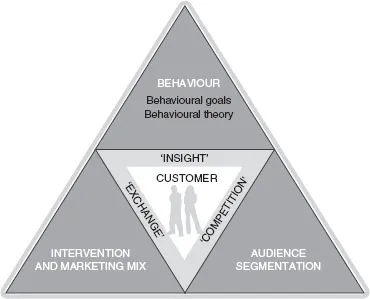
The ‘Customer Triangle’ is a diagrammatic representation of the eight benchmark criteria that are described below (Figure 1.1).
Figure 1.1 The Customer Triangle
Source: French and Blair-Stevens (2005).
These eight ‘benchmarks’ describe the key concepts and principles of social marketing, and include: Customer Orientation, Exchange, Competition Analysis, Insight, Theory, Behavioural Focus, Segmentation and Method Mix.
1 CUSTOMER ORIENTATION
This is about more than just understanding people. It involves ‘seeing things through their eyes’. This means understanding people’s social context, the challenges they face and their coping mechanisms. Adopting a customer orientation perspective requires finding out, through different types of audience research, about the lives, needs, fears, aspirations and concerns of your target audience. This should include direct research with the target audience, observation, collating intelligence from existing data and seeking the views of key people who understand or influence the audience. A key risk to avoid is assuming that we know what people want. The aim is to develop interventions that are informed by what we know will motivate people rather than starting from the premise that people need to understand and then change in line with what experts recommend.
2 BEHAVIOURAL FOCUS
The bottom line for social marketing is about measuring changes in behaviour. However, the focus is not just on ‘changing’ behaviour, but on being able to influence and sustain positive behaviours over time. This means that, in some instances, such as recycling, what we are aiming to do is to encourage people to keep doing a positive behaviour. Social marketing interventions recognise the dynamic and changing nature of behaviour and do not treat it as a simple on/off switch. They recognise that achieving sustaina...