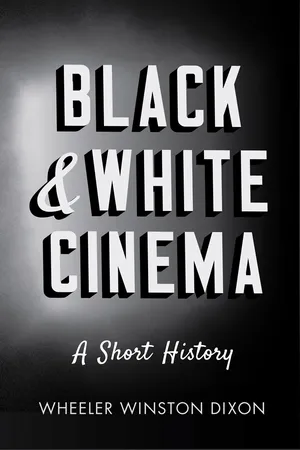
From the glossy monochrome of the classic Hollywood romance, to the gritty greyscale of the gangster picture, to film noir’s moody interplay of light and shadow, black-and-white cinematography has been used to create a remarkably wide array of tones. Yet today, with black-and-white film stock nearly impossible to find, these cinematographic techniques are virtually extinct, and filmgoers’ appreciation of them is similarly waning.
Black and White Cinema is the first study to consider the use of black-and-white as an art form in its own right, providing a comprehensive and global overview of the era when it flourished, from the 1900s to the 1960s. Acclaimed film scholar Wheeler Winston Dixon introduces us to the masters of this art, discussing the signature styles and technical innovations of award-winning cinematographers like James Wong Howe, Gregg Toland, Freddie Francis, and Sven Nykvist. Giving us a unique glimpse behind the scenes, Dixon also reveals the creative teams—from lighting technicians to matte painters—whose work profoundly shaped the look of black-and-white cinema.
More than just a study of film history, this book is a rallying cry, meant to inspire a love for the artistry of black-and-white film, so that we might work to preserve this important part of our cinematic heritage. Lavishly illustrated with more than forty on-the-set stills, Black and White Cinema provides a vivid and illuminating look at a creatively vital era.
- 240 pages
- English
- ePUB (mobile friendly)
- Available on iOS & Android
eBook - ePub
Black and White Cinema
About this book
Information
Subtopic
Film & Video1
Origins
In their first incarnation, the movies were magic. The public had no idea how they worked, and as with any magic show, audiences were happier to be kept in the dark rather than learning the secrets of their construction. The first viewers of the Lumière films, for example, were amazed by the sight of a train rushing toward them (L’Arrivée d’un train en gare de La Ciotat, 1895), a sight they had hitherto seen only in real life, which now appeared as a phantasmal image on the cinema screen. A gardener being watered with his own hose as a prank (L’Arroseur arrosé, 1895), workers leaving the Lumière factory (La Sortie d’Usines Lumière, 1895), a snowball fight against a backdrop of Utrillo trees (Bataille de boules de neige, 1896)—it was all too new, and for the first time removed from actual existence. The audience had no opportunity to interact with the images they viewed; they remained spectators only, spellbound in the dark. Painting and photography had brought viewers the illusion of pictorial verisimilitude, but without movement. Now, the pictures on the screen danced and shimmered, pulsating with artificial existence, somehow taking the audience out of their own corporeal reality and transporting them into a phantom zone of a “realistic” presentation of events taken from life. And thus was the spell of the movies born.

An early Edison filmstrip, photographed by William Kennedy Laurie Dickson
When the ultra-realist painter Paul Delaroche saw one of the first Daguerreotypes in 1839, he famously exclaimed, “From today, painting is dead,” but of course that wasn’t, and isn’t, the case. The impressionists, the surrealists, and others who saw reality and interpreted rather than recorded it, even in idealized fashion, immediately and intuitively sensed the limitations of the photographic image; they sought to move beyond it, to destroy it, to transform it into something else.
In contrast, the first films remained slavishly representative of their subjects; even the fantasy films of Georges Méliès, for example, sought to replicate the real within the realm of fantasy. So as Nancy Mowll Mathews notes, one can see in the American Mutoscope films of life in early New York, such as Madison Square, New York (1903) or Panorama of the Flatiron Building (1902), traces of the work of the realist painter Joseph Oppenheimer, as reflected in his canvas Madison Square (1900), clearly a source of inspiration and pictorial guidance for early filmmakers (“City in Motion” 119).
Cinema pioneer William Kennedy Laurie (aka W.K.L.) Dickson, who began his career working for Thomas Edison and was one of the many inventors of the motion picture camera, eventually split off from Edison to join the American Mutoscope Company. American Mutoscope’s Delivering Newspapers (1899) bears a striking resemblance to George Bellows’s charcoal drawing Election Night, Times Square (completed between 1906 and 1909), with its monochromatic rush of action and streaks of bustling humanity; and Mutoscope’s At the Foot of the Flatiron (1903) is closely related to Everett Shinn’s pastel and watercolor drawing Sixth Avenue Shoppers (Mathews, “City in Motion” 120, 121). An even more direct example of pictorial representationalism can be found in American Mutoscope’s Spirit of ’76 (1905), which duplicates almost exactly the composition, framing, and lighting of Archibald Willard’s painting of the same name from 1891, attempting not only to capitalize on the fame of the painting, but also to “bring it to life” (Mathews, “Art and Film” 154).
And, of course, soon films themselves were examining the exhibition process itself, as with Edwin S. Porter’s famous short film Uncle Josh at the Moving Picture Show (1902), which he both photographed and directed. A country rube tries vainly to interact with the “performers” on the screen; unable to separate illusion from reality, he ducks when a train approaches and later tries to intervene when a young woman’s virtue is threatened, only to discover that all he has managed to do is tear down the theater screen, exposing the projectionist and the cinematographic apparatus behind it—apparently, an early case of motion picture rear projection. As Antonia Lant notes of John Sloan’s depiction of early cinemagoers in his painting Movies, Five Cents (1907), “Film gatherings . . . combined new, peculiar, and contradictory elements. Key among these were assembling in the darkness, sexual and class mixing, mesmerization through lit motion, and a palpable sense of privacy within the mass. . . . As has often been remarked subsequently, film going offered spectators the apparently incompatible combination of public display and private reverie” (162). And indeed, this was clearly the case. One could not only get lost in the crowd, one could also get “lost” in the images, which is one of the primary aims of the spectatorial experience in nearly every case; to take the viewer out of her- or himself, to remove corporeal consciousness and replace it with an identification with an illusory other, whether that image is moving or static, projected on a screen or displayed on an iPad, representational or abstract. Whether or not the pictorial artist or filmmaker intends it—and often, more didactic artists in either discipline will claim this is manifestly not their intent—every imagistic construction implies a viewer, just as it implies, or acknowledges, the existence, past or present, of its creator.
In such films as Georges Méliès’s A Trip to the Moon (1902, d.p. Lucien Tainguy), special effects exploded off the screen in waves of wonder: fantastic rocket ships, rabid moon devils, constellations that became alive with chorus girls, a moon that took a direct hit in the face when the spaceship landed, a suspenseful confrontation with the hostile aliens, and a miraculous escape. In Segundo de Chomón and Ferdinand Zecca’s The Red Spectre (1907, d.p. unknown), hand-tinted in lurid shades of red, a demon appears in a cavern and creates one illusion after another, entirely without narrative, in a naked attempt to dazzle the audience into silence and submission during its brief nine-minute running time.

A scene from Alice Guy’s La Vie du Christ (1906), photographed by Anatole Thiberville
Alice Guy, the marginalized foremother of the cinema, began her career by directing and photographing the charming fantasy La Fée aux choux (1896), and then went on to direct no fewer than 409 films in Europe and then America, including L’Utilité des rayons X (1898), a very early example of fantasy/science fiction; the thirty-three-minute religious spectacle La Vie du Christ (1906, d.p. Anatole Thiberville), which featured extensive use of special effects, a large cast, and lavish sets; and a 1913 adaptation of Edgar Allan Poe’s The Pit and the Pendulum, which terrified audiences with its Gothic brutality. As Gwendolyn Audrey Foster notes,
Like many other silent filmmakers of the era, Guy readily mixes staged studio settings with natural location shooting, a practice which continues to the present day. However, the extreme stylization of Guy’s vision in La vie du Christ effectively creates an alternative universe, in which the protagonists of the film seem enshrined by each of the carefully framed compositions. Indeed, Guy’s film is almost a moving painting, in which the prescient naturalism of the performers seems at times strikingly removed from the constructed settings which dominate most of the production. (“Performativity and Gender” 8)
As to Guy’s compositional technique, Foster remarks:
Although the camera moves little and adheres to the style of proscenium arch directing (popularized in the early twentieth century), the development of multiplaned spaces populated by hundreds of onlookers and participants is impressive. The sets highlight the use of forced perspectives, reminiscent of illuminated Medieval manuscripts. Actions often take place at the borders of the frame to further the sense of extradiegetic space. The shot compositions are often unusually complex and involve staged designs that center around columns, arches, and multiple-level platforms with extraordinarily complex designs. (“Performativity and Gender” 11)
These, of course, are but a few examples—audiences had also seen Edwin S. Porter’s and George S. Fleming’s thrilling “true life” adventure Life of an American Fireman (1903, d.p. Porter) and The Great Train Robbery (1903, d.p. Porter and Blair Smith), both filled with violent action, films that through their pervasive influence almost singlehandedly created a series of genre conventions: the mother and her child saved from the flames in Fireman; the train robbers tracked to doom by an unrelenting posse for their crimes. It was all there on the screen—murders, daring escapes, phantasmagoric transformations, magic, suspense, spectacle, everything to take the viewer out of themselves and transport them into another world.
Black-and-white cinema was especially seductive. It reveled in its artificiality and artifice, even if the primary considerations for most black-and-white films were economic rather than artistic. But as that changed, many filmmakers resisted color, just as Charles Chaplin and Yasujirô Ozu initially resisted sound—black-and-white films had a special magic that the specific insistence of color films could never replicate. As Mark Winokur and Bruce Holsinger note,
In the 1930s and 1940s cost was not the only factor determining which film stock a film project would employ. Hollywood Technicolor tended to be used to make everything pretty, so that the most serious dramas often tended to be black and white: Citizen Kane (1941), The Little Foxes (1941), the entire genre of film noir, and so on. . . . Black and white is never just that: It is also all the gradations of gray in between. And silver. And beiges. . . . White has, if anything, even more variations, and gray is practically infinite. Black and white is the color of glamour cinematography. The most glamorous icons of the screen, those actors who only require last names—Garbo, Bogart, Bacall, Gable, Dietrich—are most famously photographed in black and white. (“Movies and Film: The Aesthetics of Black and White and Color”)
Thus, almost from its inception, the cinema has been torn between the supposedly direct representationalism of color and the transformative power of black and white, switching back and forth as mood and/or circumstance dictated, creating a world of continual contestation. Alice Guy’s hand-colored films, for example, are an attempt not only to break the boundaries of black and white, but also to create an entirely new, hybrid medium—the image in constant pictorial flux. And while the world that these films inhabit is a result of many factors, in the final result it is the director of cinematography who translates this world into images on the screen. Too often, however, their contributions go unnoticed, sometimes out of ignorance, and sometimes—as we’ll see—because the director may claim all the credit, as if no other artists were responsible for a film’s visual presentation. Though few claimed to be or were acknowledged as such, the cinematographers discussed in this volume were all artists, instinctively knowing where light should come from naturally, how it should fall on an actor’s face, how to light for comedy, tragedy, or romance.
These cameramen—and they were all men, in a male-dominated profession that openly discriminated against women, relegating them to the editing room or script supervision positions—created the fundamental grammar of the cinema. (It was not until the 1960s that women, such as Brianne Murphy, would start moving behind the camera within the film industry, but that was during the beginning of the all-color era. In the classical black-and-white period of motion picture history, it’s a sad fact that cinematography was a profession completely dominated by men.)
As Daniel Bruns astutely notes, the world of black-and-white cinematography has its own special rules:
For the best results when lighting for black and white . . . [one should] create dramatic shadows and highlights while still keeping a full range of midtones. This is often best achieved with a strong backlight and keylight. That’s because without color to lead viewers’ eyes in the shot, the only areas that a viewer’s eyes are going to be drawn to will be areas of sharp contrast. . . . The grays are especially important for capturing the proper tone in skin and the gradual depth of objects in your scene. That’s why overcast days are some of the best times to shoot landscapes in black and white. . . . The real trick is to make sure that the image not only includes a healthy gray level, but pure blacks and pure whites as well. Otherwise, your image will simply look washed out. (“Shooting in Black and White”)
But these are just general rules; the image in black and white is always waiting to be “discovered,” as it does not exist in real life. As Günther Rittau, one of the cinematographers on Fritz Lang’s two-part epic Die Nibelungen (1924), noted,
All who are engaged in this task are apprentices of the new “camera-art”—for there is no master. We appeal to the eye by a transient sequence of optical impressions, as the musician appeals to the ear by an acoustic sequence of sounds. The lens is our etching needle. We turn backwards and sweep along the avenues of time; we observe humanity in all its moods—and discover a new physiognomy. We turn slowly, and the flowers bloom. We turn quickly, and there is revealed to us the secret of the bird’s flight. We let the camera swing through space, and observe its dynamics. We create giants and dwarfs, legendary forests, dragons, and knights errant. We lead man over the whole earth and point out to him the grandeur of Nature; and we conduct him through the secret, tiny places of the microscope. (“Camera Art”)
Or as cinematographer Philip Rosen, later a director, wrote in 1922,
A scene may be photographed in such a manner that it has little or no effect on the audience. On the other hand, the same scene, properly filmed, may conjure in the audience practically any mood that the director wishes to effect. . . . To the director, as well as the cinematographer, photography should be what the artist’s colors and materials are to him. . . . Every sequence should have its own writing, that is, every sequence should be designed photographically, according to the impression which is designed to be conveyed. The simplest examples of designing for effect are the uses of light for “happiness” and shade for “sorrow.” (qtd. in Keating 24–25)
Throughout the industry, pioneering cinematographers were figuring out new ways to push the possibilities of the medium, using “cookies” to cast shadow patterns on the sets and the actors, neutral density filters to create a day-for-night effect, and exploring various new film stocks and post-production techniques to make the images suit the subject matter of each individual film. And as the profession began to become regularized, a group of cameramen founded the American Society of Cinematographers (ASC) on January 8, 1919, among them Philip Rosen, Homer Scott, William C. Foster, L. D. Clawson, Charles Rosher, Victor Milner, Joseph August, Arthur Edeson, Fred LeRoy Granville, Devereaux Jennings, Robert S. Newhard, and L. Guy Wilky (Birchard).
Rosen would soon advance to the director’s chair, working for the most part on program pictures. In fact, he was more prolific as a director than as a cinematographer, with only thirty features to his credit as a director of photography (DP) and some 140 films as a director, starting with The Beachcomber in 1915 (d.p. Gus Peterson) and ending with a series of atmospheric thrillers such as The Mystery of Marie Roget (1942, d.p. Elwood Bredell) and The Secret of St. Ives (1949, d.p. Henry Freulich), along with several films in the long-running Charlie Chan series in between. Rosen was an early example of a cinematographer who knew how to efficiently and effectively “cover” a scene with speed and precision and yet deliver either moody, densely shadowed work on his thrillers or more brilliant, sharp images in his comedy work. Rosen also helped to form the Director’s Guild in 1936, and could consistently be relied upon as a person who was sensitive to both the artistic and commercial requirements of the medium (Birchard).
Other forming members of the ASC were less well known. Homer Scott shot his firs...
Table of contents
- Cover
- Title Page
- Copyright
- Dedication
- Epigraphs
- Contents
- List of Illustrations
- Acknowledgments
- Prologue
- 1. Origins
- 2. The 1930s: Escapism and Reality
- 3. The 1940s: A Black-and-White World
- 4. The 1950s: The Age of Anxiety
- 5. The 1960s: Endgame
- Epilogue
- Works Cited
- Index
- About the Author
Trusted by 375,005 students
Access to over 1.5 million titles for a fair monthly price.
Study more efficiently using our study tools.
Frequently asked questions
Yes, you can cancel anytime from the Subscription tab in your account settings on the Perlego website. Your subscription will stay active until the end of your current billing period. Learn how to cancel your subscription
No, books cannot be downloaded as external files, such as PDFs, for use outside of Perlego. However, you can download books within the Perlego app for offline reading on mobile or tablet. Learn how to download books offline
Perlego offers two plans: Essential and Complete
- Essential is ideal for learners and professionals who enjoy exploring a wide range of subjects. Access the Essential Library with 800,000+ trusted titles and best-sellers across business, personal growth, and the humanities. Includes unlimited reading time and Standard Read Aloud voice.
- Complete: Perfect for advanced learners and researchers needing full, unrestricted access. Unlock 1.5M+ books across hundreds of subjects, including academic and specialized titles. The Complete Plan also includes advanced features like Premium Read Aloud and Research Assistant.
We are an online textbook subscription service, where you can get access to an entire online library for less than the price of a single book per month. With over 1.5 million books across 990+ topics, we’ve got you covered! Learn about our mission
Look out for the read-aloud symbol on your next book to see if you can listen to it. The read-aloud tool reads text aloud for you, highlighting the text as it is being read. You can pause it, speed it up and slow it down. Learn more about Read Aloud
Yes! You can use the Perlego app on both iOS and Android devices to read anytime, anywhere — even offline. Perfect for commutes or when you’re on the go.
Please note we cannot support devices running on iOS 13 and Android 7 or earlier. Learn more about using the app
Please note we cannot support devices running on iOS 13 and Android 7 or earlier. Learn more about using the app
Yes, you can access Black and White Cinema by Wheeler Winston Dixon in PDF and/or ePUB format, as well as other popular books in Media & Performing Arts & Film & Video. We have over 1.5 million books available in our catalogue for you to explore.