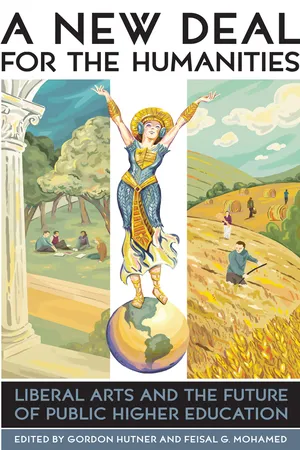
Many in higher education fear that the humanities are facing a crisis. But even if the rhetoric about “crisis” is overblown, humanities departments do face increasing pressure from administrators, politicians, parents, and students. In A New Deal for the Humanities, Gordon Hutner and Feisal G. Mohamed bring together twelve prominent scholars who address the history, the present state, and the future direction of the humanities. These scholars keep the focus on public higher education, for it is in our state schools that the liberal arts are taught to the greatest numbers and where their neglect would be most damaging for the nation.
The contributors offer spirited and thought-provoking debates on a diverse range of topics. For instance, they deplore the push by administrations to narrow learning into quantifiable outcomes as well as the demands of state governments for more practical, usable training. Indeed, for those who suggest that a college education should be “practical”—that it should lean toward the sciences and engineering, where the high-paying jobs are—this book points out that while a few nations produce as many technicians as the United States does, America is still renowned worldwide for its innovation and creativity, skills taught most effectively in the humanities. Most importantly, the essays in this collection examine ways to make the humanities even more effective, such as offering a broader array of options than the traditional major/minor scheme, options that combine a student’s professional and intellectual interests, like the new medical humanities programs.
A democracy can only be as energetic as the minds of its citizens, and the questions fundamental to the humanities are also fundamental to a thoughtful life. A New Deal for the Humanities takes an intrepid step in making the humanities—and our citizens—even stronger in the future.
- 210 pages
- English
- ePUB (mobile friendly)
- Available on iOS & Android
eBook - ePub
A New Deal for the Humanities
About this book
Information
Topic
EducationSubtopic
Educational Policy1
From the Land-Grant Tradition to the Current Crisis in the Humanities
Roger L. Geiger
How important are the humanities for public universities? This chapter is intended to provide some historical perspective on this current issue. It proceeds in three parts. First, the land-grant movement provided a natural experiment. It created almost simultaneously two kinds of institutions, ostensibly having the same purpose: universities that included the liberal arts or what were then called literary studies, and colleges that did not. Second, the experience of those universities that did embrace the liberal arts as they emerged in the twentieth century illuminates the conditions that did or did not facilitate the vitality of the liberal arts. Finally, from this perspective, the chapter will review recent interpretations of the “the crisis in the humanities” and consider prospects for a new deal.
The Land-Grant Movement
As soon as states began to establish land-grant colleges, two divergent interpretations emerged. Daniel Coit Gilman of Yale’s Sheffield Scientific School conducted a survey of the emerging institutions and became the spokesman for the university approach. He proposed that the new institutions be called “our National Schools of Science,” stressing that the gift of federal lands made them a national project, and that they were dedicated above all to “natural science in its applications to human industry.” He objected to the already prevalent term “agricultural colleges,” arguing that “the liberal education of the industrial classes is as much an object of the grant as their practical training.”1
He was arguing against proponents of agricultural colleges, or agricultural and mechanic—A&M—schools. These colleges focused, at least in their rhetoric, on educating farmers to farm. They stressed model farms and compulsory manual labor for students. And they tended to be overtly hostile to the liberal arts—considering them useless for the practical arts and emblematic of the elitist classical education they sought to displace.
Elsewhere, I have characterized these A&Ms as premodern institutions.2 Namely, these institutions operated partially in the educational space between the common schools and degree-granting colleges—what only later became secondary education. Admissions were exceedingly fluid, reflecting the diverse and problematic preparation of students and political pressures for broad access. Their credentials had little value in the labor market. Hence, there was little incentive to complete a full course and graduate, and few students did.
The most effective model for a public university had been shaped by Henry Tappan at the University of Michigan, the largest institution of higher education in the country. This model was developed more fully at Cornell by Andrew Dickson White, who had taught history under Tappan. Devoted to the liberal arts, White structured Cornell in two divisions, one for academic departments and the other for nine applied and professional fields (including history and political science, intended for educating statesmen). Just eight states, including New York, awarded the land grant to institutions that seriously embraced the university model. Rudimentary universities existed in Missouri and Wisconsin; and California, Minnesota, Nebraska, Ohio, and Illinois created new universities inspired more or less by the Michigan/Cornell model. Specifically, they sought to cover all fields of knowledge, including the liberal arts, and they aspired to keep abreast with the advancement of knowledge.
The liberal arts were challenged in all of these universities by Grangers, populist trustees, and legislators who wanted only practical education. But a commitment to university ideals prevailed in the most successful institutions. Illinois Industrial University is a good example. Its first head, Regent John Milton Gregory, upheld the liberal arts—despite the institution’s name—against strong crosscurrents during the turbulent founding years, especially through his hiring of faculty. He sought to raise admission standards in order to secure students ready for higher education. His successor, Selim Peabody, resisted the erosion of liberal arts in the 1880s. He stressed that the growing cohorts of engineering students also needed a liberal education and the liberal arts departments should be preserved. In 1885 it officially became the University of Illinois.3
The next president, Andrew Sloane Draper (1894–1904), was a schoolman who had not attended college and had no appreciation of the liberal arts. He kept salaries low in the College of Literature and Arts, and referred to its faculty as “a set of ‘cheap men.’” But the college was the fastest growing unit in the university, and its dean, David Kinley, tirelessly promoted it. A product of Johns Hopkins and Wisconsin, Kinley did something essential for top universities: he evaluated faculty against the best departments of other research universities and made excellent appointments as the college expanded. The university, however, lagged its peers in library collections, research, and graduate education (awarding its first PhDs in 1903).4
Only in 1904 did the university appoint a president committed to making Illinois a great institution and capable of persuading the trustees of this destiny. Edmund James (1904–1920), a German PhD (Halle) and former head of the University of Pennsylvania Wharton School, believed that academic excellence and public service were mutually reinforcing. He sought excellence in all areas, but particularly the liberal arts. This aspiration was symbolized by his commitment to build a great library, the pride of the university to this day. In 1908 Illinois was invited to join the Association of American Universities (AAU), and in 1910 Edwin Slosson named it one of the fourteen “Great American Universities.”5
And the A&Ms? They were impeded by several factors. Where states supported both a university and an A&M college, resources were divided to the detriment of both. The cultivation of the practical arts was stunted without the presence of basic science. Agricultural science flourished at Cornell, Wisconsin, and California but much less so in the A&Ms. Low admission standards produced a more basic level of instruction, and low graduation rates meant fewer upper-division courses. Graduate education was virtually absent. Probably Iowa State (Iowa Agricultural College) was the most academically advanced of the A&Ms, but it trailed the universities substantially.6
As premodern institutions, the A&Ms had great difficulty adjusting to the two great movements of the age. First was the academic revolution of the late nineteenth century, which transformed the university curriculum into one based on the academic disciplines. Here, universities led in hiring disciplinary specialists, expanding subjects, and fostering research and graduate education. A&Ms were skeptical of academic specialization and preoccupied with teaching basic skills to undergraduates. Second was the standardization movement that became a major preoccupation after 1905, led by the new Carnegie Foundation, which sought to set standards that would define true colleges. Most A&Ms did not require the standard fourteen Carnegie Units for admission; and classifications of institutions put them in the lowest class, their graduates lagging two years behind standard college graduates in preparation for further study.7
The handicaps affecting A&Ms proved long lasting. Most did not award their first PhD until the 1920s, and then most graduate work was science related. None achieved the status of a research university until the 1950s. Today, only five of the old A&Ms belong to the AAU, the first three being admitted in 1958 (Penn State, Michigan State, and Purdue). The correlation is clear, but how did the absence of the liberal arts affect these schools?
Although research universities are most readily measured by science indicators, the academic revolution was spearheaded by philology, history, and economics, broadly construed. More Americans studied humanities and social sciences at German universities than natural sciences. Thus, the original research universities embraced these fields as wissenschaftlich from the outset. These studies operated on a higher intellectual plane for those few institutions able to cultivate them. By neglecting these fields, A&Ms were isolated from a significant body of academic knowledge; more importantly, they were remote from the intellectual sophistication that scholars derived from those fields and the university ideals that accompanied them. Most of the university builders of the era came from the humanities and social sciences—Edmund James, Benjamin Wheeler, William Rainey Harper, A. D. White, James Burrell Angell, Nicholas Murray Butler, Arthur Twining Hadley, George Vincent. Natural-scientist presidents included Charles Eliot, David Starr Jordan, and Charles Van Hise, but applied fields produced none.
Nurturing the Liberal Arts
The vitality of the liberal arts depended not only on their adequate representation in universities, but also on the academic environment in which they existed. After the heroic age of university building, a long period of stability ensued. The fourteen institutions that Slosson called “Great American Universities” in 1910 were still the only real research universities in 1940—by objective measures such as leading scientists, PhDs awarded, and peer ratings. University leadership in this era was not very impressive, particularly for state universities. However, they had internalized a logic of academic advancement, and progress now depended largely on deans and department heads. But these figures often became the academic barons of the era, resisting change in the interest of maintaining their current advantages. Under these conditions, for a number of reasons, the former academic ideals were sometimes compromised. This apparently happened at Illinois.
David Kinley, who practically ran the university during James’s last years, assumed the presidency in 1920 for the remainder of the decade. One can hardly imagine a more suitable choice; he had been a dean since 1894 and had upheld academic values for the College of Literature and Arts and the Graduate School. But some of that baggage compromised his tenure. As an autocratic dean, he had alienated many faculty. He continued to uphold high standards. An economist by training, and an econo-chauvinist in temperament, Kinley was openly contemptuous of some other fields, particularly sociology, psychology, education, and agriculture. During World War I, he was also a willing supporter of 100 percent Americanism, a mentality persisting through the postwar Red Scare and afterward. His conservatism was shared and encouraged by the trustees and the business community, ties with whom he cultivated, but not by many of the faculty.
Kinley engaged in practices that today would be clear violations of academic freedom. He forced a historian with socialist leanings to resign. Since he believed, like many others of that era, that students needed to be protected from radical ideas, he routinely vetted the politics of potential hires. He also held a view of the faculty typical of those times—that a few outstanding scholars were desirable, but that most faculty were essentially teachers. Under his watch, there was a notable exodus of some of the university’s best scholars, particularly in the humanities. One departing professor decried “the intolerance of independent opinion, the suppression of free speech, the everlasting paternalism . . . the failure to give democratic ideals even a hearing.” There was general resentment against the absence of intellectual freedom and excessive, petty regula...
Table of contents
- Cover
- Title Page
- Copyright Page
- Dedication
- Contents
- Acknowledgments
- Introduction
- Chapter 1. From the Land-Grant Tradition to the Current Crisis in the Humanities
- Chapter 2. Old Wine in New Bottles, or New Wine in Old Bottles? The Humanities and Liberal Education in Today’s Universities
- Chapter 3. We Are All Nontraditional Learners Now: Community Colleges, Long-Life Learning, and Problem-Solving Humanities
- Chapter 4. Humanities and Inclusion: A Twenty-First-Century Land-Grant University Tradition
- Chapter 5. Sticking Up for Liberal Arts and Humanities Education: Governance, Leadership, and Fiscal Crisis
- Chapter 6. Speaking the Languages of the Humanities
- Chapter 7. Graduate Training for a Digital and Public Humanities
- Chapter 8. Can the Humanities Save Medicine, and Vice Versa?
- Chapter 9. The Need for Critical University Studies
- Chapter 10. What Are the Humanities For? Rebuilding the Public University
- Afterword
- Notes on Contributors
- Index
Trusted by 375,005 students
Access to over 1.5 million titles for a fair monthly price.
Study more efficiently using our study tools.
Frequently asked questions
Yes, you can cancel anytime from the Subscription tab in your account settings on the Perlego website. Your subscription will stay active until the end of your current billing period. Learn how to cancel your subscription
No, books cannot be downloaded as external files, such as PDFs, for use outside of Perlego. However, you can download books within the Perlego app for offline reading on mobile or tablet. Learn how to download books offline
Perlego offers two plans: Essential and Complete
- Essential is ideal for learners and professionals who enjoy exploring a wide range of subjects. Access the Essential Library with 800,000+ trusted titles and best-sellers across business, personal growth, and the humanities. Includes unlimited reading time and Standard Read Aloud voice.
- Complete: Perfect for advanced learners and researchers needing full, unrestricted access. Unlock 1.5M+ books across hundreds of subjects, including academic and specialized titles. The Complete Plan also includes advanced features like Premium Read Aloud and Research Assistant.
We are an online textbook subscription service, where you can get access to an entire online library for less than the price of a single book per month. With over 1.5 million books across 990+ topics, we’ve got you covered! Learn about our mission
Look out for the read-aloud symbol on your next book to see if you can listen to it. The read-aloud tool reads text aloud for you, highlighting the text as it is being read. You can pause it, speed it up and slow it down. Learn more about Read Aloud
Yes! You can use the Perlego app on both iOS and Android devices to read anytime, anywhere — even offline. Perfect for commutes or when you’re on the go.
Please note we cannot support devices running on iOS 13 and Android 7 or earlier. Learn more about using the app
Please note we cannot support devices running on iOS 13 and Android 7 or earlier. Learn more about using the app
Yes, you can access A New Deal for the Humanities by Gordon Hutner, Feisal G. Mohamed in PDF and/or ePUB format, as well as other popular books in Education & Educational Policy. We have over 1.5 million books available in our catalogue for you to explore.