Over the past decade, as digital media has expanded and print outlets have declined, pundits have bemoaned a “crisis of criticism” and mourned the “death of the critic.” Now that well-paying jobs in film criticism have largely evaporated, while blogs, message boards, and social media have given new meaning to the saying that “everyone’s a critic, ” urgent questions have emerged about the status and purpose of film criticism in the twenty-first century.
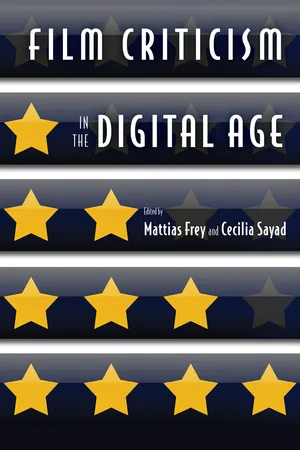
In Film Criticism in the Digital Age, ten scholars from across the globe come together to consider whether we are witnessing the extinction of serious film criticism or seeing the start of its rebirth in a new form. Drawing from a wide variety of case studies and methodological perspectives, the book’s contributors find many signs of the film critic’s declining clout, but they also locate surprising examples of how critics—whether moonlighting bloggers or salaried writers—have been able to intervene in current popular discourse about arts and culture.
In addition to collecting a plethora of scholarly perspectives, Film Criticism in the Digital Age includes statements from key bloggers and print critics, like Armond White and Nick James. Neither an uncritical celebration of digital culture nor a jeremiad against it, this anthology offers a comprehensive look at the challenges and possibilities that the Internet brings to the evaluation, promotion, and explanation of artistic works.
- 284 pages
- English
- ePUB (mobile friendly)
- Available on iOS & Android
eBook - ePub
Film Criticism in the Digital Age
About this book
Information
Subtopic
Art Theory & CriticismPart I
The Critic and the Audience
1
Thumbs in the Crowd
Artists and Audiences in the Postvanguard World
Greg Taylor
I first began recording some of the ideas that eventually led to the book Artists in the Audience on a 512k dual-floppy drive DOS PC in orange type.1 If I recall correctly, the computer and compatible printer cost me close to a thousand dollars in the late 1980s—a considerable sum for what was in fact a glorified word processor and certainly not a research tool. The critics who served as the focus of my study—acerbic B-movie aficionado Manny Farber and psychomythological Hollywood hallucinator Parker Tyler—had to be unearthed through more laborious means, though this was itself an attractive prospect insofar as their importance seemed to me to stem not simply from their apparent formative influence on those who appeared in their wake but also from the subsequent obscuring of this very influence over time. They were cult figures to me—insufficiently known, underacknowledged, and therefore deserving of serious metacritical rehabilitation. Poring through Farber and Tyler’s critical oeuvres thus meant harassing used-bookstore owners and weary interlibrary loan clerks and perusing microfiche and musty bound volumes, which I recall being heavy and also difficult to position correctly on a photocopy machine. But in the end all that effort made these legendary figures seem that much more special, and worthy of rescue from cultural marginality, much like the movies—and unplumbed depths of movies—they had championed in their day.
Some twenty-five years later, dual-floppy DOS PCs exist only as junk—having been rendered even more useless than the manual typewriters they once replaced—and the Internet has turned cultural marginality into an increasingly puzzling concept. At the time of this writing, entering “Manny Farber” (with the quotation marks) into Google nets some 49,000 results, which apparently takes the search engine 0.22 seconds to produce. For “Parker Tyler” the total is 60,200, which, curiously enough, happens 0.09 seconds faster. Does this make Tyler slightly more “popular”—or even more culturally “present”—than Farber? It’s an interesting question. Googling “pink polka dot elephant” (again, with quotation marks intact) nets 105,000 results in 0.21 seconds, which tells us something about Google’s special insight into cultural value. At any rate, however, specialness sure ain’t what it used to be. In this seemingly postvanguard world both Farber and Tyler even have their own Facebook pages, despite the fact that Farber passed away in 2008 and Tyler has been dead for nearly forty years.
What is a “postvanguard” world? It is not a world in which the assumptions and methodologies governing cultist and camp appreciation (as detailed in Artists in the Audience) have become invisible, outdated, or irrelevant, as witness the lasting interest in Farber, Tyler, cult films and directors, obscure cultural objects, and mainstream cultural objects viewed through a skewed, revelatory perspective—but also (and more importantly) the larger zeitgeist of engaged spectatorship and fandom that so dominates our age and drives our all-encompassing celebratory and putatively user-driven interaction with pop culture. It is, rather, an age in which the vanguard perspective’s sheer ubiquity has so colored the very fabric of contemporary Western culture that for all intents and purposes it now is that culture. There’s no escaping it. Since the 1990s and with the dawn of the Internet age, America has gone right through empowered spectatorship and out the other side, emerging into a world where the very notion of cultural obscurity has been rendered problematic, because everyone has access to everything, every thing has personal importance to at least someone, and anyone can (in theory) share the personal importance of any thing or experience with the rest of us. The “death of Cool” doesn’t mean that nothing is cool anymore, but it does mean that the playing field on which the value of cool is determined is so vast and crowded as to render that value highly relative and highly personal (“cool” rather than “Cool,” perhaps), robbed of the validation and authority once granted by a single coherent counterculture that no longer exists as such. Thus, the point is not so much that cultism and camp simply exhausted themselves in their search for new material to reclaim for vanguard rehabilitation—margins still exist, both on the fringes and deep within cultural texts—but rather that the vanguard gesture of reclamation of margins has itself lost most of its potency, insofar as everyone seems to be claiming cultural authority and specialized cultural knowledge at the same time, and both are so readily available. As a result the sense of individual empowerment that once issued from such knowledge—for example, knowledge of vanguard film critics or of the works they championed—has necessarily given way to a deeper if perhaps illusory sense of shared or collective cultural mastery. So while it may be initially disheartening to realize that the obscure song, band, radio station, movie, or critic you treasured and effectively “owned” within your small circle of like-minded friends back in the day has lost its cachet, and that thousands, perhaps millions, of others have in fact shared your rarified knowledge and taste, there is nevertheless a certain comfort in community and in the realization that user-driven cultural engagement is now a way of life.
If the Internet and related social media represent in many ways the ne plus ultra of empowered, creative spectatorship—and thus the ultimate realization of the vanguard project, writ large—the diffusion of vanguard ideals within the public sphere also raises the question, “What next?” What happens after artists fill the audience and after spectators are granted the means, opportunity, and encouragement to assert their active ownership of culture? And more specific for us, what happens to criticism, given the presumably compromised cultural authority of old-time expert tastemakers—and heightened cultural authority of everyone else—within this brave new world? The answer is that following art itself, criticism has now also expanded and exploded in a thoroughly unprecedented manner, to the point where anyone is capable of being a critic, and (more important) what counts as “criticism” in effect encompasses practically any form of articulated spectatorship. Because there are no longer any gatekeepers significantly regulating public expression (the Internet having revolutionized self-publishing) and because the vanguard intervention blew the walls off long-standing assumptions of taste and decorum in criticism, anyone who wishes to state anything about any cultural product now has a forum in which to do so; furthermore, that statement can legitimately range anywhere from fanboy/-girl celebration or reclamation, to a pithy Rotten Tomatoes or Metacritic or 6-Second Moviefone review, to complex audiovisual analysis on a specialty blog. It all counts, and—most important for us here—none of these articulations is “uncritical”—including the expression of fandom—if only because in the postvanguard world the simple gesture of liking something or declaring it special (pace Warhol) is sufficient to confer on it a sense of aesthetic significance, even if (or perhaps especially because) almost no one uses the terms aesthetic or art anymore. It doesn’t matter, because cultural interest and aesthetic significance are now virtually the same thing—or can be, at any rate. When I post an image of an artwork, or an intriguing photo of a sunset, trees, or waves on Facebook or Tumblr, I am in effect making an evaluative claim by expressing that this image is of value and worth sharing, offering it to the world as a reflection of my elevated taste. I can choose to add a short title or caption such as “interesting photo I came across—love the composition,” but my point is that I needn’t do so in order to make a critical gesture. Others—at the very least my friends, I hope—can post their own comments affirming my good taste and expressing their own, and they can then repost the image on their own Tumblr page, if they want. Then others may do the same, and so on. This practice of posting and reposting, asserting and reaffirming, now happens millions of times every hour. And each time it happens, an instance of criticism takes place.
Readers may balk at my looseness with the term criticism here. Surely posting an image is not the same thing as writing a sophisticated review or analytical essay or even a journalistic blurb. And it’s not. But it is an implication of aesthetic assessment, and as such it now meets the minimum requirement for a critical gesture—and thus, for an act of criticism—because vanguard cultism and camp, as they developed in the 1960s and thereafter, eliminated the need for coherent aesthetic criteria when asserting specialized cultist knowledge and liberated camp taste. Coherent aesthetic criteria could get in the way or be counterproductive and, at very least, might drag the spontaneous flamboyance of the countercultural gesture back into the mundane traditionalism of judicious assessment. And, of course, the mundane traditionalism of judicious assessment ran counter to the very spirit of the vanguard enterprise, which initially sought to promote aesthetic renewal through aesthetically aggressive engagements with presumably nonaesthetic material—here, popular movies. That cultist and camp interventions were always fundamentally aesthetic in nature is absolutely essential to our understanding of their form and function. However effaced such underlying aesthetics were in practice—they had to be, in order to make the critic the revealer of aesthetic import—and however taken for granted, buried, and ignored they variously became through subsequent popular dissemination of vanguard approaches, they nonetheless form the backbone of cultism and camp, which could not exist outside of a broadly aesthetic context. My argument in Artists in the Audience was that both Manny Farber and Parker Tyler assumed the validity of their own aesthetic frameworks and ideals as a given. For abstract painter Farber—a product if also harsh critic of the New York School moment—aesthetic vibrancy, vitality, grit, unpretentious rough-hewn action seemed to be appearing more authentically on the margins of American movies than in the mammoth, sleepy, middlebrow canvasses of Jackson Pollock, Robert Motherwell, and Mark Rothko. For poet Tyler—a product of the American surrealist scene—Pollock’s faux-revelatory baked-macaroni canvasses were more beside the point, eclipsed in interest by the true revelations made possible by the poetic, indeed erotic, spectator’s engagement with the movies in his or her midst, which could be reformed by criticism into complex American quasi-surrealist texts.
Like Without Why—Goodness and Badness in an Age of Evaluation
But at least both Farber and Tyler were fully cognizant of their own aesthetic biases, biases that made engaging with popular cinema productive and fun to begin with. For those who have surfaced in their wake, however, things have not necessarily been so obvious, in part because mainstream modernist aesthetics became so thoroughly sullied by the taint of Establishment orthodoxy but also in part because cultist isolation of vital margins and camp appreciation of the hidden riches of just about anything could rely so heavily on sheer force of gesture (the ability to claim that I like what I like, know what I know, see what I see) as to make oppositional spec...
Table of contents
- Title Page
- Copyright Page
- Contents
- Acknowledgments
- Introduction: Critical Questions
- Part I. The Critic and the Audience
- Part II. New Forms and Activities
- Part III. Institutions and the Profession
- Part IV. Critics Speak
- Afterword
- Selected Bibliography
- Notes on Contributors
- Index
Trusted by 375,005 students
Access to over 1.5 million titles for a fair monthly price.
Study more efficiently using our study tools.
Frequently asked questions
Yes, you can cancel anytime from the Subscription tab in your account settings on the Perlego website. Your subscription will stay active until the end of your current billing period. Learn how to cancel your subscription
No, books cannot be downloaded as external files, such as PDFs, for use outside of Perlego. However, you can download books within the Perlego app for offline reading on mobile or tablet. Learn how to download books offline
We are an online textbook subscription service, where you can get access to an entire online library for less than the price of a single book per month. With over 1.5 million books across 990+ topics, we’ve got you covered! Learn about our mission
Look out for the read-aloud symbol on your next book to see if you can listen to it. The read-aloud tool reads text aloud for you, highlighting the text as it is being read. You can pause it, speed it up and slow it down. Learn more about Read Aloud
Yes! You can use the Perlego app on both iOS and Android devices to read anytime, anywhere — even offline. Perfect for commutes or when you’re on the go.
Please note we cannot support devices running on iOS 13 and Android 7 or earlier. Learn more about using the app
Please note we cannot support devices running on iOS 13 and Android 7 or earlier. Learn more about using the app
Yes, you can access Film Criticism in the Digital Age by Mattias Frey, Cecilia Sayad in PDF and/or ePUB format, as well as other popular books in Media & Performing Arts & Art Theory & Criticism. We have over 1.5 million books available in our catalogue for you to explore.