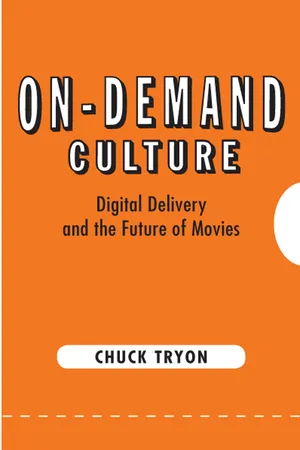
The movie industry is changing rapidly, due in part to the adoption of digital technologies. Distributors now send films to theaters electronically. Consumers can purchase or rent movies instantly online and then watch them on their high-definition televisions, their laptops, or even their cell phones. Meanwhile, social media technologies allow independent filmmakers to raise money and sell their movies directly to the public. All of these changes contribute to an “on-demand culture, ” a shift that is radically altering film culture and contributing to a much more personalized viewing experience.Chuck Tryon offers a compelling introduction to a world in which movies have become digital files. He navigates the complexities of digital delivery to show how new modes of access—online streaming services like YouTube or Netflix, digital downloads at iTunes, the popular Redbox DVD kiosks in grocery stores, and movie theaters offering digital projection of such 3-D movies as Avatar—are redefining how audiences obtain and consume motion picture entertainment. Tryon also tracks the reinvention of independent movies and film festivals by enterprising artists who have built their own fundraising and distribution models online. Unique in its focus on the effects of digital technologies on movie distribution, On-Demand Culture offers a corrective to address the rapid changes in the film industry now that movies are available at the click of a button.
- 272 pages
- English
- ePUB (mobile friendly)
- Available on iOS & Android
eBook - ePub
On-Demand Culture
About this book
Information
1
Coming Soon to a Computer near You
Digital Delivery and Ubiquitous Entertainment
In an interview discussing the closure of all of the Blockbuster Video stores in Canada, Kaan Yigit, president of Solutions Research Group, commented that “this is the Netflix decade for movies. Kids growing up will hardly ever know there was a time you actually went to a store to get a movie.”1 Yigit’s comments underscored the perceived mobility of movies and television shows across a variety of platforms and devices, a shift that seemed to make trips to the video store unnecessary. These changes in film distribution—formerly associated with physical copies of DVDs sold at big-box retailers or rented from local video stores—have altered not only the economics of the movie industry but also the perceived value of movies themselves, creating even deeper interconnections between the movie industry and digital hubs such as Apple, Amazon, Netflix, and Facebook. At the same time, the role of retailers such as Walmart, Target, and Best Buy is changing dramatically. Rather than just selling physical media, Walmart has been making a gradual effort to position itself in the digital marketplace, both through its digital delivery service, Vudu, and its participation in a cloud-based movie storage service, UltraViolet.Yet, even though the electronics and entertainment industries have made significant efforts to promote digital delivery, the persistence of the DVD as a format cannot be underestimated. As of 2011, 92 million homes continued to have at least one DVD or Blu-Ray player, with two-thirds of those homes having more than one. Another 46 million homes had video game consoles that could play DVDs. Finally, digital delivery accounted for only 13 percent of home video spending in 2010, suggesting that physical media remain a preferred way for people to watch movies.2 What has changed is the perceived concept and value of the textual artifact, whether that is a movie or television show. This shift in perspective is shaped by the increased mobility associated with digital delivery and the speed with which texts now circulate (or in some cases fail to circulate) across digital platforms. In this sense, platform mobility alters not only the economics of the film industry but also the practices of consumers seeking a few minutes’ entertainment.
This chapter explores the ways in which digital delivery reworks traditional models of distribution. Any account that seeks to explain these transitions comes up against a number of terminological difficulties. Although it would be tempting to describe digital movie delivery as “post-theatrical,” the use of day-and-date distribution, in which movies are released simultaneously in theaters, on DVD, and through video-on-demand (VOD), complicates any strict distribution timeline. More crucially, the timing and location of distribution is altered, as trips to the video store or movie theater are replaced by a variety of delivery mechanisms that allow users to purchase or rent movies anytime and anywhere, producing new forms of audience mobility. However, even while digital delivery services offer promises of ubiquitous access, there are a number of significant limits that constrain when and where users can watch movies. Thus, while this chapter surveys the variety of formats and distribution patterns that have emerged in the era of digital delivery, I am also conscious of the degree to which new delivery models may not fulfill every promise of access, convenience, and affordability. In addition, I am attentive to the fact that digital delivery is not an entirely new practice. Although it has become more viable thanks to increasingly fast broadband, the widespread acceptance of platform mobility is the result not merely of technological factors but also of cultural changes.
These changes are most commonly associated with a transformed infrastructure, in which the internet has become a site for renting, purchasing, and downloading movies, often for instantaneous viewing. These distribution practices came to include a range of methods—streaming video, digital downloads, electronic sell-through (EST), and VOD—and many services also offered “digital lockers” that would allow customers to store movies in the cloud, so that they would no longer have to worry about losing a physical copy or about seeing an older format sink into obsolescence. These services have been affiliated with a wide range of online retailers, video sharing sites, and social networking hubs, as well as being available as applications through mobile devices such as cell phones and iPads. As a result, users’ modes of access have changed considerably, moving from a relatively stable domestic, post-theatrical distribution system associated with physical media—whether VHS tapes or DVDs—to one that is marked by profound uncertainty and unpredictability. In addition to delivering movies and television shows in a wide range of formats, digital delivery systems also experimented with a number of different pricing models, illustrating even further uncertainty about how users would access entertainment. While movie studios continued to encourage consumers to pay for permanent ownership of a movie or television show—whether on a physical format or in a digital locker—consumers generally opted to pay for temporary access to a movie through rental or subscription services, often known as subscription video-on-demand (SVOD). They were far less likely to purchase DVDs or any other form of physical media. As a result, many distributors, especially television networks, sought to create artificial or temporary forms of scarcity that would increase demand for purchasing media products by making television shows or movies temporarily unavailable.
This chapter looks at a wide range of movie distribution practices, beginning with pay-per-view movies through cable television and some of the early experiments with digital delivery through internet-based services such as DivX and MovieFlix. Although many of these early initiatives failed, they help to illustrate Hollywood’s earliest attempts to reach busy consumers at home, even while the studios sought to retain control over the amount of time users might have to watch a given movie, which might, in turn, help them to control the degree to which those movies might be shared. I then focus on the current digital delivery ecosystem, which continues to be marked by instability and experimentation, especially given that the interests of the studios and the interests of content aggregators, such as Netflix, Amazon, and Hulu, may not be aligned. Thus, rather than a singular “celestial jukebox,” to use Chris Anderson’s formulation, we have a series of discrete streaming megaplexes, which for the most part offer only incomplete access to the full catalog of movie and television titles. At the same time, these industry changes often take place with such rapidity that it is difficult to document them. Thus, this chapter attempts to make sense of some of the key strategies that have been used to transition from physical media such as DVDs to digital delivery systems ranging from streaming video to electronic sell-through. Instead of a single dominant platform, we are witnessing the proliferation of platforms, devices, and strategies, so that the landscape of digital delivery remains far from settled.
These changes can be measured by the flow of traffic online and the debates over bandwidth between cable services such as Comcast and video rental services such as Netflix, which became one of the most significant sources of bandwidth use on the internet. In fact, by March 2011, Netflix was regarded as the largest source of internet traffic in the United States, accounting for 29.7 percent of all peak downstream traffic, while similar sites like BitTorrent and YouTube used 10.4 percent and 11 percent, respectively. Overall, real-time entertainment, which includes both streaming video and streaming music options, constituted nearly half of all downstream traffic, while web surfing accounted for only 17 percent.3 In this sense, digital media provided a persistent form of flexible entertainment.
In discussions of these services, they are frequently described in terms of their ability to break the barriers of geographic tyranny, providing audiences with new forms of access to films they normally wouldn’t see. In a New York Times article on the Independent Film Channel’s (IFC) decision to distribute Hong Kong action director Johnnie To’s Vengeance (2009), for example, the IFC on-demand service is depicted as a means of allowing movie buffs to discover new talents: “a new conduit is opening for Mr. To and other foreign and independent directors who struggle to have their work seen in theaters in the United States outside of urban centers such as New York and Los Angeles.”4 Similarly, the origin story for the streaming movie site and social network Mubi (formerly The Auteurs) emphasizes the inability to access quality movies online legally. Mubi founder Efe Cakarel frequently reports in interviews that he realized the need for Mubi when he was unable to track down a version of Wong Kar-Wai’s In the Mood for Love (2000) to fill the time during a long layover at the Tokyo airport.5 In both cases, films are characterized as increasingly mobile and audiences as becoming more cosmopolitan, seeking access to a wide range of entertainment, often while in transit from one location to another.
At the same time, there is widespread debate within the industry about how much audiences are willing to pay for entertainment. Although Chris Anderson’s concept of the “long tail” is based on the idea of unlimited shelf space and virtually frictionless forms of distribution, it quickly became evident that bandwidth and other costs—including the initial production costs of making a movie or television show—made digital delivery far more complex than it might have initially appeared. In addition, competition over rights often determines what content might be available at a given time, as content producers seek to maximize the value of their movies and television series. Thus, although digital delivery seemed to hold out the promise of unlimited choice, audiences were often confronted with the difficulty of navigating a frequently changing menu of choices as movies and television shows migrate from one platform or service to another.
In one of his characteristically blunt industry analyses, David Poland tracks not only the proliferation of hardware but also the shifting grounds associated with software—the television and movie content that viewers are now encouraged to purchase. As Poland points out, streaming rights can expire at sites such as Netflix, often without warning, making it difficult to keep up with what is available and what isn’t, changes that complicate the anything, anytime, anywhere promises associated with long tail marketing. In fact, these “access problems” inspired the creation of the website Instawatcher to track literally hundreds of Netflix titles that are due to expire.6 The site allows users to search for specific titles and even alerts visitors to some of Netflix’s most popular current titles. The implied point of Instawatcher is that our access to streaming versions of movies may be contingent and temporary rather than permanent. This impermanency leaves Poland to conclude, with a characteristic stab at fantasies of ubiquity: “How much anything/anywhere is enough? When does everyone who is not in puberty get to too much/too many places?”7
Poland’s arguments about the complications associated with digital delivery would only be reinforced in September 2011, when Starz announced that it would no longer provide streaming rights for movies and television shows to Netflix, cutting deeply into its streaming catalog at precisely the moment the service instituted significant price increases for monthly subscriptions. Although Netflix had historically been marketed and discussed in terms of its ability to offer a wide selection of content at a comparatively low price, by September 2011 the company could offer very little streaming content from the major studios, requiring customers to pay for a significantly more expensive DVD-and-streaming subscription if they wanted to see films made by Universal, Fox, Warner Bros., Disney, and Sony, as well as Dreamworks films made after 2010.8 Although Netflix’s access to streaming rights eventually changed, the end of the Starz deal illustrates the degree to which SVOD catalogs are contingent and often somewhat more limited than video stores, especially when it comes to new releases, a situation that often makes it difficult to find legal versions of streaming titles.
Histories of Media Mobility
Although digital delivery has been treated in the entertainment press as a new phenomenon, it is important to consider the longer history of pay-per-view (PPV) entertainment, whether that content was delivered through cable television services or online. As Janet Wasko notes, subscription television services were approved in 1968 by the Federal Communications Commission and began operating in the 1970s, garnering 1.7 million subscribers by 1984. By the mid-1980s, subscribers could watch programs on PPV, permitting them to pay for specific programs, particularly event screenings such as boxing matches, concerts, and Wrestlemania events. This programming proved incredibly lucrative for cable companies, earning them $2.5 billion in 2002 alone. Movie studios made extensive use of PPV, recognizing it as a viable alternative to rentals at a video store because it allowed consumers to access and purchase movies without leaving home. In fact, as Wasko notes, a special PPV screening of Star Wars drew in 1.5 million consumers who paid $8 per television set to watch the movie, although premium events like Wrestlemania could cost as much as $49.99.9 The primary limitation to PPV was that broadcasters would show the movie or television episode at the same time to everyone who ordered it, unscrambling the channel only after the content was purchased and thus making it difficult for viewers to watch at their own convenience, which is what made live events more attractive to cable companies.
One of the most prominent early attempts at digital movie delivery was the use of Digital Video Express (DivX), a studio initiative by which customers would pay US $4 to purchase a DivX title on a disc programmed to be viewable for up to forty-eight hours, approximately the same cost as a rental at a bricks-and-mortar video store. The user could call to pay an additional amount for the right to view the film for two more days. Finally, users could also arrange for an unlimited number of views by paying another fee, creating what Paul McDonald referred to as a “peculiar hybrid of sell-through and rental video models.”10 The service launched in 1998, primarily through the electronics chain Circuit City, with initial tests in Richmond and San Francisco, and within less than a year 87,000 DivX capable players were sold, with approximately 400 titles available through the service.
Like other future services, such as Netflix and Redbox, DivX was marketed as an alternative for movie viewers who did not have time to stop at video stores to return movies. The “expiration date” allowed users to let their right to access a film terminate rather than having to pay for late fees, and they could dispose of used discs after they were done with them rather than returning them to a store. However, the format also introduced a number of other limitations. For example, DivX discs did not contain the extras that were popular with many consumers of DVDs, so that users had only a limited form of interactivity with the disc itself. More crucially, as McDonald points out, the system was essentially “closed.” That is, DivX discs could not be played on standard DVD players, and the hardware costs for DivX players were substantially higher than those for DVD players. Thus, as McDonald concludes, “without the added features or widescreen presentation, DivX actually seemed like DVD only less. DivX offered copyright holders such as the Hollywood majors greater control over video consumption but it was precisely that control which consumers rejected.”11
This conflict over DivX is instructive in that it anticipates more recent experiments in digital delivery. As McDonald notes, the temporary viewing window gave studios far greater control over the circulation of their content, allowing them to circumvent some of the problems they had faced with video piracy and with what he calls “ownership issues caused by the first sale doctrine.”12 Because the “first sale doctrine” entitles people to sell or share physical media, purchasers of books, CDs, and DVDs can resell those texts or loan them to others. Formats such as DivX disrupted that practice by permitting only a single user to watch a movie. Further, given that studios controlled the distribution pipeline, they could easily take films out of circulation. Many of these problems have resurfaced in the era of digital delivery, as customers have begun to use models that allow temporary access—video-on-demand, streaming video—rather than paying for enduring ownership rights, whether through a physical copy or through a “copy” of the film stored in the cloud, although these protections might be circumvented if, for example, college roommates or parents and children were to share passwords for their subscriptions.
Ultimately, these early attempts at marketing the digital delivery of movies and television shows helped to establish many of the practices that are still in place. Wasko documents a number of independent sites that experimented with digital delivery, most notably SightSound Technologies and MovieFlix. SightSound began operating in 1999, and by January 2001 it was offering a limited selection of movies produced by independents, including Miramax, with the company offering downloads of Miramax’s Guinevere for $3.49 for a twenty-four-hour viewing window. However, by 2001 Sig...
Table of contents
- Title Page
- Copyright Page
- Contents
- Acknowledgments
- Introduction: On-Demand Culture
- 1: Coming Soon to a Computer near You: Digital Delivery and Ubiquitous Entertainment
- 2: Restricting and Resistant Mobilities: Negotiating Digital Delivery
- 3: “Make Any Room Your TV Room”: Digital Delivery and Media Mobility
- 4: Breaking through the Screen: 3D, Avatar, and the Future of Moviegoing
- 5: Redbox vs. Red Envelope, or Closing the Window on the Bricks-and-Mortar Video Store
- 6: The Twitter Effect: Social Media and Digital Delivery
- 7: Indie 2.0: Digital Delivery, Crowdsourcing, and Social Media
- 8: Reinventing Festivals: Curation, Distribution, and the Creation of Global Cinephilia
- Conclusion: Digital Futures
- Notes
- Select Bibliography
- About the Author
Trusted by 375,005 students
Access to over 1.5 million titles for a fair monthly price.
Study more efficiently using our study tools.
Frequently asked questions
Yes, you can cancel anytime from the Subscription tab in your account settings on the Perlego website. Your subscription will stay active until the end of your current billing period. Learn how to cancel your subscription
No, books cannot be downloaded as external files, such as PDFs, for use outside of Perlego. However, you can download books within the Perlego app for offline reading on mobile or tablet. Learn how to download books offline
Perlego offers two plans: Essential and Complete
- Essential is ideal for learners and professionals who enjoy exploring a wide range of subjects. Access the Essential Library with 800,000+ trusted titles and best-sellers across business, personal growth, and the humanities. Includes unlimited reading time and Standard Read Aloud voice.
- Complete: Perfect for advanced learners and researchers needing full, unrestricted access. Unlock 1.5M+ books across hundreds of subjects, including academic and specialized titles. The Complete Plan also includes advanced features like Premium Read Aloud and Research Assistant.
We are an online textbook subscription service, where you can get access to an entire online library for less than the price of a single book per month. With over 1.5 million books across 990+ topics, we’ve got you covered! Learn about our mission
Look out for the read-aloud symbol on your next book to see if you can listen to it. The read-aloud tool reads text aloud for you, highlighting the text as it is being read. You can pause it, speed it up and slow it down. Learn more about Read Aloud
Yes! You can use the Perlego app on both iOS and Android devices to read anytime, anywhere — even offline. Perfect for commutes or when you’re on the go.
Please note we cannot support devices running on iOS 13 and Android 7 or earlier. Learn more about using the app
Please note we cannot support devices running on iOS 13 and Android 7 or earlier. Learn more about using the app
Yes, you can access On-Demand Culture by Chuck Tryon in PDF and/or ePUB format, as well as other popular books in Mezzi di comunicazione e arti performative & Film e video. We have over 1.5 million books available in our catalogue for you to explore.