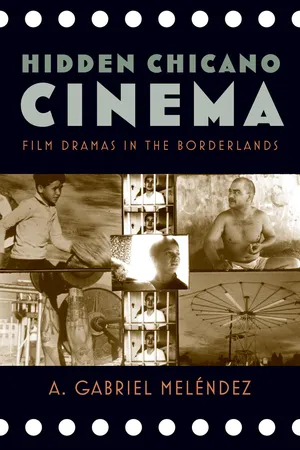
Hidden Chicano Cinema examines how New Mexico, situated within the boundaries of the United States, became a stand-in for the exotic non-western world that tourists, artists, scientists, and others sought to possess at the dawn of early filmmaking, a disposition stretching from the silent era to today as filmmakers screen their fantasies of what they wished the Southwest Borderlands to be.The book highlights “film moments” in this region’s history including the “filmic turn” ushered in by Chicano/a filmmakers who created new ways to represent their community and region. A. Gabriel Meléndez narrates the drama, intrigue, and politics of these moments and accounts for the specific cinematic practices and the sociocultural detail that explains how the camera itself brought filmmakers and their subjects to unexpected encounters on and off the screen. Such films as Adventures in Kit Carson Land, The Rattlesnake, and Red Sky at Morning, among others, provide examples of movies that have both educated and misinformed us about a place that remains a “distant locale” in the mind of most film audiences.
- 288 pages
- English
- ePUB (mobile friendly)
- Available on iOS & Android
eBook - ePub
Hidden Chicano Cinema
About this book
Information
Subtopic
Film & Video1
Borderlands Cinema and the Proxemics of Hidden and Manifest Film Encounters
More than once I have recalled an exchange among graduate students in my seminar “Critical Regionalism: Discourses on the Southwest.” Early one semester students brought forth their ideas regarding the ethnic and cultural make-up of the Southwest. From the discussion that ensued I learned that some newcomers to the region were working from the assumption that the American Southwest was a region populated by whites and American Indians, as in the notion of “playing cowboys and Indians.” Indeed, this view seems to follow what recently has become the strongest projection of the region in the American cultural imagination. Other students held to a different view. One student in particular, a well-read, well-traveled white woman, asserted: “I’ve always thought of Mexicans when I think of the Southwest.” As I came to learn, this student’s view had not been colored by what she had read (she was forthcoming about having enrolled in the seminar to read and study the region’s history and literature) but rather from what she had seen and learned from movies. Until then the idea had never dawned on me that segmented and mutually exclusive images of the Southwest lived in the public imagination. This differentiation of the region by race, ethnicity, and culture challenges the notion of “triculturalism” so often invoked by scholars of the Southwest Borderlands. For some it seems the Southwest is almost always “Indian Country,” a land of desert cliff dwellers and mobile Apaches, a place renowned today for the “Indian Market” held each summer in Santa Fe. For others, the Southwest is a tableau upon which white cowboys yodeling over happy trails are ever threatened by desperados, bandidos, or “bad hombres” and are driven by their heated desire for hacienda maidens or loosely corseted cantina girls.
The discussion with my graduate students, and now this work, circles me back to an early piece of Chicano film scholarship by Carlos Cortes. In “Who Is María? What Is Juan? Dilemmas of Analyzing the Chicano Image in U.S. Feature Films,” Cortes asserts that schools and formal learning are not uniformly synonymous with education (1992, 75). Cortes argues that we are constantly receiving information from a “societal curriculum” (the informal curriculum of family, peers, and the media) that has as much if not more to do with the formation of hegemonic knowledge than do schools and universities: “Movies teach. The celluloid curriculum teaches about myriad topics, including race, ethnicity, culture, and nationality” (1992, 75). Cortes arrives at several considerations that are pertinent to my study. He makes the case that movies provide information about race, ethnicity, culture, and foreignness, they organize information about these very notions, they influence values and attitudes, they help shape expectations of viewers, and they provide models for action (80–85). Equally useful are Cortes’s observations on the role of moviemakers as textbook writers. Cortes notes that the intention and purpose of filmmakers varies widely and, he maintains, there is a tendency in films to employ ethnicity as a social signpost to mark difference and, in the worst of cases, to perform deviance. According to Cortes, some image-makers intentionally set out to create celluloid portraits of ethnic groups while others do so incidentally by inclusion or exclusion, or by adding ethnic traits to their film characters. Cortes divides U.S. feature films with racial and ethnic content into three categories: (1) films that use ethnic images to examine national character; (2) films that attempt to influence societal attitudes toward ethnic groups; and (3) films that simply take advantage of existing audience predispositions about ethnic groups (often ideas fueled by earlier movies) (86–87).
The Proxemics of Mexicans in Front of the Camera
The filming of the Borderlands has been a vast proposition, one that over the decades has involved the crafting of images of Indians, Mexicans, and Anglos, with representatives of each group casting about in a mix of interethnic relationships set against the backdrop of the Southwest as either a mythic landscape or a foreign and wild place. From time to time some representations have been redeemed, though most remain dated fixtures of a multiethic regionalism that has come to be known as triculturalism in New Mexico or, as José Limón (1994) notes, as wars of maneuver and position in South Texas.
In legend, it was none other than Thomas Alva Edison himself who cranked out Indian Day School at the Isleta Pueblo in 1898, the first film shot in the Southwest Borderlands. In reality, it was Edison’s underlings who shot several minutes of footage of Indian children marching around and around the old schoolhouse at Isleta Pueblo. Amazingly, the Edison Company and other pioneering film companies (Biograph, Lubin, Selig Polyscope) were filming the Southwest a mere two years after the first public screenings of the flickers in New York and Paris (“100 Years,” 9), and these companies filmed many subjects. Thus, it can be said that filming the ethnic other is braided into the history of film itself, a process that began much earlier in the border states and can be dated to the arrival of photography in the West.
In this book, I wish to consider the image of Mexicans in U.S. films and photography. I write as a member of a particular social group that in the latter half of the nineteenth century became the object of a neocolonial gaze magnified on celluloid by that handmaiden of modernity: cinema. To the adage “Know thyself” I append the cautionary question: how do film and photographic images reveal, trouble, or otherwise disturb what I or others are able to know about the self or about the people who share a cultural experience distinct from mainstream American society? One thing is clear: once caught in the colonial gaze of early image making, subalterns remain the victims of that past, for, as Cortes reminds us, “Celluloid images go on for decades as television reruns and on videocassette” (Cortes 1992, 88).
My forebears were cast onto film in ways they as subjects could not have imagined when, according to the New Mexico Film Office, “moviemakers fell prey to the intoxicating charms of New Mexico [at] the dawn of film history . . . cranking their cameras at the heart-thumping natural splendors, framing in their viewfinders the dazzling array of exotic native cultures” (“100 Years,” 9). Like other scholars of color, I, too, cannot move away from the nagging sense of dislocation that comes from the kind of encounter described above, nor from the lingering effect of such encounters into the present.
Fatimah Tobing Rony calls the phenomenon of discovering that one’s cultural inheritance has been the object of the filmic gaze an “experience of the third eye.” For Rony the experience of the third eye comes as a momentary realization when one is seated in a darkened movie theater or standing before a certain photograph. These moments are about becoming conscious, sometimes painfully so, that one hails from a cultural community that has been under some kind of quasi-anthropological surveillance and scrutiny for quite some time. Ancestors and forebears, one discovers, have been spied upon for purposes not solely filmic and not solely incidental. It is the sense of having been studied that is particularly disconcerting to members of historically excluded populations; they are forced to confront visual representations which they recognize as themselves but which they also understand are not of their own making. “Most everybody has had this experience of the third eye,” observes Rony. “But for a person of color growing up in the United States, the experience of viewing oneself as an object is profoundly formative” (1996, 4). Expanding on her point, Rony brings forth W.E.B. Du Bois’s concept of “double-consciousness” to suggest that such moments are not only intimate, but powerful ruptures that rend the veil between the object of the filmic gaze and the intention that gets locked into the imagination of the consumer of the image. In Rony’s words:
The experience of the third eye suggests that Dubois’s [sic] insight can be taken one step further—the racially charged glance can also induce one to see the very process which creates the internal splitting, to witness the conditions which give rise to the double consciousness described by Dubois. The veil allows for clarity of vision even as it marks the site of socially mediated self-alienation.
The movie screen is another veil. We turn to the movies to find images of ourselves and find ourselves reflected in the eyes of others. The intended audience for dominant Hollywood cinema was, of course, the “American,” white and middle-class. Not Hopi, Sumatran, or Dahomeyan or even African American, but “American.” (4)
In her book The Third Eye, Rony convincingly demonstrates that “understanding how the ‘native’ is represented in film” requires a broad critical examination of the various “scientific” and popular forms of visual representation that have given form to “ethnographic cinema.” For Rony, “ethnographic cinema” involves “the pervasive racialization of indigenous people in both popular and traditional scientific cinema” (1996, 8). She points out that “ethnographic film, at least in the popular imagination, is still by and large racially defined” (7). Rony calls attention to the ways in which early filmmaking has been complicit in representing the Other as savage, exotic, hypersexual, or quaint, that is, anything but real. I agree with Rony’s assertion that “cinema is not only a technology, it is a social practice with conventions that profoundly shape its forms” (9). Like her, I find it necessary to broadly investigate the whole notion of “ethnographic cinema” and its constituent parts, as Rony suggests, accounting for “the broad and variegated field of cinema which situates indigenous people in a displaced temporal realm” (8). As in other parts of the globe, it is critical to investigate the broad spectrum of film genres and formats that constitute the early film archive of the Southwest. Such an undertaking must properly account for the gamut of film products made about the Borderlands, including scientific research films, educational films, colonial propaganda films, and commercial entertainment films (8). Rony notes that film studies have only recently begun to examine the construction of race in classic Hollywood cinema, and she alerts us to how fundamental to critical scholarship is the need to examine the links between ethnographic representations, popular media, and Hollywood’s penchant for presenting the culture of non-Westerners as entertainment, spectacle, and pseudo-history.
Traveling among the Mexicans and Indians
The Southwest, a region acquired from Mexico in the nineteenth century and inhabited by widely different Native American groups and distinct castes of mexicanos, is perhaps the only part of the United States that was subjected to the visual scrutiny typical of Western imperial penetration in other parts of the world. Much of this scrutiny can be credited to the tribe Eliot Weinberger winsomely labels “the Camera People.” Weinberger’s description is parodic:
There is a tribe, known as the ethnographic film-makers, who believe they are invisible. They enter a room where a feast is being celebrated, or the sick cured, or the dead mourned, and though weighted down with odd machines, entangled with wires, imagine they are unnoticed—or at most, merely glanced at, quickly ignored, later forgotten. Outsiders know little of them, for their homes are hidden in the partially uncharted rainforests of the Documentary. Like other documentarians they survive by hunting and gathering information. Unlike others of their filmic group, most prefer to consume it raw. (qtd. in Grimshaw 2001, 1)
Sardonic wit aside, we are still left with a group of power and relationship brokers who by virtue of accidents of history were exclusively in possession of the technology of photographic reproduction and, no less important, of the means to distribute their products to a consuming public that anxiously awaited them. It was almost always the case that the camera people who entered the Borderlands came with varying degrees of professional standing in the emerging field of visual ethnography. Some were self-directed, start-up impresarios in the burgeoning field of tourist exploration. The film and photography this tribe turned out in its drive toward “scopic possession”—the obsession of Westerners “to prospect the world as tourist-explorers”—follows the logic of imperialist expansionism, a chief goal being the creation of an “entertaining narrative of evolution . . . by juxtaposing the white tourist with the peoples filmed.” For Rony, the juxtaposition of the “enlightened white tourist” exploring the margins of civilization ensured that the dichotomies of “the Native versus the Civilized, the Ethnographic versus the Historical, the Colonized versus the Colonist” would become indelibly inscribed in the West’s apprehension of non-Western peoples (1996, 82).
Ellen Strain calls this drive to possess the margins of the world “touristic viewing.” The tourist gaze along with the dominance of the West at the end of the nineteenth century and its multiple consequences have been amply documented in cultural studies and American studies scholarship.1 Still, what Strain and others have deemed to be the scopic form of an imperial-pursuit travelogue reminds us that the visual objectification of the cultural other in foreign and distant lands for both “scientific research” and “entertainment” was replicated in the U.S.-Mexico Borderlands. It bears noting that for historically specific reasons, New Mexico, even more so than other border states, remained “a distant locale” for most white Americans. While the Southwest was geographically inscribed in the boundaries of the United States in the mid-nineteenth century, for all intents and purposes it remained a region on the periphery of U.S. modernity, a distinct place, vast and removed from the technological developments that could be found in the urban areas of the eastern United States. To most urban Americans, New Mexico and what José Limón calls “Greater Mexico” were as exotic and as dark a place as any that could be found on the world map. Its people, too, the majority mexicanos and American Indians, were viewed as a part of the archive of human variation (Rony 1996, 85) to be photographed, filmed, catalogued, scrutinized, and ultimately possessed by legions of amateur and quasi-scientific adventure-seekers.
Of course, the era of the adventure-tourist sauntering into the Southwest came at the end of a long interval of nefarious military and political conquests over its native inhabitants. Not until several tumultuous decades had passed and reports to the eastern United States signaled that the Borderlands were firmly in the political control of the United States, its inhabitants having been formally detached from the Republic of Mexico, did more ordinary adventure-seekers deem it time to film the people of the region. As if taking a step back in time, a fledgling movie industry seized on the spectacle of conquest and quickly began the work of reifying Manifest Destiny in the American imaginary. War, conquest, and battlefield heroics made good drama, and thus entertainment film gorged itself on the self-justifying logic of American imperialism. Charles Ramírez Berg calls the movie industry of this period “a sort of Monroe Doctrine and Manifest Destiny Illustrated.” “On the whole,” he explains, “Hollywood endorsed North American dominance of the hemisphere, and as often as it depicted the hegemony uncritically, movies helped to perpetuate it” (2002, 4–5). The earliest of these historical film dramas were long on heroics and short on accuracy; in a word, they were partial to the winners.
Nowhere in the history of film is the concept of Manifest Destiny more celebrated than in the popular culture that surrounds the Alamo. In fact, were it not for the emergence of dramatic motion pictures, the now iconic 1836 battle at the mission of San Antonio de Bexar fought at the outset of the Texas War of Independence might be just one among many military confrontations dead and forgotten in the American imaginary. But as Richard Flores astutely notes, “It is the emergence of motion pictures, with their visual texture and iconic density, that best exemplifies the linkage between the Alamo as a historical event and its emerging cultural memory, made real by the project of modernity” (2002, 95). In pointing to an early treatment of the Alamo story, Flores makes this point: “Once the West was firmly established and secure from the threat of outsiders (i.e., after the Mexicans had been defeated at the Alamo), a Utopic elsewhere could be imagined as the material place of future colonizations. Mélies’s Alamo film, then, anticipates and explores his later cinematic motifs where the Mexican Other serves as both a threat to the West and an aggressive savage in need of rule” (2002, 98).
Although a spate of entertainment films on the Alamo were made between 1911 and 1915 (Flores 2002), it is William Christy Cabanne’s Martyrs of the Alamo or the Birth of Texas (1915) that installed the Alamo tropes that would come to be the cornerstones of Texas-U.S. nation building. These tropes would stretch from the famous “line drawn in the sand” to “death before disgrace,” items immediately ascribable to a “heroic” defense of the Alamo by Anglo American frontiersmen. In doing so, Martyrs effectively recasts history into myth and becomes one of the most powerful magnifications of Manifest Destiny set before audiences in 1915.2 Released in major American cities within months of D. W. Griffith’s infamous racist film The Birth of a Nation, Martyrs is a knockoff of Birth that utilizes all the stylistic and narrative conventions pioneered by Griffith (who supervised Cabanne). In the logic of American filmmakers of the silent era, historical drama was fodder for ideological and propagandistic enterprise. History, especially if it dealt with the “vanquished other,” was meant to raise the stock of white Americans, making them out to be the triumphant victors. Martyrs and The Birth of a Nation are so much of a piece that it is now necessary for scholars to examine both films side by side. Rooted in notions of white superiority, they provide evidence that Griffith was an equal opportunity racist whose ideological basis for filmmaking went beyond a black-white binary. His aims, stated or not, were to devalue non-whites and reify white supremacist logic through the power of film.
These historical dramas of conquest and white triumph present the unique circumstance of bringing into view the circumspect qualities of individual or residual encounters with the Other. They emerge as public diatribes on nationhood and nationalism. It is in this sense that they are only minimally about Reconstruction and the Texas War of Independence and resolutely about the fear of ethnic others. This fear was relegated to the past but was called up at the very moment the films were being made. Reminding us that “Martyrs is more concerned with 1915 than with 1836,” Flores assails this apparent paradox by underscoring how the myth of the Alamo is merely an expansion of the nationalistic discourse of the United States:
I contend that in this film we have a series of cinematic projections that mediate local, national, and international concerns. At the local level, the cinematic collapsing of the historical relationship between the United States and Mexico, in which the Battle o...
Table of contents
- Title Page
- Copyright Page
- Contents
- Preface and Acknowledgments
- 1. Borderlands Cinema and the Proxemics of Hidden and Manifest Film Encounters
- 2. Ill Will Hunting (Penitentes)
- 3. A Lie Halfway around the World
- 4. Lives and Faces Plying through Exotica
- 5. Red Sky at Morning, a Borderlands Interlude
- 6. The King Tiger Awakens the Sleeping Giant of the Southwest
- 7. Filming Bernalillo
- 8. Toward a New Proxemics
- Conclusion
- Notes
- Bibliography
- About the Author
Trusted by 375,005 students
Access to over 1.5 million titles for a fair monthly price.
Study more efficiently using our study tools.
Frequently asked questions
Yes, you can cancel anytime from the Subscription tab in your account settings on the Perlego website. Your subscription will stay active until the end of your current billing period. Learn how to cancel your subscription
No, books cannot be downloaded as external files, such as PDFs, for use outside of Perlego. However, you can download books within the Perlego app for offline reading on mobile or tablet. Learn how to download books offline
Perlego offers two plans: Essential and Complete
- Essential is ideal for learners and professionals who enjoy exploring a wide range of subjects. Access the Essential Library with 800,000+ trusted titles and best-sellers across business, personal growth, and the humanities. Includes unlimited reading time and Standard Read Aloud voice.
- Complete: Perfect for advanced learners and researchers needing full, unrestricted access. Unlock 1.5M+ books across hundreds of subjects, including academic and specialized titles. The Complete Plan also includes advanced features like Premium Read Aloud and Research Assistant.
We are an online textbook subscription service, where you can get access to an entire online library for less than the price of a single book per month. With over 1.5 million books across 990+ topics, we’ve got you covered! Learn about our mission
Look out for the read-aloud symbol on your next book to see if you can listen to it. The read-aloud tool reads text aloud for you, highlighting the text as it is being read. You can pause it, speed it up and slow it down. Learn more about Read Aloud
Yes! You can use the Perlego app on both iOS and Android devices to read anytime, anywhere — even offline. Perfect for commutes or when you’re on the go.
Please note we cannot support devices running on iOS 13 and Android 7 or earlier. Learn more about using the app
Please note we cannot support devices running on iOS 13 and Android 7 or earlier. Learn more about using the app
Yes, you can access Hidden Chicano Cinema by A. Gabriel Meléndez in PDF and/or ePUB format, as well as other popular books in Media & Performing Arts & Film & Video. We have over 1.5 million books available in our catalogue for you to explore.