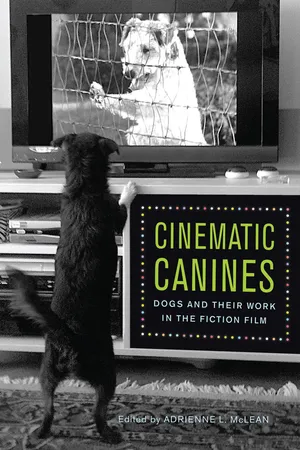
Dogs have been part of motion pictures since the movies began. They have been featured onscreen in various capacities, from any number of “man’s best friends” (Rin Tin Tin, Asta, Toto, Lassie, Benji, Uggie, and many, many more) to the psychotic Cujo. The contributors to Cinematic Canines take a close look at Hollywood films and beyond in order to show that the popularity of dogs on the screen cannot be separated from their increasing presence in our lives over the past century.The representation and visualization of dogs in cinema, as of other animals, has influenced our understanding of what dogs “should” do and be, for us and with us. Adrienne L. McLean expertly shepherds these original essays into a coherent look at “real” dogs in live-action narrative films, from the stars and featured players to the character and supporting actors to those pooches that assumed bit parts or performed as extras. Who were those dogs, how were they trained, what were they made to do, how did they participate as characters in a fictional universe? These are a just a few of the many questions that she and the outstanding group of scholars in this book have addressed.Often dogs are anthropomorphized in movies in ways that enable them to reason, sympathize, understand and even talk; and our shaping of dogs into furry humans has had profound effects on the lives of dogs off the screen. Certain breeds of dog have risen in popularity following their appearance in commercial film, often to the detriment of the dogs themselves, who rarely correspond to their idealized screen versions. In essence, the contributors in Cinematic Canines help us think about and understand the meanings of the many canines that appear in the movies and, in turn, we want to know more about those dogs due in no small part to the power of the movies themselves.
- 264 pages
- English
- ePUB (mobile friendly)
- Available on iOS & Android
eBook - ePub
Cinematic Canines
About this book
Information
Subtopic
Film History & CriticismPart One
Stars and Featured Players
1
Answering a Growl
Roscoe Arbuckle’s Talented Canine Co-star, Luke
Joanna E. Rapf
In June 1916 the fan magazine Photoplay ran a story about actor Jack Pickford’s dog, Prince. The article quotes the dog as saying, “Actor dogs have only one growl coming: they don’t get enough publicity in the magazines—I mean us stars” (42). Prince is right; dogs had played a significant role in film from its beginnings, but compared to their human co-stars, they had not received much publicity. No dog, for example, had yet been featured on the cover of Photoplay or Motion Picture Magazine. Several of the dogs that played a significant role in early cinema—even the strays that often wandered into the frame in documentary-style “actualities,” as well as early fiction films—can be found listed in books and articles about dogs in the movies. But oddly, Luke, comic actor Roscoe “Fatty” Arbuckle’s magnificently trained pit bull terrier (as the American Staffordshire terrier is colloquially known), is rarely mentioned in these treatments of cinematic canine history.1 This may be because of the 1920s scandal involving the death of a movie starlet that ruined Arbuckle’s career, and as his name faded from the pantheon of great silent-era performers, so did Luke’s. Or it may be Luke’s breed; because of its association with fighting and its presumed viciousness, the pit bull even today receives a bad rap. But it might also be due to Luke’s somewhat anomalous status as Arbuckle’s family pet, as well as co-star—ironically, this was likely a significant component of Luke’s fame during an era, the 1910s, in which pet ownership was growing across the United States (see Grier 2006). Probably it is a combination of all of these, and while both Arbuckle and Luke deserve more recognition today, this essay focuses on the remarkable accomplishments of “Fatty’s” four-legged friend and compares Luke’s film work to that of some of his canine contemporaries, especially the better known “Keystone Teddy,” a Great Dane mix.
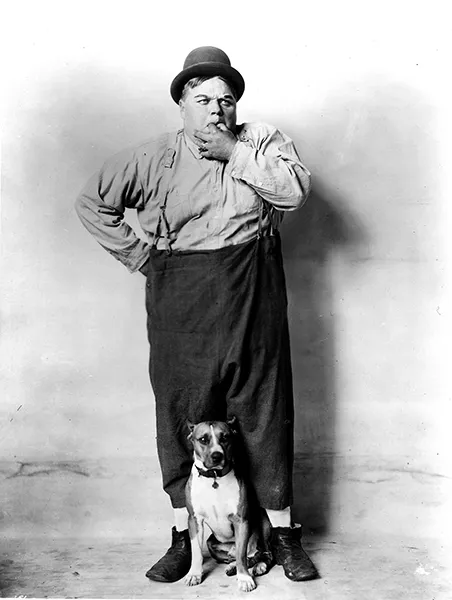
Roscoe Arbuckle and Luke. Collection of the author.
Of the number of dogs that are regularly mentioned in histories of animals in film as featured players during the first two decades of the twentieth century, Blair, a border collie owned by Cecil Hepworth, is usually the first. Blair starred as Rover in Hepworth’s Rescued by Rover (1905), a film Jonathan Burt discusses in some detail in Animals in Film (2002), making the useful observation that in the silent era dogs and humans alike had to communicate through gestures and their bodies and without spoken language. A shared understanding between human and animal is therefore expressed visually and takes place “outside the realm of language” (116). The result is a sense of equality between human and animal that does not exist in sound film, where humans have the superior power of words. Conceptually, silent films allowed animals, perhaps especially dogs, to interact with people in ways that made them seem quite human.
Blair’s first appearance in a film had actually been in Alice in Wonderland (1903), where he was simply a large, unnamed dog; but he went on to play Rover (which, as a result of his popularity, soon became a favorite dog’s name) in two more shorts, Rover Takes a Call (1905) and The Dog Outwits the Kidnapper (1908), in the latter of which Hepworth’s daughter, Barbara, played the child. Then there was Jean, known as “the Vitagraph Dog,” a border collie owned by Laurence Trimble, an aspiring writer and actor who happened to be on the set of the Vitagraph Studios in Brooklyn in 1908 when the director (who may well have been Edwin S. Porter) was looking for a dog to play in a scene with Florence Turner, known as “the Vitagraph Girl.” Both the dog and Trimble stayed on at Vitagraph, and by 1912 Trimble was writing for and acting with John Bunny. Trimble’s first directing credit was Saved by the Flag (1910), with Ralph Ince (IMDb.com), but what he is best known for are the sixteen to eighteen films he made for Vitagraph with his dog, Jean.
Jean’s first starring short seems to have been Jean and the Calico Doll, with ten-year-old Helen Hayes, released in August 1910. In an article in the New York Times (March 15, 1931, “Miss Hayes and Films: Her First Appearance”), Hayes says she played the juvenile lead “in two pictures in support of Jean, the collie. Jean was the famous dog of the day, and I was very thrilled,” but other sources list only one film (see IMDb.com). Often credited as the first canine movie star, Jean died in 1916. Trimble and Vitagraph then tried another dog, Shep, but he was nowhere near as successful as Jean. After World War I Trimble traveled to Germany where he found a military dog, a German Shepherd, who eventually became “Strongheart,” a canine star discussed in the next essay in this volume.
The Intelligent Big Barker
Probably the best-known dog star in these early years was Keystone Teddy (also known as “Teddy the Wonder Dog”), sometimes called “the first canine superstar of the American cinema” (Hopwood n.d.). The large brindled dog was featured in at least eighteen shorts at Mack Sennett’s studio and was paid an impressive $350 a week during his heyday. Teddy is briefly mentioned in Photoplay (November 1914, 93) as having chewed the legs off of a doll owned by child star Clara Horton, but it took a while for his star potential to be recognized. This came about in 1916 with the western short A Man’s Friend. His next film, The Nick of Time Baby, starring Bobby Vernon and Gloria Swanson, was released in December 1916. In it, Teddy rescues a kidnapped baby and reunites him with his parents. The ending, like the ending of Teddy’s most famous film, Teddy at the Throttle (1917), shows Gloria, Bobby, and Teddy in a familial embrace. Rob King (2009) has suggested that The Nick of Time Baby was illustrative of Keystone’s efforts to widen its generic appeal beyond slapstick or “knockabout” comedy and attract a family audience in addition to its established fan base of working-class men. The dog—responsive, welcoming, heroic, an embodiment of unconditional love and loyalty—was a natural vehicle for broadening the audience for Keystone films. King even suggests that Teddy was a “loaded symbol of the films’ sentimentalism . . . as a substitute for the child that a grown-up sexual coupling might create, a cipher through which the narratives withhold the sexual meanings of the young lovers’ romance” (173). A dog functioning as a child substitute in these early films prefigures the use of dogs in screwball comedy in the 1930s, when, during the era in which the Production Code regulated the content of Hollywood’s motion pictures, the visual depiction of sex was verboten and dogs became surrogate children, the most famous, of course, being Asta in the Thin Man series (see Ross and Castonguay in this volume). The dog as surrogate child may well apply to Teddy, but it is even more applicable to Luke, both in film and as the Arbuckle family pet in a family that included no children. That Keystone used these dogs to attract women and children moviegoers is obvious in this brief piece about The Nick of Time Baby in the Mack Sennett Weekly (January 1, 1917, 3): “This comedy will have a strong appeal for the whole family. . . . One of the star performers is a magnificent Great Dane dog—‘Teddy’—who is all but human. The women and children as well as ‘Pa’ will shriek with delight to see ‘Teddy’ rescuing a baby from a watery grave; taking him home in his great jaws as tenderly as a mother could carry him in her arms.”
In a May 1917 Photoplay story, Julian Johnson similarly puts the emphasis on Teddy, suggesting that Sennett’s standard melodramatic formula isn’t very funny until the end, when Teddy comes to the rescue: “Gloria Swanson is the prettiness, but Teddy, a big barker so intelligent that only Shep, ‘the dead Thanhouseran we never cease to mourn,’ is a fit comparison—Teddy is the temperament and action of this play. So far, Teddy has not organized his own company nor paid himself a $10,000 salary, but we presume these will be the next steps in the annals of this young genius” (86).
Jean’s temporary replacement, Shep, is mentioned in passing, but Teddy is clearly the emerging star. His next film for Sennett, The Road Agent, was released in February 1917, but it is for Teddy at the Throttle that he is remembered today, perhaps just because it, unlike many of Teddy’s films that are lost or not available in consumer viewing formats, can easily be seen today.2 Actually, he only appears at the beginning and then again at the end; in between is a convoluted story of love and greed involving Gloria Swanson and Bobby Vernon (again), and villain Wallace Beery. Teddy is introduced as “Gloria’s” pet (stars often played characters with their own names in these films); they dance together, sing together, and are clearly bonded.3 Then he drops out of the story until Gloria, chained to railroad tracks by villain Beery, has to be rescued in Sennett’s favorite melodramatic fashion. She gets out her dog whistle, and Teddy comes to the rescue, jumping out a window, dropping several stories to the ground, running over hills, fording a river, finding Gloria, and then taking a distress message to Bobby.
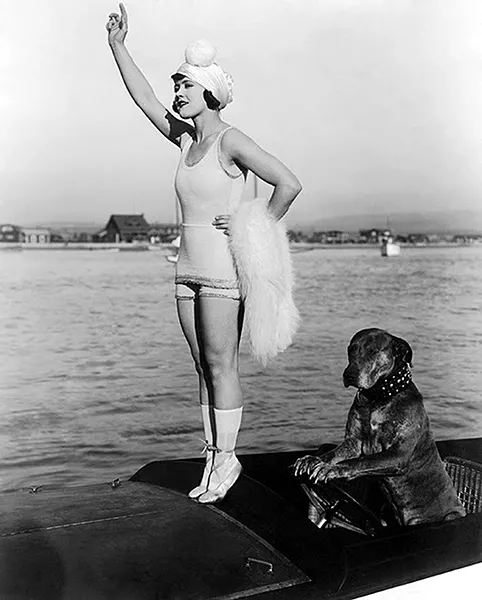
Gloria Swanson and Teddy the Wonder Dog in a publicity still for Teddy at the Throttle (Clarence G. Badger, Keystone, April 1917). Collection of Adrienne L. McLean.
Besides being a classic last-minute rescue, the final scenes of Teddy at the Throttle are in fact very much like rescues Luke had already done in Arbuckle films. For example, at one point on the Sennett cyclorama (a sort of treadmill in front of a moving backdrop), Bobby Vernon, on a bicycle, grabs Teddy’s tail in order to be pulled along faster. This seems to be a clear repetition of an earlier scene in Fatty’s Plucky Pup (1915), in which Arbuckle on a bicycle and Luke on his four legs are racing to save a girl; although Arbuckle doesn’t grab Luke’s tail (it was shorter than Teddy’s), in both cases it is the dogs rather than the men who are the heroes. Teddy saves the day by leaping into the cab of the locomotive and barking enough to warn the engineers of a problem ahead. The dog does not actually pull the throttle, but he gets the engineers to do it just as the train cuts the chains binding Gloria to the tracks. The happy ending, like the ending of The Nick of Time Baby—but also Fatty’s Plucky Pup and Fatty and Mabel Adrift (January 1916)—shows three loving heads, a family together: boy, girl, and dog. A slight variation on the familial portrait is that in Teddy at the Throttle Teddy is pushed to the side so that Bobby and Gloria can kiss—but his head reappears through the space between their clasping bodies. In some of Arbuckle’s films it is actually Luke who receives the kiss.
Teddy at the Throttle was such a hit that Harry C. Carr presumably interviewed Teddy for the July 1917 issue of Photoplay (“An Interview in Great Danish: Teddy, the Keystone Dog Graciously Grants an Audience”). Apparently unaware of the lively and talented Luke, Carr wrote that Teddy, among motion picture dogs, was “the only one I ever saw who wasn’t a poor, cowering, spiritless, terrorized imitation of an animal.” According to Carr, tongue-in-cheek, “motion picture animals fill a sad destiny: most of them are the support of a lot of lazy bums.” For the interview Teddy responded to Carr’s questions in “Great Danish,” and, translated, his answers were as follows:
I am two years old, and I am from a distinguished family of noble antecedents, although I have a hazy idea that my father and mother were divorced, as I never remember seeing the old man. They began training me when I was a few weeks old. The first thing they taught me was to lie down; the second, to keep out of fights. I was given the latter lesson by having an ammonia gun shot off under my nose while engaged in a rough and tumble scrap. Since then they have taught me about things a dog can learn to do. (26)
Since Teddy chewed Clara Horton’s doll in 1914, he was obviously a little older than two at the time of this “interview,” but he was now a featured player on the Sennett lot and was lent out to Mary Pickford for Stella Maris in 1918 and ended his acting career with Mabel Normand in The Extra Girl in 1923, although he has a brief appearance with another canine performer named Cameo (also sometimes called “Cameo the Wonder Dog,” who made some dozen films, often uncredited, through the early 1930s) in The Hollywood Kid (1924).
A Contract for Life
Coincidentally, 1914, Teddy’s first year with Keystone, was also the year Luke entered Roscoe Arbuckle’s life. There are conflicting stories about how this happened. A lively but no doubt inaccurate studio publicity story in 1917, connected with that year’s release of The Butcher Boy, in which Luke has a significant role, relates that the dog, initially named “Lonesome Luke” because “he was so forlorn,” appeared in Arbuckle’s dressing room as “a wouf-wouf waif”; and after the comedian was unable to locate the owner, the two “adopted each other” (Charles E. Meyer, “Fatty Arbuckle and His Dog Luke Bosom Friends and Fellow Artists, Wherein Is Related the History and Achievements of the World’s Greatest Canine Actor,” Paramount Publicity Release, April 1917, ACF-BRTD).4 Luke tells his own story in Photoplay (November 1918, 63) in “Speaking for Himself,” a tongue-in-cheek parody of the familiar Hollywood success story, arriving in Tinseltown already a full-fledged star after signing a “contract for life” with Roscoe Arbuckle:
But when I stepped out on the platform of my private baggage car, upon my arrival on the West Coast, and saw assembled to greet me a representative group of the film colony’s dog-stars, I knew I’d come home.
A Spitz made a nice little speech and presented a silver-spiked collar as a token of esteem. . . .
On our way to the studio, Fatty put this thing right up to me.
“Luke,” he said gravely! “We need you old man. Sign this contract, for $50,000 a week.”
A less far-fetched account—and probably the accurate one—is that he was a gift to Minta Durfee, Arbuckle’s wife, as a six-week-old puppy, born in December 1913, from D. W. Griffith’s assistant director Wilfred Lucas, after whom he was named (Oderman 1994, 70). Andy Edmonds (1991) suggests that Luke was actually a “bribe” to Minta to perform a difficult stunt (82). Regardless of how he joined the Arbuckle family, Luke’s first screen appearance may be at the beginning of The Knockout (released in June 1914), an early short in which Arbuckle shares screen time with Charlie Chaplin during a boxing match that prefigures Chaplin’s own eloquent choreography during a similar match in City Lights (1931). Luke does not play a part in the narrative of this film. He appears only briefly at the very beginning, as Arbuckle emerges from a shop, sandwich in one hand and Luke in the other. He shares the sandwich with Luke but then spots Minta and tosses the food aside to go see her. The scene that follows is touching because we see a moment among the three of them onscreen that must reflect the affection they had for each other in real life. As Roscoe holds Luke, both he and Minta lovingly pat the dog’s paw but end up in the process patting each other’s hands. As his full attention turns to Minta, Roscoe tosses Luke behind him, and he does not reappear in the film. The opening is merely a cameo, introducing a dog who will play bigger and bigger roles as he learns the tricks of the trade.
The evolution of the roles Luke played in e...
Table of contents
- Title Page
- Copyright Page
- Dedication
- Contents
- Acknowledgments
- Introduction: Wonder Dogs
- Part One. Stars and Featured Players
- Part Two. Character and Supporting Actors
- Part Three. Stock, Bits, and Extras
- Afterword: Dogs at the Digital Divide
- Works Cited
- Notes on Contributors
- Index
Trusted by 375,005 students
Access to over 1.5 million titles for a fair monthly price.
Study more efficiently using our study tools.
Frequently asked questions
Yes, you can cancel anytime from the Subscription tab in your account settings on the Perlego website. Your subscription will stay active until the end of your current billing period. Learn how to cancel your subscription
No, books cannot be downloaded as external files, such as PDFs, for use outside of Perlego. However, you can download books within the Perlego app for offline reading on mobile or tablet. Learn how to download books offline
Perlego offers two plans: Essential and Complete
- Essential is ideal for learners and professionals who enjoy exploring a wide range of subjects. Access the Essential Library with 800,000+ trusted titles and best-sellers across business, personal growth, and the humanities. Includes unlimited reading time and Standard Read Aloud voice.
- Complete: Perfect for advanced learners and researchers needing full, unrestricted access. Unlock 1.5M+ books across hundreds of subjects, including academic and specialized titles. The Complete Plan also includes advanced features like Premium Read Aloud and Research Assistant.
We are an online textbook subscription service, where you can get access to an entire online library for less than the price of a single book per month. With over 1.5 million books across 990+ topics, we’ve got you covered! Learn about our mission
Look out for the read-aloud symbol on your next book to see if you can listen to it. The read-aloud tool reads text aloud for you, highlighting the text as it is being read. You can pause it, speed it up and slow it down. Learn more about Read Aloud
Yes! You can use the Perlego app on both iOS and Android devices to read anytime, anywhere — even offline. Perfect for commutes or when you’re on the go.
Please note we cannot support devices running on iOS 13 and Android 7 or earlier. Learn more about using the app
Please note we cannot support devices running on iOS 13 and Android 7 or earlier. Learn more about using the app
Yes, you can access Cinematic Canines by Adrienne L. McLean in PDF and/or ePUB format, as well as other popular books in Media & Performing Arts & Film History & Criticism. We have over 1.5 million books available in our catalogue for you to explore.