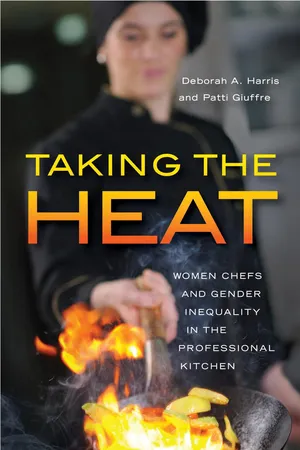
A number of recent books, magazines, and television programs have emerged that promise to take viewers inside the exciting world of professional chefs. While media suggest that the occupation is undergoing a transformation, one thing remains clear: being a chef is a decidedly male-dominated job. Over the past six years, the prestigious James Beard Foundation has presented 84 awards for excellence as a chef, but only 19 were given to women. Likewise, Food and Wine magazine has recognized the talent of 110 chefs on its annual “Best New Chef” list since 2000, and to date, only 16 women have been included. How is it that women—the gender most associated with cooking—have lagged behind men in this occupation? Taking the Heat examines how the world of professional chefs is gendered, what conditions have led to this gender segregation, and how women chefs feel about their work in relation to men. Tracing the historical evolution of the profession and analyzing over two thousand examples of chef profiles and restaurant reviews, as well as in-depth interviews with thirty-three women chefs, Deborah A. Harris and Patti Giuffre reveal a great irony between the present realities of the culinary profession and the traditional, cultural associations of cooking and gender. Since occupations filled with women are often culturally and economically devalued, male members exclude women to enhance the job’s legitimacy. For women chefs, these professional obstacles and other challenges, such as how to balance work and family, ultimately push some of the women out of the career. Although female chefs may be outsiders in many professional kitchens, the participants in Taking the Heat recount advantages that women chefs offer their workplaces and strengths that Harris and Giuffre argue can help offer women chefs—and women in other male-dominated occupations—opportunities for greater representation within their fields. Click here to access the Taking the Heat teaching guide (http://rutgerspress.rutgers.edu/pages/teaching_guide_for_taking_the_heat.aspx).
- 246 pages
- English
- ePUB (mobile friendly)
- Available on iOS & Android
eBook - ePub
Taking the Heat
About this book
Information
1 • Home versus Haute
Gender and Status in the Evolution of Professional Chefs
In 2013, the ABC television network debuted its new competitive cooking program The Taste. The competition featured a variety of amateur and professional cooks whose dishes were blind taste-tested by four judges, chefs Anthony Bourdain, Ludo Lefebvre, and Brian Malarkey and cookbook author/cooking show host Nigella Lawson. The Taste promised to truly democratize cooking contests. No longer would the winner be predetermined by who had the most years of experience working as a chef or who had won the most professional accolades. On this cooking show, the winner would be decided solely by—as the name of the program promised—the taste of the cook’s dish. To this end, the show began with contestant hopefuls preparing a small tasting portion of their signature dish, which was then served to the four judges who ate each bite without seeing who had prepared it. Contestants ranged from stay-at-home moms to professional chefs, and the show emphasized how this blind taste-testing would level the playing field to allow home cooks to compete with professionals.
However, as the first episode of The Taste progressed, a pattern emerged. After tasting each dish, the judges would discuss their responses to what they just ate. Several times this talk would turn to whether or not something about the dish served as a “tell,” or marker, that the food was prepared by either a professional (meaning a chef or someone employed in the culinary field) or an amateur. Presentation styles, perceived sophistication of the ingredients, and the skillfulness of the technique used to prepare the food were all cited by the judges as ways to differentiate types of contestants. Often the origins of a particularly good dish were discussed with a knowing smile that “of course” this dish was the work of a professional. At the end of the discussion, the cook would be revealed to the judges.
The judges’ commentary helps illustrate the long-held division between home cooking done by nonprofessionals and the food produced by those within the culinary industry. Their discussion was based on the underlying assumption that professional cooking experience would undoubtedly be represented in the dishes of chefs and this food would be superior to the efforts of those who cook at home. While such responses could seem antithetical to the purpose of the show, which was to democratize cooking competitions, they highlight an enduring hierarchy in which cooking performed at home is seen as less than the cooking carried out by professionals.
Much of this hierarchy derives from the fact that chefs have traveled a long road to arrive at the professional status they receive today. For much of their history, chefs have been seen as a form of blue-collar manual labor. It has been quite the journey from the “chef as servant” mentality to the idea of “chefs as the new rock stars,” complete with television shows, lucrative product lines, and international restaurant empires. Michael Symons notes how, historically, “Cooks have been publicly ignored, privately humiliated, ordered to eat last, and not paid any income” (2000, 173). Only in the last few decades have we seen the mass movement of chefs into the public consciousness.
While there can be many factors influencing this transition in the status of professional chefs, we are using this chapter to discuss the gendered history of the occupation. We wanted to know how the occupation of professional chef became identified as men’s work. As no jobs are intrinsically “men’s” or “women’s” work, we have to examine how certain occupations became coded as masculine or feminine pursuits. Part of this answer can be found in the origins of professional chefs and how the concepts of feminization threat and precarious masculinity were major influences during the establishment of the occupation. The exclusion of women was integral in raising the status of the occupation. By performing this boundary work, men chefs were able to control access to resources and opportunities and aid in the overall professionalization of chefs (Lamont and Molnar 2002).
This chapter begins with a discussion of the public and private divides in men and women’s cooking. Then we skip ahead to the establishment of the first professional chefs in France during the 1700s and changes to French cuisine during the nouvelle cuisine movement of the 1960s and 1970s. We then describe the development of the American gastronomic field during the twentieth century, and we document the rise of celebrity chefs in American culture and what this has meant for women’s place in professional kitchens. Throughout our discussion we highlight ways in which women were formally excluded from the gastronomic field and, more recently, how women’s participation and influence has been marginalized and downplayed. Our main purpose is to illustrate how the exclusion of women and the maligning of women’s cooking has been an integral part of the establishment of professional chef as an occupation, particularly in its journey toward becoming a high-status pursuit. This information sets the stage for the current gender relations in professional cooking and provides context for the entrenchment of men’s continued dominance of the chef occupation.
GENDER, COOKING, AND SEPARATE SPHERES
Gender and cooking have been intricately linked for much of human history. This has usually taken the form of women’s cooking being associated with routine maternal care work that nourishes family members. In contrast, men’s cooking has long been viewed as more high status and important. Some of the first men to cook publicly were men working for ancient Egyptian royalty (Swinbank 2002). This form of cooking was professionalized via the priest class, who engaged in animal sacrifices to their gods involving the preparation and cooking of meat. These priests were able to link their food handling and preparation to the divine and garner powerful positions in society. Therefore, their cooking was given special status and was elevated above the ordinary, everyday cooking of women (Pollan 2013).
This example illustrates how part of the different statuses afforded to men and women’s cooking can be traced back to the public or private nature of cooking. This was particularly true following the spread of industrialization during the late 1700s to early 1800s, and the rise in what came to be known as the “separate spheres” for men and women (Crittenden 2001). Historically men’s public agricultural work was seen as more important than the home-oriented cooking of women (Symons 2000). According to Ann Crittenden (2001), when men began to work for wages in this new cash economy, women remained in the bartering family economy. During this period, men were moving into the public realm through paid work, politics, and other areas of public life. Women, in contrast, were relegated to the private sphere of the home where they were tasked with domestic duties, such as cooking, cleaning, and childcare. Because it did not receive a wage, unpaid labor in the home became defined as unproductive. Women’s family labor (particularly that of middle- and upper-class women) became defined as a labor of love as men withdrew from the home. Women were encouraged to create citizens of the new republic (Crittenden 2001) and take care of the emotional needs of the family.
The separate spheres ideology helped institutionalize power in the hands of men as they were the gender associated with positions of influence in business, law, and politics (Crittenden 2001). Women lacked legal rights to participate in many realms of public life, which further cemented the ideas that men and women were simply better at different things. The different tasks aligned with the two spheres became hierarchically arranged with the paid labor of men done in public seen as much more valuable than the unpaid labor of women done within the home.
These gender divisions also relate to cooking and many are still in practice today. While men have been taking on some of the sharing of cooking tasks, they still cook much less often than women. In Marjorie DeVault’s (1994) study of men and women’s domestic foodwork she found that women not only do most of the actual cooking, but also most of the other food-related labor, such as organizing and meal planning. Foodwork is such an everyday event, and it received little attention and became a form of invisible labor for many women. Because women’s cooking is performed in the home as unpaid labor, it is automatically given less importance than both the general work done by men outside of the home for a wage and, in particular, the professional cooking performed by men chefs (Shapiro 2001; Swinbank 2002).
FROM CARÊME TO ESCOFFIER: THE BIRTH OF FRENCH HAUTE CUISINE AND PROFESSIONAL CHEFS
It took more than the rise of separate spheres for the burgeoning chef occupation to become established as a masculine field. First, cooking had to be unified and codified into a particular form—French haute cuisine. Haute cuisine (or high-status cuisine) was developed in France during the seventeenth century and was founded as, and continues to be, food of the elites (Trubek 2000). The early chefs who created these dishes were often selected out of the military. In fact, the position known as chef de cuisine originated from the military title officer de cuisine (Ferguson 2004). Chef positions at this time were very competitive and characterized by a closed ranking system and a high level of hierarchy due to their military history. Having one’s own personal (male) chef was seen as a sign of status and early chefs were called upon to create large, decadent feasts to showcase their employer’s wealth. Dinners were elaborate and required a large staff, sometimes numbering into the hundreds, which also helped symbolize the employer’s status (Pinkard 2009). Despite their skills in cooking, organization, and management, as well as the artistry displayed by chefs, they were still seen as a class of servants with no more acknowledgment than any other hired help. Many chefs, understandably, grew tired of this lack of recognition. Early chefs sought to differentiate their work from the low-status cooking of homemakers and untrained domestic staff. Yet, even if chefs were able to demonstrate the special type of ingenuity they claimed elevated their efforts above la petite cuisine prepared by women in the home, most still toiled for years in obscurity because their creations were seen as belonging to their employer (the person presenting such elaborate food) rather than an expression of their own creativity and taste.
The first chef to garner major attention on his own was Marie Antoine Carême (1784–1833). During his lifetime, Carême would become known as the “King of Chefs” and become the first celebrity chef whose influence extended beyond individual kitchens to shape the larger gastronomic culture (Ferguson 2004). While it could be argued that there were other chefs who had garnered some form of renown within culinary circles, Carême is credited with radically changing what it meant be a chef and his influence is still evident today, particularly in traditional French kitchens.
Carême was one of twenty-five children and was abandoned by his parents in Paris during the height of the French Revolution in 1794 when he was only ten years old. This time period became known as the Reign of Terror due to the vast numbers of bodies lining the streets of Paris due to extreme poverty, hunger, and widespread massacres (Kelly 2003). Carême was extremely lucky to be rescued by a cook, who offered him work at a pastry shop and, as a young man, he exhibited an early talent for elaborate sugar and pastry work. Over the course of his career, Carême cooked for numerous members of the nobility and for other wealthy patrons. Ian Kelly (2003) describes how a typical feast prepared by Carême could include eighteen choices of dishes per each of the twelve guests. Such dinners would take days to prepare and require numerous assistants and underchefs.
Carême had a grand vision of the role of chefs in the French culinary world. He believed that chefs should be seen as a legitimate occupation and emphasized the role of chef as “the scholar, the scientist, and the artist” (Ferguson 2004, 57). Part of Carême’s influence came in his abandonment of traditional dietetic or medicinal modes of cooking. At this time, many early restaurants bore little resemblance to what we call a restaurant today. Restaurant proprietors aligned themselves with medical practitioners and sold mainly curative broths at their establishments to elite members of society. By the 1700s, the burgeoning medical profession was emphasizing their specialized knowledge and separating itself from cooks who were seen as a more manual trade (Spang 2000). Carême’s cooking shed the old linkages to food as medicine and emphasized a “pure gastronomic aesthetic” and the view that food could serve as art for art’s sake (Fantasia 2010, 30). One of his great accomplishments was his ability to employ cooking methods that allowed the natural flavors of his foods to be showcased while, at the same time, using them in visually stunning showpieces that married culinary taste with art (Kelly 2003).
Some of Carême’s other accomplishments involved systemizing the principles of post-revolutionary cuisine through publishing works that outlined his theories and methods of French cuisine (Rao, Monin, and Durand 2003). These cookbooks gave one of the first behind-the-scenes views of cooking for some of French society’s most elite diners, as well as encouraged other cooks to replicate his ideas (Kelly 2003). Carême is also credited with helping develop what came to be known as the French mother sauces (béchamel, espagnole, velouté, hollandaise, and tomate), turning the focus toward the freshness of the food prepared, and emphasizing several new sanitation practices. It is also Carême who was responsible for designing the white jacket and toque (pleated hat) still worn by professional chefs today to mark their status (Ferguson 2004). These sartorial choices were meant to elevate the position of chef away from manual labor to more professional and respected standing. For example, the longstanding myth that the 100 pleats on a toque represent all the ways chefs know how to prepare an egg helps highlight the knowledge and training needed to be considered a true chef.
Carême’s publication of L’Art de la Cuisine Française (1833–1834), a three-volume set focusing on French cuisine, helped cement his reputation as a culinary master and his legacy as the first celebrity chef. While Carême was not alone in publishing books on French cuisine, his work was particularly wide-ranging, covering not only the history of French cooking but also notes on food preparation. This time period also saw the creation of culinary journals that featured well-regarded chefs. The movement of Carême and his chef contemporaries into publishing had ramifications beyond just the careers of individual chefs. According to Amy Trubek, “The written word helped chefs move from being anonymous domestics in the homes of the nobility to being experts for the public because now their knowledge could be spread everywhere” (2000, 29). These writings helped underscore the professional nature of chefs by codifying and standardizing French cuisine. Just as medicine had to move towards standardized texts and training in order to be seen as a legitimate profession, the writings of early chefs helped provide a sense of legitimacy to their work. These writings also served the purpose of reinforcing the dichotomy between the elevated, rational cuisine of men—who were teachers—and the simple, maternal cooking of women—who could be educated by the books of these accomplished men chefs.
The concept of men professional chefs as educators of women home cooks was not new. Even prior to the Revolution, men like François Marin and François Menon were capitalizing on the decline in large noble houses with extensive staff by publishing books aimed at smaller homes where the cooking was performed by women (Pinkard 2009). The status of men as the source of cooking information was further established because of women’s lesser status in book publishing at this time. The loudest voices producing culinary knowledge were men, and the contributions of women to French gastronomic culture were stifled. Similarly, gender norms at the time also precluded women from engaging in the newfound restaurant culture, reaffirming that cooking in the public sphere was the realm of men.
The French gastronomic field was further refined through the work of Georges Auguste Escoffier (1846–1935). Escoffier was a chef and writer whose Le Guide Culinaire, published in 1902, is still referenced by some chefs today. Prior to the Revolution, chefs worked primarily in the houses of the nobility. The public places where food was available included taverns, inns, and cookshops, which were seen as low status, and businesses known as a tables d’hôte, or host’s tables, which were large public eating houses where patrons were seated at a large communal table and served food selected by the owner, or host (Gopnik 2011). Another option for food was in businesses run by caterers (traiteurs), who were part of a restricted guild allowed to cook for those without kitchens. The strict rules of the guilds and the laws guiding them meant that there were few places outside of the homes of nobility for chefs to work.
Following the Revolution of 1789, these restrictions were overturned and chefs who had worked primarily in the houses of the nobility moved into the public realm to work in restaurants (Rao et al. 2003). This change was instrumental in the development of the gastronomic field as more consumers equaled new places of support for cultural creators, which resulted in a more autonomous environment in which to create (Bourdieu 1993). Chefs who moved into restaurants were able to exercise more control than when they worked primarily for the nobility. Escoffier was no different and, in 1889, he helped open the Savoy Hotel in London. Working with a hotel developer is seen as commonplace among today’s well-known chefs, but Escoffier’s work at the Savoy was unusual at the time and helped move haute cuisine from private, upper-class households to public restaurants (Fantasia 2010).
The movement from noble houses to public restaurants marked a turning point in French culture and the occupation of professional chef. At the Savoy, Escoffier pulled from his time as an army chef and reorganized his restaurant kitchen into the more standardized, station-oriented hierarchy that it is today. No longer did individual chefs craft dishes from start to finish. Instead, kitchens were manned by a number of cooks who each contributed a different element to a dish. For example, one cook may be tasked with cooking a piece of fish while others are responsible for making the sauce that goes on top of the fish or the vegetables that are served alongside it. Breaking up tasks in this way greatly increased the efficiency and speed with which cooks were able to prepare food.
Escoffier implemented several other influential changes to haute cuisine, including á la carte ordering, reducing the number of courses offered in a meal, and eliminating many of the fussy displays and garnishes that had marked fine dining during Carême’s time (Rao et al. 2003). He replaced the traditional French, or banquet style of eating, that required all the food to be placed on the table at once, with a Russian service in which courses would be served one at a time in an order chosen by the host or his chef (Gopnik 2011). Escoffier also emphasized the scientific aspects of professional cooking with particular focus on the ability to create recipes that could be replicated and produced for large numbers of diners each night. Through these efforts, Escoffier was able to save labor and streamline the production of food. The modern concept of a restaurant that can serve hundreds of diners a night would be inconceivable without many of these systems and arrangements put in place during Escoffier’s time in the kitchen.
During this time, there was pressure to engage in social closure practices within the occupation. Rick Fantasia (2010) details how the relatively closed European markets were suddenly threatened by American agricultural production following a European agricultural depression in 1873. According to Fantasia, European agricultural producers and chefs were concerned that the entrance of American products and American ways of food production would sully ...
Table of contents
- Cover
- Title Page
- Copyright
- Dedication
- Contents
- Acknowledgments
- Introduction: “There’s a Girl in the Kitchen?!”: Why a Study of Women Chefs
- 1. Home versus Haute: Gender and Status in the Evolution of Professional Chefs
- 2. From Good to Great: Food Media and Becoming an Elite Chef
- 3. Fitting In and Standing Out: Entering the Professional Restaurant Kitchen
- 4. Bitches, Girly Girls, or Moms: Women’s Perceptions of Gender-Appropriate Leadership Styles in Professional Kitchens
- 5. Challenging “Choices”: Why Some Women Leave Restaurant Kitchen Work
- Conclusion: Where Are the Great Women Chefs?
- Appendix: Methodological Approach
- References
- Index
- About the Author
Trusted by 375,005 students
Access to over 1.5 million titles for a fair monthly price.
Study more efficiently using our study tools.
Frequently asked questions
Yes, you can cancel anytime from the Subscription tab in your account settings on the Perlego website. Your subscription will stay active until the end of your current billing period. Learn how to cancel your subscription
No, books cannot be downloaded as external files, such as PDFs, for use outside of Perlego. However, you can download books within the Perlego app for offline reading on mobile or tablet. Learn how to download books offline
We are an online textbook subscription service, where you can get access to an entire online library for less than the price of a single book per month. With over 1.5 million books across 990+ topics, we’ve got you covered! Learn about our mission
Look out for the read-aloud symbol on your next book to see if you can listen to it. The read-aloud tool reads text aloud for you, highlighting the text as it is being read. You can pause it, speed it up and slow it down. Learn more about Read Aloud
Yes! You can use the Perlego app on both iOS and Android devices to read anytime, anywhere — even offline. Perfect for commutes or when you’re on the go.
Please note we cannot support devices running on iOS 13 and Android 7 or earlier. Learn more about using the app
Please note we cannot support devices running on iOS 13 and Android 7 or earlier. Learn more about using the app
Yes, you can access Taking the Heat by Deborah A. Harris, Patti Giuffre in PDF and/or ePUB format, as well as other popular books in Social Sciences & Food Industry. We have over 1.5 million books available in our catalogue for you to explore.