- 238 pages
- English
- ePUB (mobile friendly)
- Available on iOS & Android
eBook - ePub
About this book
The book aims to provide a comprehensive, holistic and practical framework for readers who are interested or involved in developing a marketing plan so that they can appreciate various marketing concepts and put them together in an easy to read guide. Demanding and savvy customers along with a turbulent marketing environment, require marketers to be highly sensitive to the environmental monitoring systems capable of identifying the latest marketing trends and opportunities and threats at an early stage. In response to these issues, the proposed manuscript covers the themes of planning, implementing and controlling marketing activities, which will provide guidance to marketers and non-marketer alike, in undertaking a marketing plan. The latest research findings in the marketing area are included. This book is written for marketing students and it is the intention of the authors to make this manuscript as basic, straightforward and to the point as possible. Business practitioners will also find this book useful.
Information
Chapter 1
Introduction to Marketing Planning
We are involved in marketing every day as marketers and as consumers. When we get up in the morning, we encounter marketing. The alarm clock on the nightstand, the bed in which we sleep, the TV we turn on, the toothbrush and toothpaste we use to brush our teeth, and the list goes on. Marketing is defined as “an organizational function and a set of processes for creating, communicating, and delivering value to customers and for managing customer relationships in ways that benefit the organization and its stakeholders.”1
In order to benefit the organization and its stakeholders, a customer-oriented approach needs to be established. A customer-oriented organization develops a win-win situation between itself and its customers by concentrating on satisfying customer needs and wants and achieving its own objectives at the same time. This is often called relationship marketing, as the organization monitors and responds to market information—including competitor actions and customer needs—with the view to building stronger relationships with its target audiences wherever possible. Market planning should be a means of building long-term relationships with customers through the development of a customer-focused mission statement and objectives and goals at the corporate through individual product line levels. It is necessary to examine all of these levels to implement the marketing concept and determine the appropriate marketing strategy to provide the right level of value to the customer.
This book is concerned with building a marketing plan that has the customer-oriented marketing definition in mind. In this book, we provide a framework for marketers to develop customer-oriented marketing strategies and plans that match an organization with its internal and external environments. In this chapter, we introduce the role of marketing planning by discussing the benefits and barriers of marketing planning, followed by the marketing planning process.
The Role of Marketing Planning
Marketing planning is the process that leads to an understanding of an organization’s position in the market and a series of marketing decisions and actions to achieve an organization’s goals within a specific time frame. The emphasis is on the process that includes tasks such as performing analysis, designing actionable strategies, implementing the strategies, controlling the whole marketing process, and setting up a time frame for the staff concerned. A marketing plan is the record of the activities from marketing actions, and it should be comprehensive, flexible, and logical.2 A marketing plan can be considered a manual for marketing actions that is based on an analysis of the internal and external situations, clear marketing objectives and strategies for targeted customers, and management of marketing activities through implementation and control. It states where an organization is, where to go, how to get there, and by when.
The Benefits of Marketing Planning
Building a marketing plan can have a great, positive impact on an organization. There are five main benefits of marketing planning:
- Marketing planning allows the marketers to thoroughly examine their internal and external situations with the aim of understanding the organization’s overall position in the market.
- Marketing planning forces the marketers to consider the needs and wants of their stakeholders, especially their target customers who provide sales revenue (for for-profit organizations) or other monetary and nonmonetary returns (for nonprofit organizations).
- Marketers can utilize the planning process to systematically identify and evaluate a variety of scenarios, possibilities, and results.
- Planning identifies the resources that will be needed to perform the planned marketing activities in order to achieve short-, medium-, and long-term corporate objectives.
- Marketing planning helps marketers evaluate the results so as to revise objectives and marketing strategies if necessary.
In general, marketing planning can prepare marketers to have a firm understating of the business, its strategies, and the underlying factors that form those strategies. Given such a shared understanding, executives will be able to respond rapidly to new threats and opportunities.
The Barriers to Effective Marketing Planning
Building a marketing plan is not an easy task. In addition to the complexity of various marketing issues, marketers need to deal with potential barriers to effective marketing planning. There are a number of barriers3 to marketing planning, including cognitive, procedural, resource, organizational, cultural, and data availability difficulties. The following is a summary of 10 of the main impediments to successful planning:4
- Confusion between tactics and strategy. Managers might focus more on short-term tactics that help sell a product than on a strategy that aims at long-term sustainable competitive advantage. Managers often make the mistake that marketing planning is not required with short-term tactics. On the contrary, an organization with a strategic focus needs the assistance of the holistic approach of marketing planning to materialize the strategy.
- Isolating the marketing function from operations. In order to overcome this barrier, marketers need to work with staff from other departments such as research and development and engineering to develop new products, accounting and finance to set appropriate budgets, production to deal with logistics and channel management issues, and sales departments to overcome barriers to effective selling and gathering relevant market intelligence. Top management plays an important role to ensure that marketers receive all necessary support and resources so they can perform marketing planning properly.
- Confusion between the marketing function and the marketing concept. Some top management confuse piecemeal marketing functions with the holistic marketing concept. The former is concerned with separate marketing functions, such as advertising, customer service, sales, and product management, whereas the latter holds an inclusive view of marketing and integrates all marketing activities in a marketing plan that can satisfy the needs of selected customer segments in order to achieve the objectives.
- Organizational barriers. Depending on the organization structure, an organization may be divided into various departments or units. Marketers face potential barriers when departments or units other than marketing or marketing-related areas are not interested in marketing planning. Other departments or units may have their own agendas to run their sections.
- Lack of in-depth analysis. Organizations don’t face the issue of too little information but rather a lack of information management. The major challenge is the capacity to provide in-depth analysis of the information available. Without in-depth analysis, marketers won’t know where their organizations stand in the market, and the consequence is a failure to provide a strategic direction.
- Confusion between process and output. Some organizations tend to make their marketing plans, the output, too bulky to be of any particular use. This is the outcome of focusing on the plan rather than the process. Some marketers mistakenly believe that a bigger output reflects a better process.
- Lack of knowledge and skills. Some marketers rarely apply marketing concepts and techniques in their marketing planning. Some are unable to differentiate between corporate objectives, marketing objectives, and advertising objectives. Adding to this confusion, communication and interpersonal skills often need to be strengthened or marketing plans will be ineffectively implemented.
- Lack of a systematic approach to marketing planning. Within an organization, there may be different strategic business units conducting marketing planning. Consequently, each unit develops its own marketing plan. The variations of these plans might be caused by different levels of data analysis, different opinions on how to achieve corporate objectives, or perhaps different motivations of participating managers. The large discrepancy in marketing plans from different units makes corporate headquarters’ coordination work very difficult, if not impossible.
- Failure to prioritize objectives. Some organizations set too many objectives. There are too many subobjectives of subobjectives. One of the major contributions of marketing planning is to provide a strategic focus. Marketing planning should assist marketers to focus more on the important objectives and take out the trivial ones.
- Hostile corporate cultures. Since corporate cultures are difficult to change and tend to maintain the existing power structure and the status quo, the introduction of marketing planning might create tensions that lead to changes in organizations. Resistance to change and office politics are often barriers to building an effective marketing plan.
Marketing planning is not a straightforward task, nor can it be completed in a linear, one-off manner. Marketers are likely to encounter various organizational, attitudinal, process, and cognitive barriers that hinder effective planning. Successful planning takes patience, knowledge, persuasion, and negotiation skills. Understanding the potential barriers to marketing planning helps marketers to be better prepared for the challenges ahead.
The Marketing Planning Process
The marketing planning process goes through four major steps, as shown in Figure 1.1. Step one is the situation analysis. The main purpose of this step is to understand where the organization stands. Step two is to analyze the target market so that marketers can understand the buying behavior of their target customers. This is followed by the step of setting marketing objectives and strategies. The final step is concerned with implementation of the strategies and evaluation of the results in terms of the objectives.
The cycle of a marketing plan is usually 1 year. Data gathering and analysis sometimes takes months to complete. Marketers need to factor in the time issue when preparing a marketing plan. In addition, as shown in Figure 1.1, marketing planning is a continuous effort rather than a once-a-year exercise. What follows is a brief summary of the four major steps. Each of these steps is discussed in more detail in later chapters.
Step 1: Situation Analysis
A situation analysis is an assessment of the environment in which the organization operates and of the organization itself. The former assessment is called external analysis and the latter internal analysis. The external analysis helps marketers identify the trends and changes of external factors, such as social, political, technological, economic, natural, and competitive environments, and develop an in-depth understanding of customers (current and potential). These external factors are beyond the control of the marketers. In the case of the external environment, the best marketers can do is understand the issues and adapt. On the other hand, the internal analysis is meant to assess internal factors that can be controlled by the organization. The principal internal factors to consider are the organization’s marketing, finance, human, and manufacturing resources, and the organization must develop knowledge of its management and organizational structure and culture. The situation analysis of the external and internal factors will lead to the construction of a SWOT (strengths, weaknesses, opportunities, and threats) analysis. The strengths, weaknesses, opportunities, and threats should be analyzed in relation to the organization’s current situation and market needs. This analysis assists marketers to determine what the organization does well and what it does not. It also identifies the issues that need to be improved. We will discuss the situation analysis in chapter 2.
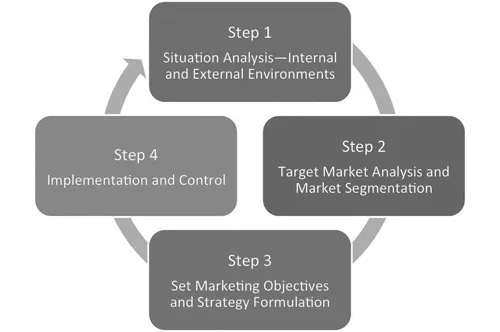
Figure 1.1. Four steps to successful marketing planning.
Step 2: Target Market Analysis
Once the marketer understands his or her organization’s strengths, weaknesses, opportunities, and threats, the next step in marketing planning is to understand the markets and customers. Marketing information is critical in understating markets and customers. Two important tools are available to allow the marketer to gather marketing information. One is marketing research, and the other is marketing intelligence. Both tools generate marketing information for the marketer to understand consumer behavior—that is, who is buying or would buy what, and how, how often, where, when, and why that person buys. Marketing research goes through five steps: (a) defining the problem and the research objectives, (b) developing the research design for collecting information, (c) collecting the data, (d) analyzing and interpreting the data, and (e) reporting the research findings. While marketing research is usually conducted on an ad hoc basis, marketing intelligence is performed on a continuing basis.
Once marketing research has been completed, the organization must undertake the steps of the target marketing process: market segmentation, market targeting, and market positioning. Because re...
Table of contents
- Title Page
- Copyright Page
- Contents
- Illustrations
- Foreword
- Acknowledgments
- Chapter 1. Introduction to Marketing Planning
- Chapter 2. The Situation Analysis
- Chapter 3. Analyzing the Target Market, Part 1
- Chapter 4. Analyzing the Target Market, Part 2
- Chapter 5. Marketing Objectives and Strategy Formulation
- Chapter 6. Planning for Products and Brands
- Chapter 7. Planning for Pricing
- Chapter 8. Planning for Integrated Marketing Communications
- Chapter 9. Planning for Distribution Channels and Market Logistics
- Chapter 10. Marketing Implementation and Control
- Appendix
- Notes
- References
- Announcing the Business Expert Press Digital Library
Trusted by 375,005 students
Access to over 1.5 million titles for a fair monthly price.
Study more efficiently using our study tools.
Frequently asked questions
Yes, you can cancel anytime from the Subscription tab in your account settings on the Perlego website. Your subscription will stay active until the end of your current billing period. Learn how to cancel your subscription
No, books cannot be downloaded as external files, such as PDFs, for use outside of Perlego. However, you can download books within the Perlego app for offline reading on mobile or tablet. Learn how to download books offline
Perlego offers two plans: Essential and Complete
- Essential is ideal for learners and professionals who enjoy exploring a wide range of subjects. Access the Essential Library with 800,000+ trusted titles and best-sellers across business, personal growth, and the humanities. Includes unlimited reading time and Standard Read Aloud voice.
- Complete: Perfect for advanced learners and researchers needing full, unrestricted access. Unlock 1.5M+ books across hundreds of subjects, including academic and specialized titles. The Complete Plan also includes advanced features like Premium Read Aloud and Research Assistant.
We are an online textbook subscription service, where you can get access to an entire online library for less than the price of a single book per month. With over 1.5 million books across 990+ topics, we’ve got you covered! Learn about our mission
Look out for the read-aloud symbol on your next book to see if you can listen to it. The read-aloud tool reads text aloud for you, highlighting the text as it is being read. You can pause it, speed it up and slow it down. Learn more about Read Aloud
Yes! You can use the Perlego app on both iOS and Android devices to read anytime, anywhere — even offline. Perfect for commutes or when you’re on the go.
Please note we cannot support devices running on iOS 13 and Android 7 or earlier. Learn more about using the app
Please note we cannot support devices running on iOS 13 and Android 7 or earlier. Learn more about using the app
Yes, you can access Building a Marketing Plan by Ho Yin Wong in PDF and/or ePUB format, as well as other popular books in Business & Marketing. We have over 1.5 million books available in our catalogue for you to explore.