eBook - ePub
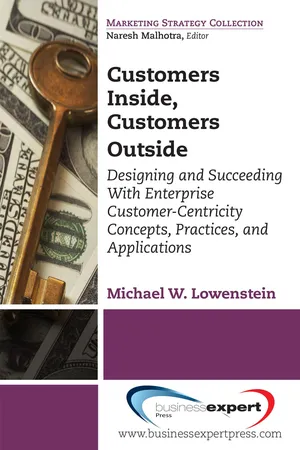
Customers Inside, Customers Outside
Designing and Succeeding With Enterprise Customer-Centricity Concepts, Practices, and Applications
- 154 pages
- English
- ePUB (mobile friendly)
- Available on iOS & Android
eBook - ePub
Customers Inside, Customers Outside
Designing and Succeeding With Enterprise Customer-Centricity Concepts, Practices, and Applications
About this book
Over the past several years, leading companies have
entered a period of major marketing and operational
adjustment and convergence, or intersection. It's a
reaction to a critical fact of life: Customers—not organizations—
now control the decision-making dynamics
and how organizations are perceived. We are
witnessing significant multichannel media application
(and resultant omnichannel access by consumers),
along with more effective and pervasive customer
data gathering, analysis, and modeling.
If you're observing these major shifts in your own
organization, you'll need this book. Inside, you'll
learn how to build proactive customer communication,
improve relationships, drive positive brand
perception, optimize channel selection and message
personalization, and enhance employee-related factors
(hiring, training, reward, recognition), all leading
to superior customer experience and a customercentric
culture. In addition, the author has incorporated
content on "Big Data" generation and analytics,
which you'll master while scoring a direct hit to the
moving target—your continuously changing, and increasingly
independent, customer base.
Trusted by 375,005 students
Access to over 1 million titles for a fair monthly price.
Study more efficiently using our study tools.
Information
CHAPTER 1
The Customer-Centric Enterprise
Management Overview
Creating, and sustaining, a truly customer-centric enterprise requires both focus and dedication in a number of key areas. Some are strategic, and some are tactical. They include process, messaging, and optimizing experiences. This section addresses concepts, priorities, and initiatives that can be applied in several of the most important areas.
Employees and Processes
Beyond employee engagement which, conceptually, is largely about alignment with, and commitment to, both the enterprise’s goals and its value proposition, customer-centric organizations will want to focus on commitment to customers (understanding their needs, and performing in a manner which provides optimal experiences and relationships). So, with respect to hiring, training, and evaluating for motivation, cohesion, and productivity, the forward-looking and customer-centric enterprise will want to focus on employee ambassadorship. Ambassadorship has proven to leverage stronger staff loyalty and customer value. In addition, the benefit of employee research will be operationally enhanced by not only identifying drivers of employee satisfaction and engagement, but also determining what will create stronger and deeper levels of ambassadorship. As one critical product of ambassadorship, it has been proven that employee advocates have higher levels of loyalty to their organizations.
Strategic Customer Focus and “Roadmap”
Paraphrasing Lewis Carroll’s Cheshire Cat in his advice to Alice, that is, “If you don’t know where you’re going, any road will get you there,” the lesson for organizations is that a strategic orientation is needed in the design and execution of customer experiences. Additionally, value propositions should be well defined, and communication and marketing should be consistent. Finally, the customer-centric organization will have definite focus in product and service programs. In following this strategic customer-centric “roadmap,” the organization must be able to have a tangible and emotional value proposition for customers. It must understand what customers want and identify how customers “learn” and make product and brand decisions. It must involve customers in product and service design, and also in development and messaging. It must have the culture, structure, and processes for truly valuing customers; and, as part of this orientation, employees must become ambassadors for the customers and the company’s value proposition.
Role of the Chief Customer Officer
Companies endeavoring to become more customer-centric, or to sustain a customer-centric culture have, increasingly, entrusted the execution of optimal customer experience and relationships to a Chief Customer Officer, or CCO. Functioning at a senior corporate level, the CCO role is to define and lead delivery of the value proposition across the array of communication and transactional touchpoints. There are, arguably, five core areas of responsibility for the CCO:
• Customer experience and value optimization
• Customer insight, data, and action generation
• Customer relationship-building
• Customer journey management and life cycle strategic consultation
• Customer-centric culture leadership and liaison
CCOs will have backgrounds that include sales, service, strategy/innovation, customer experience, product development, and customer and brand research.
Building Trust for Stakeholders Within the Enterprise
Trust has become essential for organizations, both at the individual employee level and at the enterprise level. Trust is about being honest, keeping promises, building stakeholder partnerships, and creating a positive and memorable customer experience. It is shaped by executives and managers, who, hopefully, also contribute to its continuity as a living force within the organization. It is a foundation element in building and sustaining customer relationships, and in leveraging customer behavior.
Customer Partnering
Partnering is, as noted above, building stronger relationships between customers and the enterprise. It facilitates a deeper knowledge and understanding of customer needs, and is essential to building value for them and cementing the relationship. The concept of partnering has been practiced by organizations for hundreds of years, and has received much more emphasis since the beginning of the Total Quality movement. Bringing customers and channel partners into the center of the enterprise enables first-hand sharing of ideas, leading to innovation and stronger product and service value.
There are many variations to the concept of customer partnering. One actively cited in this section is Intuit, where “listening posts” have been set up around the company; and, customer interaction touchpoints represent opportunities for problem resolution and new product development. Intuit works with major financial institutions on a team basis.
In generating stronger customer partnerships, organizations should ask if they understand how their customers perceive advantage, solution, and benefit, how customers do business with them, what is known about competitive offerings, and what is unique (or can become unique) about the organization.
Addressing Customer Complaints, Part 1: Using Social Media to Protect Brand Equity and Customer Loyalty
Identifying the full range, or inventory, of customer complaints—and proactively, and positively, addressing and resolving them—is an extremely important element of managing value in the overall experience. However, utilizing “complainer personas” for those posting negatives about their supplier transactions or relationships does not recognize the fact that online complaints are not representative of the overall customer base. Acknowledging that, though representing a small percentage of the customers, these negative postings can do a lot of reputation and purchase damage; identifying types of complainers and how to respond to them will have limited effectiveness. Resources should be deployed to address and mitigate the individual and collective impact of customer complaints.
Managing Customer Experiences
Executives believe, overwhelmingly, that improving customer experience is a major priority; however, only about one-third had begun customer experience initiatives, and fewer still considered their programs well along. Further, though these executives felt that having strong social media leverage was important for building relationships, a high percentage have no social or mobile programs to support sales or service. Though it is recognized that better customer experiences will build loyalty, much of the investment by organizations goes into advanced technologies rather than enhanced value through more personalization, omnichannel service access, and social media integration. A customer experience success model identified as superior is that of Metro Bank in London, where optimizing customer experience is embedded into the corporate DNA.
Addressing Customer Complaints, Part 2: Getting the Whole Picture
Even though product and service loyalty levels continue to decline, for an array of reasons unhappy customers will often take their business elsewhere rather than complain to a supplier. Because such a small percentage of customers with complaints actually express them, even in business-to-business (B2B), it’s essential that organizations have a research and contact program to identify unexpressed complaints, as well as discern the level of perception with complaints addressed and resolved. Poorly resolved complaints are creators of risk and potential churn. Customers should be encouraged to make contact with questions or complaints, and they should be given sufficient contact channels. Root causes of all complaints, expressed and unexpressed, should be addressed and corrected. Having a full database of complaints facilitates both correction and stronger customer relationships.
Stakeholder Disengagement and Negativism
Organizational culture has the power to create both stakeholder advocacy and alienation, that is, positive and negative behavior, on its behalf. In the 1999 movie Office Space, clerk Milton Waddams is portrayed both as a disgruntled employee and a disgruntled customer. This reminds us that all stakeholders should be treated with fairness, inclusion, and respect—otherwise they can (and, as in Milton’s case, absolutely will) burn down the company—figuratively and literally.
Employee Retention, Engagement, and Ambassadorship Go Hand-in-Hand-in-Hand At Successful Companies+ (September 5, 2013)
Nearly all companies are concerned about employee turnover; and, with the worldwide economy in recovery, it has become a priority. In some industries—notably retail, customer service, and hospitality—annual staff churn rates of 30–40% and more are not uncommon, and even—considered acceptable. While this situation may be a reality in many companies, it isn’t a very sound strategy, and from multiple perspectives:
• The value employees can bring to customers is diminished
• The breakdown in customer–staff continuity and trust when employees leave
• The negative cultural effect of turnover on other employees
• The real “total cost” of losing employees, including hiring, training/coaching, productivity
So, retention has become a huge issue today. We should be concerned about it, of course; but we also need to focus on the degree to which employees who stay with a company are directly and indirectly contributing to customer loyalty behavior. Numerous studies have been conducted on elem...
Table of contents
- Cover
- Half Title
- Title Page
- Copyright Page
- Dedication Page
- Abstract
- Contents
- List of Figures
- Preface
- Introduction
- Chapter 1 The Customer-Centric Enterprise
- Chapter 2 Customer and Brand Decision-Making and Influence
- Chapter 3 Customer Behavior Measurement
- Chapter 4 Big Customer Data
- Chapter 5 Customer Strategy and Tactics (Branding, Communications, and Relationships)
- Afterword
- Epilogue
- About the Author
- Notes
- References
- Index
- Adpage
- Backcover
Frequently asked questions
Yes, you can cancel anytime from the Subscription tab in your account settings on the Perlego website. Your subscription will stay active until the end of your current billing period. Learn how to cancel your subscription
No, books cannot be downloaded as external files, such as PDFs, for use outside of Perlego. However, you can download books within the Perlego app for offline reading on mobile or tablet. Learn how to download books offline
Perlego offers two plans: Essential and Complete
- Essential is ideal for learners and professionals who enjoy exploring a wide range of subjects. Access the Essential Library with 800,000+ trusted titles and best-sellers across business, personal growth, and the humanities. Includes unlimited reading time and Standard Read Aloud voice.
- Complete: Perfect for advanced learners and researchers needing full, unrestricted access. Unlock 1.4M+ books across hundreds of subjects, including academic and specialized titles. The Complete Plan also includes advanced features like Premium Read Aloud and Research Assistant.
We are an online textbook subscription service, where you can get access to an entire online library for less than the price of a single book per month. With over 1 million books across 990+ topics, we’ve got you covered! Learn about our mission
Look out for the read-aloud symbol on your next book to see if you can listen to it. The read-aloud tool reads text aloud for you, highlighting the text as it is being read. You can pause it, speed it up and slow it down. Learn more about Read Aloud
Yes! You can use the Perlego app on both iOS and Android devices to read anytime, anywhere — even offline. Perfect for commutes or when you’re on the go.
Please note we cannot support devices running on iOS 13 and Android 7 or earlier. Learn more about using the app
Please note we cannot support devices running on iOS 13 and Android 7 or earlier. Learn more about using the app
Yes, you can access Customers Inside, Customers Outside by Michael W. Lowenstein in PDF and/or ePUB format, as well as other popular books in Business & Marketing. We have over one million books available in our catalogue for you to explore.