eBook - ePub
Effective Sales Force Automation and Customer Relationship Management
A Focus on Selection and Implementation
- 123 pages
- English
- ePUB (mobile friendly)
- Available on iOS & Android
eBook - ePub
Effective Sales Force Automation and Customer Relationship Management
A Focus on Selection and Implementation
About this book
As we move deeper into the 21st century, firms continue to struggle with the implementation of sales force technology tools and the role they play in sales representative performance. Foreseeing a changing environment, many sales organizations have begun to focus on technology-related strategies, business processes, and applications to adapt to these emerging issues. With this in mind, sales force technology usage has changed the methods of selling. Salespeople are no longer selling just a "product"; instead, they are providing a valuable "solution" to customer problems. Salespeople now act as consultants or experts and provide customized solutions. This role requires salespeople to develop a technological orientation to access, analyze, and communicate information in order to establish a strong relationship with customers. Sales technology enables salespeople to answer the queries of customers and effectively provide competent solutions. The ability to answer queries and provide solutions leads to strong relationships between a salesperson and a customer. Thus, technology tools are not only used for smoothing the work process, but also have strategic utilizations. With the adoption of technological tools at exponential rates, many firms fell into pitfalls and witnessed failure of their technology initiatives. The purpose of this book is to outline the important steps that must be considered and adhered to when implementing sales force technology. Perhaps the most important aspect covered within this book is that technology usage is both a strategy and a tool; therefore, we outline both strategic considerations as well as implementation procedures throughout each chapter. It is important to consider all the steps and the necessary actions that will need to take place before the first penny is spent; then and only then will the technology have its intended effect.
Trusted by 375,005 students
Access to over 1.5 million titles for a fair monthly price.
Study more efficiently using our study tools.
Information
Topic
BetriebswirtschaftSubtopic
VertriebChapter 1
Defining Technology
With the customer being the focal point and customer relationships being the central theme of many business strategies, organizations have witnessed countless opportunities created through technology advancements. These opportunities are especially prevalent in sales organizations, considering that they are responsible for creating links between firms and customers. Thus, many sales organizations have embraced technology to leverage the possibilities presented. Sales technology is a new mantra for sales organizations to gain success and build relationships. Firms are seeing the use of technology as a way of enhancing sales efficiency and sales effectiveness.
In today’s era of market-oriented firms, where sales organizations have migrated from being a transactional-oriented entity to a relational-oriented entity, there are new labels for sales representatives, such as “relationship managers.” In this transformed role, salespeople are responsible for achieving high customer-satisfaction levels. To achieve high levels of customer satisfaction, the sales representatives (hereafter, “sales reps”) must learn about the customers and use that knowledge to design need-satisfying strategies. Additionally, for sales reps, technology use facilitates the process of knowledge attainment, which further improves their performance. In addition, through the use of relationship-building tasks, sales reps are exploring multiple dimensions of technology utilization (i.e., accessing, analyzing, and communicating information), which, in turn, are affecting different aspects of sales performance. Also, salespeople’s technology orientation influences their internal role performance by smoothing the back-office tasks, enhancing communications, reducing cycle time, organizing information, and, consequently, enhancing efficiency.
Although sales technology has so much to offer, there is no scarcity of evidence outlining the history of unsuccessful technology implementation by sales organizations. In fact, more than half of sales technology investments are considered by top management to be unprofitable. One critical reason for this conflicting evidence is that there is no clear formulation of a technology concept for sales organizations. To achieve the projected effects of technology, it is necessary to define different dimensions of technology usage and outline both strategic considerations as well as implementation procedures for sales organizations.
Sales Technology
Defined broadly, technology is “an ability to act, a competence to perform, translating materials, energy and information in one set of states into another, more highly valued set of states.”1 For sales organizations, sales technology is composed of tools and techniques that aid or enable the sales task performance. Sales technology, in essence, is the adoption and utilization of different technology tools to reengineer and automate sales and marketing processes so that organizations improve their sales and marketing effectiveness and, in turn, increase revenues. Successful implementation of sales technology should support the selling process from generating the lead to closing the deal.
In the past, issues concerning the different dimensions and aspects of technology use have been raised. It is especially essential for a sales organization to address the diverse uses of technology and its differential effects on salespeople’s behavior. Individuals in an organization are supposed to perform various tasks or activities to attain outputs, and technology provides tools that help them to perform these tasks. The use of certain applications of technology depends on the specific characteristics of the assigned task. In any sales organization, sales reps perform operational and administrative tasks (e.g., learning about new and existing product lines, generating automated reports, communicating with other departments) as well as tactical and strategic tasks (e.g., identifying the most important customers, preparing sales presentations based on customers’ specific needs and requirements). Depending on the nature of the task, sales reps need particular tools to help perform these activities. The effect of technology usage on sales reps’ behavior will rely on the purpose of the task and whether it is strategic or operational in nature.
Given the fact that different dimensions of technology usage should be employed for different purposes, management should create and support work settings where sales reps are encouraged to use technology in a proper fashion. Sales reps performing operational tasks (e.g., sharing information with colleagues and managers, monitoring inventory levels, or learning about products) should use different system applications when performing these tasks than when performing strategic tasks (e.g., identifying potential customers, identifying the most important customers from the list of potential customers, or working on improvement of sales presentation skills).
Understanding how different technology tools have diverse influence on performance-enhancing behaviors is advantageous for both management and sales reps. In light of that, we categorize the use of sales force automation (SFA) and the use of customer relationship management (CRM) as two dimensions of sales technology based on their level of specificity (e.g., automation of routine and administrative tasks or strategy-building tools) for influencing different salespersons’ behaviors such as effort and adaptive selling. For example, SFA usage, with an operational orientation, comprises the utilization of technological tools supporting routine sales functions, while, as a strategic tool, CRM technology utilization includes devising methods and employing technology that help sales reps to develop sales strategies. For sales reps to build, maintain, and strengthen the relationships with customers, both routine sales tasks and strategic activities are equally important.
Sales technologies have evolved and developed quite dramatically over a short period of time. Similar to the change from an organization’s orientation from product selling to solution selling, sales technology has witnessed some major transformations (Figure 1.1). In its early stages, technology was mainly used to support decisions focused on how to gain market share. Later, front-end applications such as sales analysis systems, sales integration systems, and the like emerged to address the changes in the marketplace. Currently, as companies seek to gain the share of the customer’s mind, enterprise-wide CRM solutions are prevalent. Organizations that adopt enterprise value networks are striving for solution selling to provide customers with the highest possible value.
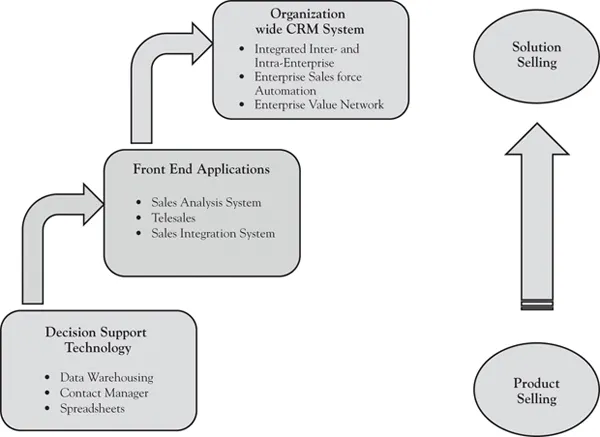
Figure 1.1. Sales technology evolution.
Organizations perceive sales technology as a means to improve sales force productivity and effectiveness because it helps them streamline the flow of the business process (Figure 1.2). It also enables sales reps to know more information about more customers. Thus, sales technology is perceived as a contributor to customer satisfaction by improving communication, speeding responsiveness, and enhancing customer service. It increases effectiveness in management through supporting team selling, optimizing interactions, and reducing administration. With proper utilization of sales technology, sales cycles can be reduced and actual selling time can be increased, sales forecasts can be improved, costs can be decreased, and revenue can be increased.
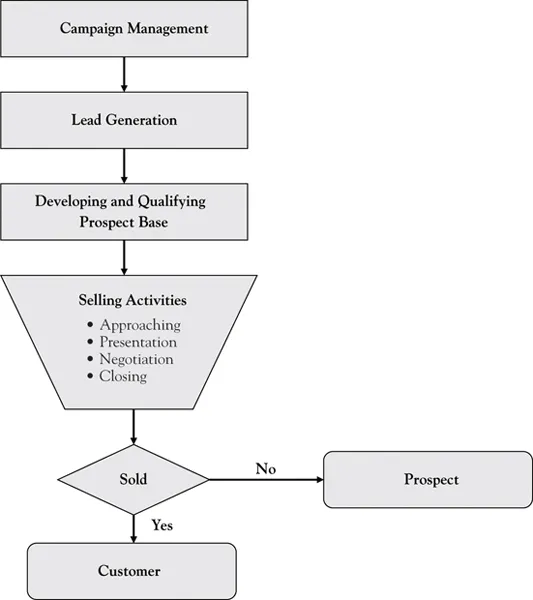
Figure 1.2. Sales technology supported business process flow.
Sales Force Automation
SFA is the application of technology to support regular sales functions and includes tools that are employed by users to perform administrative and other repetitive tasks. SFA transforms repetitive and routine manual processes to automated processes, which helps sales reps operate in a more efficient manner. For example, applications such as quarterly automated sales reports and calendaring tools are key elements of sales technology. The domain for SFA applications includes the attainment and storage of information. SFA tools assist sales reps in formulating a professional sales encounter. Sales reps can remain in contact with distant customers via e-mails and cell phones, thus reducing travel hours. They can also receive and manage orders from customers in an easy, timely fashion. Additionally, applications like calendaring and routing tables help sales reps reduce downtime and increase their own production during regular work hours.
To optimize the benefits of SFA, sales reps should be aware of the specific purposes of its use. With SFA, sales reps improve their productivity and competitiveness because the consistent and quick flow of information helps them to be more precise in their sales presentations. The assistance of SFA tools with routine tasks allows sales reps to focus more on relationship-building tasks rather than on administrative tasks. The use of SFA allows a sales force to optimize every step of its sales strategy, including presentations, informing, communications, and sales reporting. Sales reps in today’s competitive environment are required to keep track of customers’ priorities, competitor’s activities, and product market situations. With special applications and other analytic database tools, SFA helps sales reps to manage market intelligence in a well-timed manner. Additionally, and as previously mentioned, salespeople will improve in terms of efficiency as the back-office operations, such as sales reporting, become automated.
Customer Relationship Management
In order to develop better relationships with customers, organizations want to understand the needs of customer and learn about their behaviors. CRM, when used as a strategic tool, has been utilized by organizations for these purposes. Use of CRM technology focuses on relationship and strategy building, is cross-functional in nature, and provides a platform for continuous interactions with customers. For organizations, CRM is a strategy for developing an integrated and comprehensive customer database with the help of information technology (IT). CRM databases deliver both relationship and analytic data that a firm needs to manage interactions, speed up workflows, anticipate opportunities, increase revenue, and reduce costs. Specifically, business analytic data can help find customers that are the most important based on the amount of products they buy and the cost of serving them. In addition, such data are helpful in managing the supply chain, as it can assess which suppliers deliver the quality products on time and at the most reasonable price.
One of the prominent players in the financial service industry, Wells Fargo, offers customers positive experiences with the help of a CRM technology called PeopleSoft Enterprise. Especially for its online services, Wells Fargo wanted to adopt and implement a customer-centric model. Wells Fargo’s management was well aware that this vision could only be realized through a CRM solution that makes it possible for the company to serve any customer at any time. The company strategically implemented CRM technology and successfully achieved its goal of knowing its customers better. The CRM technology empowered them to offer value-oriented services and unique experiences throughout the customer life cycle. This approach can be replicated in other industries as well. For example, CRM systems can help companies running businesses within the airline industry, as they would be able to obtain business-class customer information of how often they fly and at what time of year, the purpose of the trip (i.e., business or personal), their food preferences, and so on. Access to such information will help the firm know what promotional material to send out, what new deals to promote to each customer, what preferences or options may be attractive to each customer, and when would be a good time to target each customer. The companies can use the information to build a relationship with the customer not only by reminding customers of flight cancellations or delays but also by sending birthday cards, for example.
Representing the analysis aspects of sales technology, CRM tools help sales reps develop and manage customer relationships. One can envision the functional use of CRM as a process that helps compile pieces of information about the customers, the firm’s selling efforts, marketing effectiveness, and the trends in the market. Sales reps use CRM as customer-focused technology that helps them devise strategies, which, in turn, helps them gain effectiveness in their selling methods. Notably, the best use of CRM system for sales reps will rest on the successful integration of the information acquired during data analysis over the course of their selling approach and practices. Another key area where accurate customer information will help salespeople tremendously is adaptive selling. In essence, the use of CRM technology will help sales reps in their efforts toward building and maintaining stronger customer relationships.
CRM Value Proposition
CRM solutions are offering fully functional, embedded workflow tools that are enabling firms to automate the greater part of regular, as well as unique, processes that are present among most customer-centric businesses. For example, CRM solutions make it possible to route a customer service request based on precedence or the nature of the case. A workflow can be established that sets off explicit actions or notifications based on the customer, the incident, or time-based conditions. Yet, despite the numerous benefits offered by CRM technology, it remains elusive to many firms. The primary reason for this elusiveness is that companies often focus only on the investment cost and ignore the CRM value proposition (Figure 1.3).
A manager needs to assess a CRM system from a broader perspective, as its domain is wide and it covers multiple business functions, such as marketing and analytics, customer service, integration of marketing and sales, and the like. Businesses may save money through separate or increment automation of customer-facing work processes and back-office applications; however, the value of CRM lies in the integration of these two facets of business operation. Additionally, CRM technology helps organizations offer better customer service, make call centers more efficient, cross-sell products more effectively, aid sales staff by closing deals faster, integrate marketing and sales processes, and discover new customers.
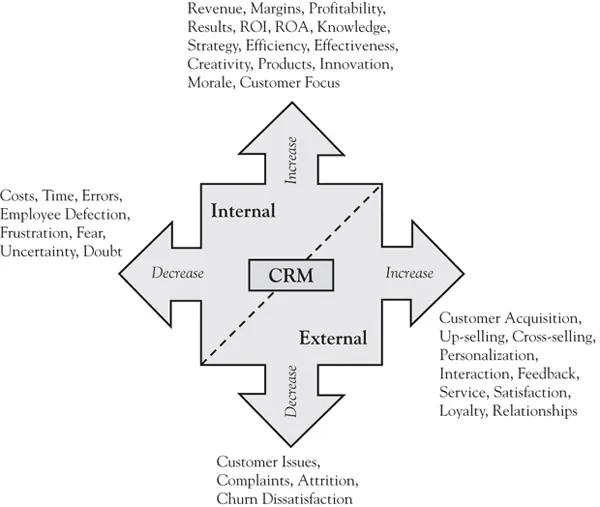
Figure 1.3. 360-degree value proposition.
Current Market Environment
A recent research report by International Data Corporation (IDC), a global market intelligence firm, suggests that even in tough economic times such as now, spending on CRM software will increase. In the past, IDC had predicted $11.4 billion in CRM related applications sales in the year 2008. This phenomenon is not limited to developed industrial economies and big corporations. Medium-sized businesses that are members of the Association of Southeast Asian Nations spent more than $200 million in 2008, out of which $24 million came from CRM applications. SFA was the most adapted CRM module by medium businesses. These business trends cement the fact that organizations are increasingly exploring the potential of technology to develop, nurture, and sustain relationships with customers like never before.
In terms of CRM implementation, telecommunication and financial service industries are the leaders, while consumer goods manufacturers, retailers, and high technology companies are close behind them. The findings of a survey of more than 1,600 business and IT professionals conducted by the Data Warehousing Institute highlight the fact that CRM budgets do not need to be extremely high; in fact, half of the respondents reported a CRM project budget of less than $500,000. In order to find the usefulness of CRM, Morgan Stanley surveyed 225 chief information officers and reported that 8% of respondents consider it critical, 20% think of it as useful, but only 38% think it reduces their IT budget. This suggests that businesses still have their doubts regarding CRM’s value. Still, the growth of CRM technology has attracted several major companies to get into the business with PeopleSoft, Oracle, SAP, and Siebel, which are becoming key service providers. Linux, an open-source platform, is also getting a great deal of attention.
As a result of tough economic times, sales organizations are encountering severe challenges in maintaining the status quo. In order to survive, many sales organizations are trying new methods to leverage the eternal triangle that involves people, processes, and technology, and a CRM initiative is definitely one of the tools that sales organizations are increasingly relying on. A recent survey finding suggests a 33% increase in CRM usage by sales organizations from 2003 to 2008. Almost 90% of telesales teams are using CRM, and 1 in 3 organizations that are not currently using CRM technology stated an intention to do so in the upcoming years.
Availability and usefulness of CRM applications would make anybody think that with CRM, things must be going super smooth for sales organizations. Core CRM usage, however, is not directly proportional to sales effectiveness. As per the finding of the 2009 Sales Performance Optimization (SPO) study conducted by the chief sales officer (CSO) of Insights,2 almost 63% of respondents reported that the primary goal of CRM initiatives was to increase revenue, yet only 16% of respondents witnessed revenue increases that would be attributed to CRM usage. It seems t...
Table of contents
- Title Page
- Copyright Page
- Contents
- Introduction
- Chapter 1: Defining Technology
- Chapter 2: Technology Application Versus Business Strategy
- Chapter 3: The Role of the Customer in Technology and Strategy Implementations
- Chapter 4: Selection Decision Process and Research
- Chapter 5: System Planning and Designing
- Chapter 6: Implementation of Designed Systems
- Chapter 7: Achieving Full Integration for Maximum Performance
- Chapter 8: Technology Assessment, Maintenance, and Adaptation
- Notes
- References
Frequently asked questions
Yes, you can cancel anytime from the Subscription tab in your account settings on the Perlego website. Your subscription will stay active until the end of your current billing period. Learn how to cancel your subscription
No, books cannot be downloaded as external files, such as PDFs, for use outside of Perlego. However, you can download books within the Perlego app for offline reading on mobile or tablet. Learn how to download books offline
Perlego offers two plans: Essential and Complete
- Essential is ideal for learners and professionals who enjoy exploring a wide range of subjects. Access the Essential Library with 800,000+ trusted titles and best-sellers across business, personal growth, and the humanities. Includes unlimited reading time and Standard Read Aloud voice.
- Complete: Perfect for advanced learners and researchers needing full, unrestricted access. Unlock 1.5M+ books across hundreds of subjects, including academic and specialized titles. The Complete Plan also includes advanced features like Premium Read Aloud and Research Assistant.
We are an online textbook subscription service, where you can get access to an entire online library for less than the price of a single book per month. With over 1.5 million books across 990+ topics, we’ve got you covered! Learn about our mission
Look out for the read-aloud symbol on your next book to see if you can listen to it. The read-aloud tool reads text aloud for you, highlighting the text as it is being read. You can pause it, speed it up and slow it down. Learn more about Read Aloud
Yes! You can use the Perlego app on both iOS and Android devices to read anytime, anywhere — even offline. Perfect for commutes or when you’re on the go.
Please note we cannot support devices running on iOS 13 and Android 7 or earlier. Learn more about using the app
Please note we cannot support devices running on iOS 13 and Android 7 or earlier. Learn more about using the app
Yes, you can access Effective Sales Force Automation and Customer Relationship Management by Raj Agnihotri in PDF and/or ePUB format, as well as other popular books in Betriebswirtschaft & Vertrieb. We have over 1.5 million books available in our catalogue for you to explore.