eBook - ePub
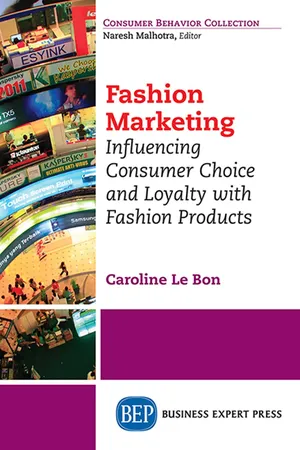
Fashion Marketing
Influencing Consumer Choice and Loyalty with Fashion Products
- 124 pages
- English
- ePUB (mobile friendly)
- Available on iOS & Android
eBook - ePub
About this book
Fashion is everywhere! It transcends domains and applies to almost any kind of product (e.g., apparel, cars, digital devices, food, literature, travel, music, house decoration and personal wellness). Fashion greatly influences public interest, media coverage, and product success. The global fashion industry is among the most important in terms of investments, trade, and employment, despite its dependence on unpredictable demand. This book focuses on the fashion apparel and accessories industry in an attempt to help managers answer the following questions: Why and how do fashion products appeal to consumers, despite their constantly varying attributes? What specific elements and benefits of fashion influence consumers, and how can companies exploit them and gain from these? Which marketing strategies and tactics should companies use to increase fashion products' success while communicating and managing customers' image? How can companies maintain customer loyalty and generate higher profits with fashion products? By undertaking deep analyses of manufacturers and retailers' best practices, interviewing customers and companies, and reviewing recent academic research on fashion marketing, this book answers such questions and thus helps managers leverage the value that fashion adds to products while creating loyal customers in truly competitive fashion markets.
Information
CHAPTER 1
Fashion as the Empire of Seduction
Fashion managers handle daily design, merchandising, distribution, promotion, and sales of ephemeral products to first seduce fashion shoppers and thereby generate greater profitability. Some of these concepts related to fashion seem to fall in opposition though. In fact, how can firms elicit high profits when they must introduce and deal with products that change every week or month? The fashion industry actually leverages this opposition constantly to develop its business beyond sequential changes.
Developing the Business of the Ephemeral
Fashion may be ubiquitous, but can anyone really appreciate its power? We first must ask ourselves what fashion represents. For most people, the term fashion designates clothes, but fashion also applies to a broad range of product categories, including mobile phones, cars, house decor, toys, music, and so on. Consider toys as an example: Pokemon and all of its related materials were really crucial for children some years ago, but when all kinds of spinning tops entered the market, no one was trading Pokemon cards anymore. Similar trends are seen in music, vacation destinations, and cooking; in France, for example, foods served in glasses are very fashionable nowadays, whereas in the United States, fancy cupcakes are available seemingly on every corner. As Coco Chanel realized, “Fashion is not something that exists in dresses only. Fashion is in the sky, in the street, fashion has to do with ideas, the way we live, what is happening.”1
By acknowledging that fashion does not apply only to clothes, we can recognize how it intrigues many people and surrounds us in our daily lives. However, to provide specific insights, I focus on fashion apparel and accessories. Fashion apparel consists of clothes for women, men, and children and accessories embody several product categories, such as shoes, glasses, hats, gloves, scarves, ties, belts, bags, jewelry, and watches. Together, fashion apparel and accessories account for an impressive proportion of global economic sectors. Just the textile and clothing sector was valued at $1.7 trillion in 2012; figures for 2010, adding footwear and luxury goods, suggest its value reached $2.5 trillion.2 These data indicate that the fashion market represents one of the largest industries worldwide.
Even during the global economic crisis, clothing and footwear markets suffered less in Europe and the United States than did other imported industrial supplies.3 The reason might be that whereas the economic crisis and globalization are often linked with the saturation of supply or demand, fashion retains its enviable top position in developing economic sectors. Fashion supply does not seem to fade, and fashion demand remains high. On average, a European shopper buys apparel nine times per year. According to the U.S. Department of Labor, American households spent an average of $1,700 each on apparel and accessories in 2010: $562 for women’s apparel, $304 for men, and $270 for children, with the remainder spent on footwear and accessories.4 Thus, fashion products account for a significant portion of individual budgets, which fashion company can access—suggesting that the fashion market has great opportunities for continued growth.
In this industry, women’s wear leads the fashion market, as shown in Table 1.1 (figures expected for 2014).5 Many women are always eager to have the latest designs in apparel and accessories. Fashion offers a means of expression for fashionable female shoppers, who constantly follow new trends to stay as fashionable as possible. Fashion apparel and accessories are part of their monthly budget. In fact, women represent 44 percent of the world clothing market, followed by men with 28 percent.
Table 1.1 Global clothing market
| Sectors | US$ (billion) |
| Women’s wear | 621 |
| Men’s wear | 402 |
| Children’s wear | 186 |
| Footwear | 195 |
| Accessories | 20 |
However, some new consumers may offer new growth levers in this business of the ephemeral, such that men, teenagers, and seniors who represent challenging and promising targets for the expansion of fashion markets.
In particular, modern men increasingly participate in fashion today by pursuing more and more fashion trends. They have become more aware of the importance and impact of their looks; according to Calvin Klein, “there has been a change in men’s attitudes toward their clothes. Men are more aware of fashion; they’re not afraid of it.”6 This increased consciousness of their apparel has led men to invest more financially and expand the variety of their wardrobe. In 2011, men’s apparel sales increased by 6.5 percent in the United States.7 In addition, their consumer behavior increasingly matches women’s. Men take greater care with their appearance and adopt more changes in their wardrobes. They appear to enjoy the changes in fashion rather than buying several identical shirts or suits just to meet their functional needs. They now seek the variety and novelty that go with fashion seasons and collection changes. Like women, men are aware of the impact of their fashion choices on their looks and their image, as conveyed in their social environment.
To leverage these new behaviors, brands and retailers design and offer specific fashion lines for men. For example, Mango created in 2008 an urban casual line for men, “HE by Mango,” which referred to Homini Emerito, “man who enjoys a reward due to its merits.” After some struggles in the mid-1990s, this line is now successful. Hence, this retailer decided to target and develop this brand for fashion-conscious men, through 117 stores in 17 countries. Another fashion retailer, Massimo Dutti, started designing fashion apparel for men in 1985 and began operating in the women’s fashion sector 10 years later. These retailers understood early the importance of this market opportunity.
But in the past, before this repositioning in men fashion design and retail market, men had relatively limited apparel choices. Their choices were steered toward classical lines or upscale designers’ collections. The image of men as fashionable shoppers arose largely at the end of the 1990s, surrounding the new concept of metrosexuals—young men with high income, living in big cities, and looking to take care of themselves in the realms of sport, cosmetics, and fashion. The English soccer player David Beckham and the actor Brad Pitt are celebrities commonly associated with this image of fashionable men. According to Michael Flocker, “The new breed of men is one of style, sophistication and self-awareness. He is just as strong and confident as his predecessor, but far more diverse in his interests, his tastes and most importantly in his self-perception. . . . Never slaves to fashion or victims of their public image, these men simply understood the power of images they were projecting and they knew how to play the game.”8
In response to this new demand, a men’s cosmetics market emerged in the early 2000s, along with many fashion apparel and accessory collections from haute couture to fast fashion. This concept has now extended to a vast group of men, spanning different age categories and different income levels. The fast-fashion market, as we discuss in Chapter 6, contributes to the accessibility of fashion apparel and accessories by offering affordable price ranges to more fashion conscious men.
Teenagers are another interesting target customers for fashion firms, especially as their spending power for fashion products has increased constantly: They spend an average of $135 monthly on apparel and accessories in France, and in the United States, their yearly clothing expenditures are estimated to account for approximately 6 percent of the household budget.9 Fashion is a critical means of expression for these young consumers, who are in the process of defining their identities. They are strongly influenced by their peers, who guide their fashion choices, look, and self-appreciation. In the process of finding their identities and positions in their social environment, teenaged consumers often fear the judgment of their groups, leading them to follow fashion trends approved by their peers. In this sense, they are sensitive to fashion changes that signal their continued inclusion in a group they choose to belong to. Following fashion trends is similar to following group norms, reassuring them in their search for identity and social status.
Retailers again have recognized the potential profitability of these young shoppers and adapted their assortments accordingly. Teenagers do not have to fit either children’s collections or adult ones anymore. Instead, they have thei...
Table of contents
- Cover
- Half Title
- Title Page
- Copyright Page
- Dedication Page
- Abstract
- Contents
- Preface
- Acknowledgments
- Introduction
- Chapter 1: Fashion as the Empire of Seduction
- Chapter 2: Fashion as a World of Influences
- Chapter 3: Fashion and Product Variety
- Chapter 4: Overseeing Cost and Price in Fashion Marketing
- Chapter 5: Fashion as a Means of Communication
- Chapter 6: Managing Channels of Distribution and Enhancing Fashion's Impact
- Chapter 7: Leveraging Fashion Equity, the Absolute Benefit
- Chapter 8: Handling Managers' Challenges for Successful Fashion Products
- Conclusion
- About the Author
- Notes
- References
- Index
- Ad page
- Back cover
Trusted by 375,005 students
Access to over 1.5 million titles for a fair monthly price.
Study more efficiently using our study tools.
Frequently asked questions
Yes, you can cancel anytime from the Subscription tab in your account settings on the Perlego website. Your subscription will stay active until the end of your current billing period. Learn how to cancel your subscription
No, books cannot be downloaded as external files, such as PDFs, for use outside of Perlego. However, you can download books within the Perlego app for offline reading on mobile or tablet. Learn how to download books offline
Perlego offers two plans: Essential and Complete
- Essential is ideal for learners and professionals who enjoy exploring a wide range of subjects. Access the Essential Library with 800,000+ trusted titles and best-sellers across business, personal growth, and the humanities. Includes unlimited reading time and Standard Read Aloud voice.
- Complete: Perfect for advanced learners and researchers needing full, unrestricted access. Unlock 1.5M+ books across hundreds of subjects, including academic and specialized titles. The Complete Plan also includes advanced features like Premium Read Aloud and Research Assistant.
We are an online textbook subscription service, where you can get access to an entire online library for less than the price of a single book per month. With over 1.5 million books across 990+ topics, we’ve got you covered! Learn about our mission
Look out for the read-aloud symbol on your next book to see if you can listen to it. The read-aloud tool reads text aloud for you, highlighting the text as it is being read. You can pause it, speed it up and slow it down. Learn more about Read Aloud
Yes! You can use the Perlego app on both iOS and Android devices to read anytime, anywhere — even offline. Perfect for commutes or when you’re on the go.
Please note we cannot support devices running on iOS 13 and Android 7 or earlier. Learn more about using the app
Please note we cannot support devices running on iOS 13 and Android 7 or earlier. Learn more about using the app
Yes, you can access Fashion Marketing by Caroline Le Bon in PDF and/or ePUB format, as well as other popular books in Business & Marketing. We have over 1.5 million books available in our catalogue for you to explore.