- 180 pages
- English
- ePUB (mobile friendly)
- Available on iOS & Android
eBook - ePub
About this book
The goals of this book are to discuss critical topics in launching new products, and to distill successful approaches from hundreds of publications and experience from launching over 50 new products into a checklist for marketing leaders, CEOs, and board members. The function of this checklist is to force consideration and completion of tasks that drive a successful product launch.
Trusted by 375,005 students
Access to over 1 million titles for a fair monthly price.
Study more efficiently using our study tools.
Information
CHAPTER 1
Context of the New Product Launch
Marketing will be the basic motivating force for the entire corporation. Soon it will be true that every activity of the corporation – from finance to sales to production – is aimed at satisfying the needs and desires of the consumer. When that stage of development is reached, the marketing revolution will be complete.
—Robert Keith, 1960.
Marketing’s ultimate role in the firm is to drive creation of value for buyers and capture … a significant part of that created value for the company.
—John Farley.
Context of the New Product Launch—the CEO’s World and How Marketing Helps
New product launches occur in the broader context of the relationship of the CEO and the marketing effort. The CEO is often juggling diverse company activities such as managing the board, raising money, communicating with investors, and leading the company strategy (see Figure 1.1). Due to the CEO’s complicated function, the CEO needs the help of the marketing leader to create a systematic, thoughtful plan that will give the organization the best chance at sustained competitive advantage, success in the market, and financial success.
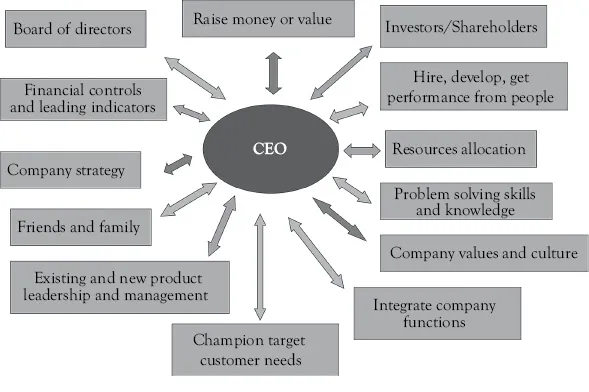
Figure 1.1 CEO’s worldview
The relationship between the CEO, the marketing leader, and team and creating value for the company are depicted in the Marketing Pyramid™ (Figure __). As shown in this diagram, the overriding goal of the CEO is to increase the valuation of the company. The CEO’s internally focused function is to increase the company’s value. The CEO can do this most effectively by ensuring that the company is focused on its target customer needs and that all functions in the company are aligned so that target customers prefer working with the company and help the company evolve to satisfy even more of their needs. The CEO works with the marketing leader to ensure the marketing and sales plan is clear, executed, and measured for continual improvement.
The marketing function was created by the CEO to amplify the CEO’s ability to understand and satisfy the target customer needs, as well as improve the alignment and integration of the company so it can get, keep, and grow profitable customers.
The Marketing Pyramid (Figure 1.2) depicts the relationship of the marketing department with the CEO and the breadth of functions of an effective marketing department. The relationship between the successful marketing leader and the CEO is characterized by powerful conversations (citation), or conversations that contain two of the three following elements:
•Enhance the relationship between the marketing leader and CEO;
•Contain an ah-ha or significant learning moment; and
•End with an effective action plan.
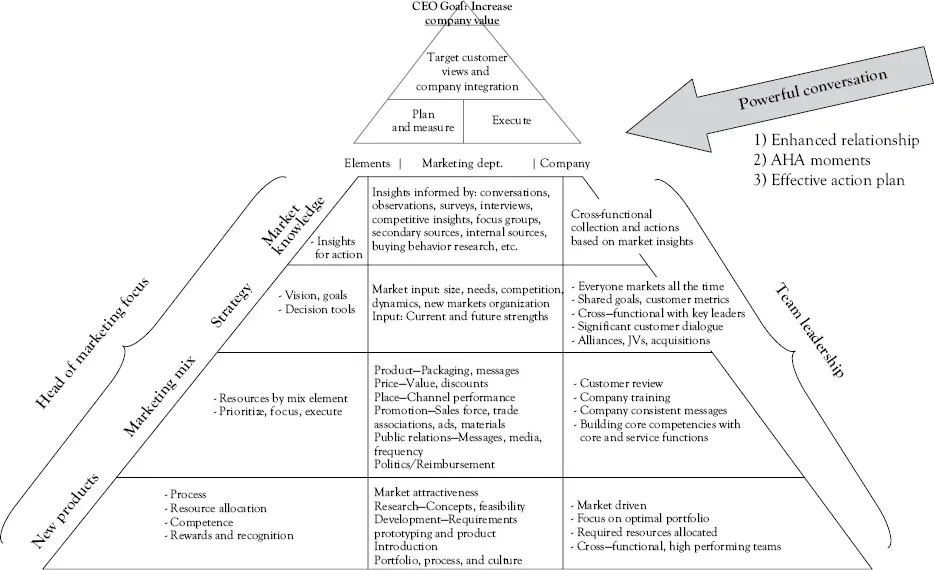
Figure 1.2 Context for CEO, marketing and new product launch
The CEO needs to work with the marketing leader to ensure that the target customer’s needs are understood, that the company strategy will create and sustain competitive advantages profitably, and that company functions are integrated and working together effectively. In addition, the CEO must endorse the marketing plan and ensure that the company measures and executes the plan.
The marketing team needs to work with prospects, customers, and colleagues in other functions to create and deliver market knowledge, marketing strategy including competitive intelligence and the marketing mix, and products and services that provide sustainable competitive advantage. In addition to these functions, the marketing team must be experts in team leadership in order to engage prospects, customers, and colleagues in this process.
Market knowledge goes beyond background information and needs to distill insights that can help the company compete. These insights come from the following:
•Conversations with customers and colleagues who are well informed on changes in the market and changes with competitors;
•Observations of customers and competitive activity;
•Product effectiveness studies; and
•Publications or relevant outlets such as social media and conferences.
Market intelligence includes the size of the market in units, sales dollars, and profit dollars; the dominant unmet market needs; competition—today and in the future, dynamics of the government or industry that may cause changes in market size and competitive advantages—potential new markets; and the strengths and weaknesses of the organizations.
The marketing team creates and implements the marketing mix that allocates resources and plans projects that impact the product (e.g., product quality, variety, design, features, brand names, packaging, and sizes), price (pricing strategy—value, penetration or competitive, list price, volume discounts, etc.), promotion (e.g., segmentation and targeting, sales force composition and management including materials, and advertising), and place or distribution (e.g., channels, coverage, and offerings per channel).
The marketing team leads the efforts to understand unmet market needs, develops products to meet those needs, and plans and implements the plans that bring the new product to the market and cause the new product to succeed. The majority of this book discusses the activities required to bring a new product to market and create early success.
High-Performance Wor...
Table of contents
- Cover
- Title
- Copyright
- Dedication
- Abstract
- Contents
- Introduction
- Chapter 1: Context of the New Product Launch
- Chapter 2: New Product Launch Team Leadership Approach
- Chapter 3: Marketing Mix: The 4 P’s
- Chapter 4: Messaging, Professional Selling, Raving Fans, and Customer Development
- Chapter 5: Sales Training, Value Propositions, the Brand Promise, Pricing, Legal, and Ethical Considerations
- Chapter 6: New Product Launch Checklist
- Appendixes
- References
- Index
- Ad Page
- Back Cover
Frequently asked questions
Yes, you can cancel anytime from the Subscription tab in your account settings on the Perlego website. Your subscription will stay active until the end of your current billing period. Learn how to cancel your subscription
No, books cannot be downloaded as external files, such as PDFs, for use outside of Perlego. However, you can download books within the Perlego app for offline reading on mobile or tablet. Learn how to download books offline
Perlego offers two plans: Essential and Complete
- Essential is ideal for learners and professionals who enjoy exploring a wide range of subjects. Access the Essential Library with 800,000+ trusted titles and best-sellers across business, personal growth, and the humanities. Includes unlimited reading time and Standard Read Aloud voice.
- Complete: Perfect for advanced learners and researchers needing full, unrestricted access. Unlock 1.4M+ books across hundreds of subjects, including academic and specialized titles. The Complete Plan also includes advanced features like Premium Read Aloud and Research Assistant.
We are an online textbook subscription service, where you can get access to an entire online library for less than the price of a single book per month. With over 1 million books across 990+ topics, we’ve got you covered! Learn about our mission
Look out for the read-aloud symbol on your next book to see if you can listen to it. The read-aloud tool reads text aloud for you, highlighting the text as it is being read. You can pause it, speed it up and slow it down. Learn more about Read Aloud
Yes! You can use the Perlego app on both iOS and Android devices to read anytime, anywhere — even offline. Perfect for commutes or when you’re on the go.
Please note we cannot support devices running on iOS 13 and Android 7 or earlier. Learn more about using the app
Please note we cannot support devices running on iOS 13 and Android 7 or earlier. Learn more about using the app
Yes, you can access Launching New Products by John Westman,Paul Sowyrda in PDF and/or ePUB format, as well as other popular books in Business & Marketing. We have over one million books available in our catalogue for you to explore.