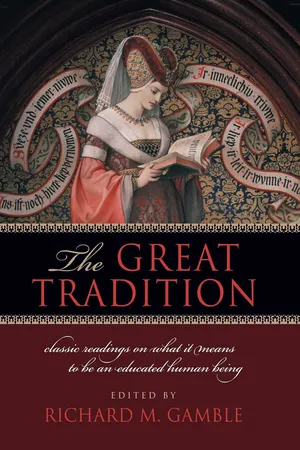
Frustrated with the continuing educational crisis of our time, concerned parents, teachers, and students sense that true reform requires more than innovative classroom technology, standardized tests, or skills training. An older tradition—the Great Tradition—of education in the West is waiting to be heard. Since antiquity, the Great Tradition has defined education first and foremost as the hard work of rightly ordering the human soul, helping it to love what it ought to love, and helping it to know itself and its maker. In the classical and Christian tradition, the formation of the soul in wisdom, virtue, and eloquence took precedence over all else, including instrumental training aimed at the inculcation of "useful" knowledge. Edited by historian Richard Gamble, this anthology reconstructs a centuries-long conversation about the goals, conditions, and ultimate value of true education. Spanning more than two millennia, from the ancient Greeks to contemporary writers, it includes substantial excerpts from more than sixty seminal writings on education. Represented here are the wisdom and insight of such figures as Xenophon, Plato, Aristotle, Seneca, Cicero, Basil, Augustine, Hugh of St. Victor, Bonaventure, Thomas Aquinas, Martin Luther, John Calvin, Erasmus, Edmund Burke, John Henry Newman, Thomas Arnold, Albert Jay Nock, Dorothy Sayers, C. S. Lewis, and Eric Voegelin. In an unbroken chain of giving and receiving, The Great Tradition embraced the accumulated wisdom of the past and understood education as the initiation of students into a body of truth. This unique collection is designed to help parents, students, and teachers reconnect with this noble legacy, to articulate a coherent defense of the liberal arts tradition, and to do battle with the modern utilitarians and vocationalists who dominate educational theory and practice.
eBook - ePub
The Great Tradition
Classic Readings on What It Means to Be an Educated Human Being
- 690 pages
- English
- ePUB (mobile friendly)
- Available on iOS & Android
eBook - ePub
The Great Tradition
Classic Readings on What It Means to Be an Educated Human Being
About this book
Information
Topic
DidatticaSubtopic
Didattica inclusivaTable of contents
- Cover
- Title Page
- Dedication
- Acknowledgments
- Introduction
- 1. Plato
- 2. Xenophon
- 3. Isocrates
- 4. Aristotle
- 5. Cicero
- 6. Vitruvius
- 7. Seneca
- 8. Quintilian
- 9. Tacitus
- 10. Plutarch
- 11. Philo
- 12. Clement of Alexandria
- 13. Origen
- 14. Basil the Great
- 15. John Chrysostom
- 16. Jerome
- 17. Augustine
- 18. Cassiodorus
- 19. Gregory the Great
- 20. Alcuin
- 21. Rhabanus Maurus
- 22. Hugh of ST. Victor
- 23. John of Salisbury
- 24. Thomas Aquinas
- 25. Bonaventure
- 26. Petrarch
- 27. Pier Paolo Vergerio
- 28. Christine de Pizan
- 29. Leonardo Bruni
- 30. Aeneas Silvius
- 31. Erasmus
- 32. Martin Luther
- 33. Ulrich Zwingli
- 34. Juan Luis Vives
- 35. Thomas Elyot
- 36. Philip Melanchthon
- 37. Johann Sturm
- 38. John Calvin
- 39. Roger Ascham
- 40. The Society of Jesus
- 41. John Milton
- 42. Giambattista Vico
- 43. Edmund Burke
- 44. Edward Copleston
- 45. Thomas Arnold
- 46. John Henry Newman
- 47. Irving Babbitt
- 48. Paul Elmer More
- 49. A. G. Sertillanges
- 50. Albert Jay Nock
- 51. Simone Weil
- 52. C. S. Lewis
- 53. Dorothy Sayers
- 54. T. S. Eliot
- 55. Christopher Dawson
- 56. Michael Oakeshott
- 57. Eric Voegelin
- Sources and Permissions
- About the Author
- Copyright
Trusted by 375,005 students
Access to over 1.5 million titles for a fair monthly price.
Study more efficiently using our study tools.
Frequently asked questions
Yes, you can cancel anytime from the Subscription tab in your account settings on the Perlego website. Your subscription will stay active until the end of your current billing period. Learn how to cancel your subscription
No, books cannot be downloaded as external files, such as PDFs, for use outside of Perlego. However, you can download books within the Perlego app for offline reading on mobile or tablet. Learn how to download books offline
Perlego offers two plans: Essential and Complete
- Essential is ideal for learners and professionals who enjoy exploring a wide range of subjects. Access the Essential Library with 800,000+ trusted titles and best-sellers across business, personal growth, and the humanities. Includes unlimited reading time and Standard Read Aloud voice.
- Complete: Perfect for advanced learners and researchers needing full, unrestricted access. Unlock 1.5M+ books across hundreds of subjects, including academic and specialized titles. The Complete Plan also includes advanced features like Premium Read Aloud and Research Assistant.
We are an online textbook subscription service, where you can get access to an entire online library for less than the price of a single book per month. With over 1.5 million books across 990+ topics, we’ve got you covered! Learn about our mission
Look out for the read-aloud symbol on your next book to see if you can listen to it. The read-aloud tool reads text aloud for you, highlighting the text as it is being read. You can pause it, speed it up and slow it down. Learn more about Read Aloud
Yes! You can use the Perlego app on both iOS and Android devices to read anytime, anywhere — even offline. Perfect for commutes or when you’re on the go.
Please note we cannot support devices running on iOS 13 and Android 7 or earlier. Learn more about using the app
Please note we cannot support devices running on iOS 13 and Android 7 or earlier. Learn more about using the app
Yes, you can access The Great Tradition by Richard M. Gamble in PDF and/or ePUB format, as well as other popular books in Didattica & Didattica inclusiva. We have over 1.5 million books available in our catalogue for you to explore.