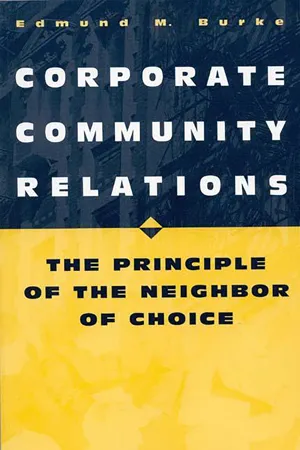
Burke challenges the current thesis that companies should act responsibly toward communities and societies. Instead, he shows that changes in society mandate that companies must develop strategies and programs that foster a reputation of trust in local communities in order that they preserve their license to operate. Burke describes strategies and programs of action that enable companies to develop trust and thus maintain their license to operate. He also describes ways to use philanthropy and volunteer programs to achieve a competitive advantage.
The public environment in which companies operate has changed significantly since the 1970s. Communities, in response to elected officials and community groups, are demanding that companies observe new norms of behavior. They expect companies to respect the environment, respond to the concerns of the community residents, and contribute to the support of community institutions. As Burke illustrates, a company's community reputation also affects the behavior of consumers and employees. Consumers prefer to buy products from companies that are involved in the community. Employees are attracted to companies that have a good community reputation.
Just as successful companies need to be a supplier of choice, an employer of choice, and an investor of choice, they now have to become a neighbor of choice. They have to behave in ways that build a legacy of trust in order to be positioned positively in the community. As Burke shows, to be a neighbor of choice, a company has to pursue three strategies: build sustainable and ongoing relationships with key community individuals, groups, and organizations; institute procedures that anticipate and respond to community expectations, concerns, needs, and issues; and focus the company's community programs on ways that promote and strengthen the community's quality of life and which also support the business goals of the company. The strategies developed by Burke will be of great use to community and public affairs managers and general managers of corporations as well as CEOs and other executive officers. Students in courses on corporate strategy and general management will find the book of value, as will students in courses on non-profit management.
- 206 pages
- English
- PDF
- Available on iOS & Android
eBook - PDF
Table of contents
- Contents
- Foreword: Why Merck Wants to Be a Neighbor of Choice
- Acknowledgments
- Introduction: The New Expectations of Today's Corporate Communities
- I. The Principle of the Neighbor of Choice
- II. Implementing the Neighbor of Choice
- III. The Three Strategies
- IV. The Social Vision
- Selected Bibliography
- Name Index
- Subject Index
Trusted by 375,005 students
Access to over 1.5 million titles for a fair monthly price.
Study more efficiently using our study tools.
Frequently asked questions
Yes, you can cancel anytime from the Subscription tab in your account settings on the Perlego website. Your subscription will stay active until the end of your current billing period. Learn how to cancel your subscription
No, books cannot be downloaded as external files, such as PDFs, for use outside of Perlego. However, you can download books within the Perlego app for offline reading on mobile or tablet. Learn how to download books offline
Perlego offers two plans: Essential and Complete
- Essential is ideal for learners and professionals who enjoy exploring a wide range of subjects. Access the Essential Library with 800,000+ trusted titles and best-sellers across business, personal growth, and the humanities. Includes unlimited reading time and Standard Read Aloud voice.
- Complete: Perfect for advanced learners and researchers needing full, unrestricted access. Unlock 1.5M+ books across hundreds of subjects, including academic and specialized titles. The Complete Plan also includes advanced features like Premium Read Aloud and Research Assistant.
We are an online textbook subscription service, where you can get access to an entire online library for less than the price of a single book per month. With over 1.5 million books across 990+ topics, we’ve got you covered! Learn about our mission
Look out for the read-aloud symbol on your next book to see if you can listen to it. The read-aloud tool reads text aloud for you, highlighting the text as it is being read. You can pause it, speed it up and slow it down. Learn more about Read Aloud
Yes! You can use the Perlego app on both iOS and Android devices to read anytime, anywhere — even offline. Perfect for commutes or when you’re on the go.
Please note we cannot support devices running on iOS 13 and Android 7 or earlier. Learn more about using the app
Please note we cannot support devices running on iOS 13 and Android 7 or earlier. Learn more about using the app
Yes, you can access Corporate Community Relations by Edmund M. Burke in PDF and/or ePUB format, as well as other popular books in Business & Business General. We have over 1.5 million books available in our catalogue for you to explore.