- Chapters are organized around a process model for CSR that outlines steps for researching, developing, implementing, and evaluating CSR initiatives
- Emphasizes stakeholder engagement as a foundation throughout the CSR Process Model
- Discusses ways to maximize the use of social media and traditional media throughout the process
- Offers international examples drawn from a variety of industries including: The Forest Stewardship Council, Starbucks Coffee, and IKEA.
- Draws upon theories grounded in various disciplines, including public relations, marketing, media, communication, and business
eBook - ePub
Managing Corporate Social Responsibility
A Communication Approach
- English
- ePUB (mobile friendly)
- Available on iOS & Android
eBook - ePub
Managing Corporate Social Responsibility
A Communication Approach
About this book
Managing Corporate Social Responsibility offers a strategic, communication-centred approach to integrating CSR into organizations. Drawing from a variety of disciplines and written in a highly accessible style, the book guides readers in a focused progression providing the key points they need to successfully navigate the benefits and implications of managing CSR.
Information
1
Conceptualizing Corporate Social Responsibility
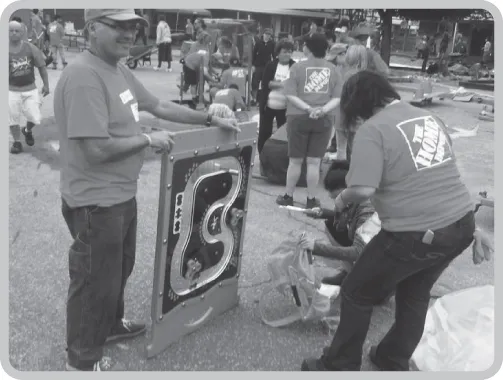
Home Depot, the world’s largest home improvement retailer, operates in the US, Canada, Mexico, and China. Home Depot supports “Team Depot,” a volunteer program led by store associates that participates in community programs.
Courtesy of Volunteer Canada
Apartheid is an historical artifact for many people reading this book rather than a current issue or reality. Apartheid was a severe, state-sanctioned racial segregation practiced in South Africa and what was then called Rhodesia (now Zimbabwe). A white minority used apartheid to oppress the indigenous black populations. In the 1970s, Dr. Leon Howard Sullivan, a US minister, plotted a corrective course of action that became known as the Sullivan Principles. The Sullivan Principles were designed to help end apartheid in South Africa by placing requirements on US corporations wanting to conduct business in South Africa. Box 1.1 lists the final seven points to the Sullivan Principles (Leon H. Sullivan Foundation, n.d.). The Sullivan Principles, along with the divestment campaign of the 1980s, did exert some pressure on the South African government. The divestment campaign worked in tandem with the Sullivan Principles. Investors were asked to divest (remove investments) from any US companies that did not adopt the Sullivan Principles. College campuses were a hotbed of activity for divestment pressures in the 1980s. Campus protests brought attention to the issue and pressured universities to cease investing in corporations doing business in South Africa. While the Sullivan Principles alone precipitated very little change, the divestment campaign is credited with having a significant effect on eradicating apartheid in South Africa.
Box 1.1 The Sullivan Principles
1. Non-segregation of the races in all eating, comfort, and work facilities.
2. Equal and fair employment practices for all employees.
3. Equal pay for all employees doing equal or comparable work for the same period of time.
4. Initiation of and development of training programs that will prepare, in substantial numbers, blacks and other nonwhites for supervisory, administrative, clerical, and technical jobs.
5. Increasing the number of blacks and other nonwhites in management and supervisory positions.
6. Improving the quality of life for blacks and other nonwhites outside the work environment in such areas as housing, transportation, school, recreation, and health facilities.
7. Working to eliminate laws and customs that impede social, economic, and political justice. (added in 1984)
Source: Leon H. Sullivan Foundation (n.d.).
The Sullivan Principles and related divestment efforts are indicators of corporate social responsibility (CSR) making a difference on a global scale. Fair treatment of workers and socially responsible investing are recognized today as CSR. The Sullivan Principles provide a foundation for socially responsible investing and, therefore, comprise a form of CSR as well. The focus of the Sullivan Principles was social improvement through the elimination of apartheid. The Sullivan Principles were not the first CSR effort or the first socially responsible investing guidelines to appear in the business world. However, the anti-apartheid efforts illustrated the potential power of CSR. Corporations were pressured to change their behavior not because their actions were illegal but because their actions failed to meet expectations for responsible behavior.
On December 3, 1984, the Union Carbide India Limited facility in Bhopal, India, leaked tons of deadly methyl isocyanate (MIC) gas. Bhopal quickly became the worst industrial accident in the history of the world. Estimates place the death toll at between 3,000 and 10,000 people in the first 72 hours. One estimate places the number of those who have died since being exposed at around 15,000. Between 120,000 to 500,000 people suffered permanent medical conditions from the exposure (Amnesty, 2009). Investigative reports since the accident all noted lax safety as the cause. Union Carbide’s own investigation identified procedural violations and operating errors (Diamond, 1985). Many safety systems did not function, and overall the facility was in disrepair. This created a very unsafe operating environment that led to tragic consequences for employees and those living near the facility (Bedford, 2009).
People in the United States were concerned because Union Carbide was using the same chemical at a US facility. Union Carbide reassured US citizens that the facility in the United States was safer. That led some people to question the original safety commitment in Bhopal (Diamond, 1984). Here is one description of the safety discrepancies between Bhopal and the United States.
Carbide had dropped the safety standards at the Bhopal plant well below those it maintained at a nearly identical facility in West Virginia. It is also important to note here that Carbide was able to operate its deteriorating plant because industrial safety and environmental laws and regulations were lacking or were not strictly enforced by the state of Madhya Pradesh or the Indian government making them indirectly responsible for the tragedy at Bhopal.
(Trade Environmental Database, 1997)
The US facility was slightly different as it had fewer control systems and relied more on manual rather than automatic systems (Shabecoff, 1984). In fact, Union Carbide documents released during litigation indicated the Bhopal facility was built using some untested technologies (Trade Environmental Database, 1997).
Bhopal should not be forgotten so that it is never repeated. Bhopal stands as an appalling example of the exploitation of developing countries. The same deadly chemical was present in Bhopal, India, and in the United States. In Bhopal, the safety standards were lax from the start and were allowed to deteriorate. In the United States, the safety standards were maintained to a higher standard. Why the neglect in Bhopal? The answer is financial gain. Union Carbide saved money by requiring less rigorous safety standards in India and by not investing in preventative maintenance (Bedford, 2009). We cannot assume corporations will naturally act in a responsible or even a humane manner. This is not to say that all corporations are inherently evil and callous toward constituent safety. Bhopal reminds us that CSR may not be naturally occurring within the corporate environment. The allure of profit sometimes can be deadly for constituents.
Nike remains the leader in the athletic shoe and garment market globally. The brand is widely recognized around the world and associated with winning. In the 1990s, Nike became associated with sweatshops and exploitation of workers. Many nongovernment organizations (NGOs), such as Global Exchange and Sweatshop Watch, began to complain about the treatment of workers in facilities that supplied Nike with products and materials. This mix of religious, student, and labor groups noted problems with corporal punishment, low wages, forced overtime, inhumane working conditions, and child labor (Team Sweat, 2008). An awareness campaign used public relations to inform constituents about the origin of Nike products. Combining the Internet with traditional news exposés, the NGOs were able to exercise a significant amount of pressure on Nike to reform its practices. Constituents increased public awareness of supplier practices, and this created negative publicity and pressure for Nike to change (Carty, 2002). We should note that the sweatshop issue was (and continues to be) endemic to the entire garment and shoe industry, not just Nike. Nike was targeted because activists know that confronting the market leader maximizes the attention that activists attract for their efforts.
NGOs included universities in the United States as their targets for the Nike effort. Students used various public relations tactics to pressure administrations into changing contracts if Nike did not alter its business practices. US universities have lucrative athletic shoe contracts with major shoe manufacturers such as Nike, Adidas, and Reebok. The Nike labor case illustrates how public relations becomes translated into political pressure via financial threats. Negative attention on the supply chain created policy changes (Bullert, 2000). O’Rourke (2005) notes that the NGOs used public relations and marketing campaigns to alter global production and consumption. The public relations efforts shifted demand from “problematic to improved products” (O’Rourke, 2005, p. 116). In essence, socially responsible consumption was creating more socially responsible corporate behavior – consumers were pushing for CSR.
These three vignettes are all pieces of the mosaic that comprise corporate social responsibility. They offer different insights into CSR and its transformative potential while reminding us that CSR transpires within a business landscape, not some abstract utopia. In these three cases, corporations engaged in “bad behavior” while experiencing economic success. But the public scrutiny of their actions contributed to outrage and pressure for change. As we shall see, pressure for “responsible behavior” may originate from inside the organization (e.g., it is seen as central to its mission), or they may emanate from pressures outside the organization as we saw in the three cases at the beginning of this chapter.
The challenge in discussing CSR is that it is not reducible to one simple concept. Our examples illustrate how irresponsible corporate behavior may take many forms. Similarly, responsible behavior is not easily defined. Nor can concerns surrounding CSR be traced to one common history. CSR is a composite of activities drawn from different academic and professional disciplines. Moreover, what constitutes CSR actions will differ from country to country. The complex nature of CSR results in a challenging first chapter that explains the conceptualization of CSR we have developed for this book, identifies costs and benefits for the corporation and society, and demonstrates the value of a communication-centered approach to CSR.
Throughout this book, we refer to stakeholders, their relationship to CSR and the corporation, and their role in the CSR process. Edward Freeman (1984) provides the classic definition of a stakeholder as “any group or individual who can affect or is affected by the achievement of organizational objectives” (p. 46). How the group or individual affects or is affected by the organization is the stake that binds them to the organization. We acknowledge that this is a broad definition and can even include nonhuman entities such as the environment. Our communication approach to CSR focuses on the importance of stakeholders and the stakeholder engagement process in conceptualizing, implementing, and evaluating CSR initiatives.
Thinking in terms of stakeholders represents a way of classifying or segmenting people – dividing people into similar groups. That is why writers often refer to types or categories of stakeholders. The stake is used to create the categories for segmentation. Typical stakeholder categories include employees (for whom employment is the stake), members of the community (for whom living near the organization is the stake), customers (for whom the product or service is the stake), and investors (for whom financial interest is the stake). Stakeholders also can be conceptualized in terms of CSR concerns or interests. For example, some stakeholders are especially concerned about and segmented according to environmental issues like air and water pollution, depletion of natural resources, or organizational impacts on endangered species. Their interest in environmental concerns is the stake that binds them to the organization. Other stakeholders are concerned with human rights and labor issues. They may focus on issues like child labor, the rights of workers to unionize, or workplace safety. The concerns of stakeholders can change and lead them to redefine their memberships. For example, those living near or working at Union Carbide’s Bhopal facility may have thought of themselves as having an economic stake in its success. But that stake may have shifted dramatically following the Bhopal industrial accident and be broadened to include health and life-and-death concerns. Stakes also can shift when people are made aware of the relevance of the corporation to their interests. For instance, campaigns have helped to inform consumers of the conditions under which their apparel is manufactured and have led them to demand change. Stakeholders, their relationships with corporations, and communication’s role in this relationship and the CSR process comprise the major theme woven throughout this book.
Corporate Social Responsibility: Seeking Parameters
When introducing a concept, it is important to define that concept and to articulate its parameters. We cannot assume everyone is working from the same conceptualization. That is especially true for CSR since it lacks one accepted definition and is a concept utilized in a variety of academic and professional disciplines. Moreover, the actions that constitute CSR can vary widely. Conceptualizing CSR is much like trying to map sand dunes in a desert. We can see the dunes, but they shift over time in both location and the grains of sand that comprise the dunes. What we can understand about dunes is that they are composed of sand and that certain forces, such as wind, serve to shape them. As we conceptualize CSR, we need to take a macro rather than a micro view to identify common elements within CSR. In a way, we are treating CSR as a philosophy and a process that anchors practices that can transform organizational behavior. We realize not everyone will agree with this approach and how we conceptualize CSR. However, we need to make a stand somewhere, and hopefully our conceptualization will stimulate discussion – even if part of that discussion targets what people feel we have failed to include.
At its most abstract, CSR is about the role of business in society. Nobel Prize-winning economist Milton Friedman (1962) is the most notable voice to claim that the primary role of business is to make money. We cannot deny this conclusion because if businesses do not make money they cease to operate, resulting in lost jobs, tax revenues, and investments. But a CSR orientation challenges the notion that the pursuit of financial concerns should be the sole or even the dominant concern of corporations. Instead, businesses are urged to consider their effects on the entire range of stakeholders connected with their operations, not just the financial stakeholders. In addition, businesses must consider their effects on the natural and social environments. The CSR philosophy encourages businesses to use their expertise and other resources to improve society.
Defining CSR
Our conceptualization of CSR is influenced by definitions that have preceded this book. For example, we appreciate Werther and Chandler’s (2006, 2011) characterization of CSR as both a means and an end. They explain that CSR is a means because it “is an integral element of the firm’s strategy: the way a firm goes about delivering its products or services to markets” (2006, p. 8). CSR is an end because it “is a way of maintaining the legitimacy of its actions in the larger society by bringing stakeholder concerns to the foreground” (2006, p. 8). We concur and believe that CSR is both a means and an end, a process and an outcome. Being socially responsible necessitates a focus on business practices and the outcomes associated with those practices. Those outcomes are not merely financial; rather, outcomes include sensitivity to the impacts on stakeholders. CSR can best contribute to the societal good when CSR acknowledges and incorporates the concerns of the wider society.
Along the same lines, the European Commission (EC) defines CSR as follows: “A concept whereby companies integrate social and environmental concerns in their business operations and in their interaction with their stakeholders on a voluntary basis” (European Commission, 2010). This definition also joins business practices with stakeholder concerns. As reflected in the EC’s definition and W...
Table of contents
- Cover
- Title page
- Copyright page
- Dedication
- Acknowledgments
- 1 Conceptualizing Corporate Social Responsibility
- 2 Strategic CSR
- 3 CSR Scanning and Monitoring
- 4 Formative Research
- 5 Create the CSR Initiative
- 6 Communicate the CSR Initiative
- 7 Evaluation and Feedback
- 8 CSR Issues
- References
- Index
- Download CD/DVD content
Trusted by 375,005 students
Access to over 1.5 million titles for a fair monthly price.
Study more efficiently using our study tools.
Frequently asked questions
Yes, you can cancel anytime from the Subscription tab in your account settings on the Perlego website. Your subscription will stay active until the end of your current billing period. Learn how to cancel your subscription
No, books cannot be downloaded as external files, such as PDFs, for use outside of Perlego. However, you can download books within the Perlego app for offline reading on mobile or tablet. Learn how to download books offline
Perlego offers two plans: Essential and Complete
- Essential is ideal for learners and professionals who enjoy exploring a wide range of subjects. Access the Essential Library with 800,000+ trusted titles and best-sellers across business, personal growth, and the humanities. Includes unlimited reading time and Standard Read Aloud voice.
- Complete: Perfect for advanced learners and researchers needing full, unrestricted access. Unlock 1.5M+ books across hundreds of subjects, including academic and specialized titles. The Complete Plan also includes advanced features like Premium Read Aloud and Research Assistant.
We are an online textbook subscription service, where you can get access to an entire online library for less than the price of a single book per month. With over 1.5 million books across 990+ topics, we’ve got you covered! Learn about our mission
Look out for the read-aloud symbol on your next book to see if you can listen to it. The read-aloud tool reads text aloud for you, highlighting the text as it is being read. You can pause it, speed it up and slow it down. Learn more about Read Aloud
Yes! You can use the Perlego app on both iOS and Android devices to read anytime, anywhere — even offline. Perfect for commutes or when you’re on the go.
Please note we cannot support devices running on iOS 13 and Android 7 or earlier. Learn more about using the app
Please note we cannot support devices running on iOS 13 and Android 7 or earlier. Learn more about using the app
Yes, you can access Managing Corporate Social Responsibility by W. Timothy Coombs,Sherry J. Holladay in PDF and/or ePUB format, as well as other popular books in Business & Advertising. We have over 1.5 million books available in our catalogue for you to explore.