- 360 pages
- English
- ePUB (mobile friendly)
- Available on iOS & Android
About this book
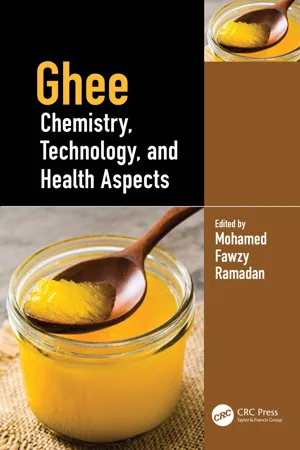
Ghee (clarified milk fat) is a dairy product composed mainly of milk fat and minor components, such as vitamins, minerals, and enzymes; and butter oil has a bland flavor, whereas ghee has a pleasing flavor. In 18 chapters, Ghee: Chemistry, Technology, and Health Aspects covers topics focusing on ghee chemistry and physicochemical properties, and ghee processing and applications, as well as ghee biosafety and health effects.
Features:
- Explores the chemistry of ghee from different dairy sources
- Discusses ghee functional constituents and their health-enhancing potential
- Written by industry experts and international scientists
- Addresses ghee-growing applications in clinical nutrition, functional foods, pharmaceuticals, nutraceuticals, and cosmetics
Authored by a team of experts, this book brings a diversity of lipid science developments to chemists, nutritionists, and researchers in the fields of food science, nutrition, food chemistry and technology, cosmetics, and nutraceuticals. This book is an essential textbook for healthy food developers as well as the research and development (R&D) researchers using milk fats. Meanwhile, it is a valuable reference work for edible fat and oil companies reformulating their products or developing new healthy products.
Frequently asked questions
- Essential is ideal for learners and professionals who enjoy exploring a wide range of subjects. Access the Essential Library with 800,000+ trusted titles and best-sellers across business, personal growth, and the humanities. Includes unlimited reading time and Standard Read Aloud voice.
- Complete: Perfect for advanced learners and researchers needing full, unrestricted access. Unlock 1.4M+ books across hundreds of subjects, including academic and specialized titles. The Complete Plan also includes advanced features like Premium Read Aloud and Research Assistant.
Please note we cannot support devices running on iOS 13 and Android 7 or earlier. Learn more about using the app.
Information
Table of contents
- Cover
- Half Title
- Title Page
- Copyright Page
- Dedication
- Table of Contents
- Foreword
- Preface
- About the Editor
- List of Contributors
- Chapter 1 Introduction to Ghee: Chemistry, Technology, and Health Aspects
- Chapter 2 Standards and Labeling of Ghee and Ghee-Derived Products
- Chapter 3 Cow Ghee: Chemistry, Technology, and Functional Properties
- Chapter 4 Nutritional and Productive Aspects of Ghee: Effect of Including Tithonia diversifolia Flour in the Concentrates of Lactating Cows
- Chapter 5 Buffalo Ghee: Chemistry, Technology, and Functional Properties
- Chapter 6 Camel Ghee: Chemistry, Technology, and Functional Properties
- Chapter 7 Camel Ghee: Nutritional Value and Health Aspects
- Chapter 8 Sheep Ghee: Chemistry, Technology, and Functional Properties
- Chapter 9 Ghee: Fatty Acids, Triacylglycerols, and Phospholipids
- Chapter 10 Acrylamide, Trans-Fatty Acids, and Cholesterol Oxides in Ghee
- Chapter 11 Ghee Aroma Compounds and Maillard Reaction Products
- Chapter 12 Ghee: Chemistry and Physicochemical Properties
- Chapter 13 Ghee Microemulsion: Chemistry and Properties
- Chapter 14 Ghee Manufacturing and Processing
- Chapter 15 Quality Markers of Ghee during Storage: Oxidative Stability, Microbial, and Sensory Properties
- Chapter 16 Novel Ghee Adulteration Detection Methods
- Chapter 17 Preparation and Properties of Low-Cholesterol Ghee
- Chapter 18 Chemistry and Safety of Ghee Residue
- Index