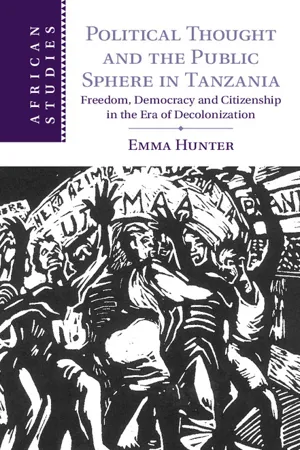
eBook - PDF
Political Thought and the Public Sphere in Tanzania
Freedom, Democracy and Citizenship in the Era of Decolonization
- 284 pages
- English
- PDF
- Available on iOS & Android
eBook - PDF
Political Thought and the Public Sphere in Tanzania
Freedom, Democracy and Citizenship in the Era of Decolonization
About this book
Political Thought and the Public Sphere in Tanzania is a study of the interplay of vernacular and global languages of politics in the era of decolonization in Africa. Decolonization is often understood as a moment when Western forms of political order were imposed on non-Western societies, but this book draws attention instead to debates over universal questions about the nature of politics, concept of freedom and the meaning of citizenship. These debates generated political narratives that were formed in dialogue with both global discourses and local political arguments. The United Nations Trusteeship Territory of Tanganyika, now mainland Tanzania, serves as a compelling example of these processes. Starting in 1945 and culminating with the Arusha Declaration of 1967, Emma Hunter explores political argument in Tanzania's public sphere to show how political narratives succeeded when they managed to combine promises of freedom with new forms of belonging at local and national level.
Information
Table of contents
- Cover
- Half-title
- Series information
- Title page
- Copyright information
- Table of contents
- Acknowledgements
- Map of Tanzania
- List of abbreviations
- Introduction
- 1 Concepts of Progress in Mid-Twentieth-Century Tanzania
- 2 Transnational Languages of Democracy after 1945
- 3 Representation, Imperial Citizenship and the Political Subject in Late Colonial Tanganyika
- 4 Patriotic Citizenship and the Case of the Kilimanjaro Chagga Citizens Union
- 5 Freedom in Translation
- 6 Languages of Democracy on Kilimanjaro and the Fall of Marealle
- 7 ‘One-Party Democracy’
- 8 Ujamaa and the Arusha Declaration
- Conclusion
- References
- Index
Trusted by 375,005 students
Access to over 1.5 million titles for a fair monthly price.
Study more efficiently using our study tools.
Frequently asked questions
Yes, you can cancel anytime from the Subscription tab in your account settings on the Perlego website. Your subscription will stay active until the end of your current billing period. Learn how to cancel your subscription
No, books cannot be downloaded as external files, such as PDFs, for use outside of Perlego. However, you can download books within the Perlego app for offline reading on mobile or tablet. Learn how to download books offline
We are an online textbook subscription service, where you can get access to an entire online library for less than the price of a single book per month. With over 1.5 million books across 990+ topics, we’ve got you covered! Learn about our mission
Look out for the read-aloud symbol on your next book to see if you can listen to it. The read-aloud tool reads text aloud for you, highlighting the text as it is being read. You can pause it, speed it up and slow it down. Learn more about Read Aloud
Yes! You can use the Perlego app on both iOS and Android devices to read anytime, anywhere — even offline. Perfect for commutes or when you’re on the go.
Please note we cannot support devices running on iOS 13 and Android 7 or earlier. Learn more about using the app
Please note we cannot support devices running on iOS 13 and Android 7 or earlier. Learn more about using the app
Yes, you can access Political Thought and the Public Sphere in Tanzania by Emma Hunter in PDF and/or ePUB format, as well as other popular books in History & African History. We have over 1.5 million books available in our catalogue for you to explore.