"Engaging case studies . . . add to understanding the social processes of voluntary and forced displacement within the continent and across the seas." —
Choice
Spurred by major changes in the world economy and in local ecology, the contemporary migration of Africans, both within the continent and to various destinations in Europe and North America, has seriously affected thousands of lives and livelihoods.
The contributors to this volume, reflecting a variety of disciplinary perspectives, examine the causes and consequences of this new migration. The essays cover topics such as rural-urban migration into African cities, transnational migration, and the experience of immigrants abroad, as well as the issues surrounding migrant identity and how Africans re-create community and strive to maintain ethnic, gender, national, and religious ties to their former homes.
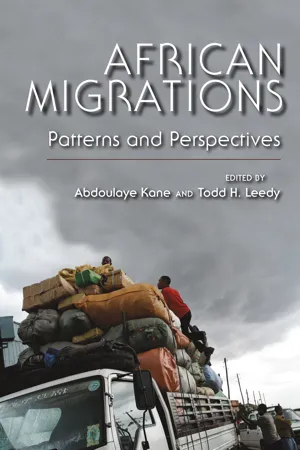
eBook - ePub
African Migrations
Patterns and Perspectives
- 316 pages
- English
- ePUB (mobile friendly)
- Available on iOS & Android
eBook - ePub
African Migrations
Patterns and Perspectives
About this book
Information
PART 1
PSYCHOLOGICAL, SOCIOCULTURAL, AND POLITICAL DIMENSIONS OF AFRICAN MIGRATION
1
OVERCOMING THE ECONOMISTIC FALLACY
SOCIAL DETERMINANTS OF VOLUNTARY MIGRATION FROM THE SAHEL TO THE CONGO BASIN
THE “WORLD’S WORST CITY”
Brazzaville, capital of the Republic of Congo, is of modest size by world standards, with a population currently estimated at somewhere between 1.2 and 1.5 million. It is also in many respects typical of cities throughout Africa and the global South, characterized by rapid population growth, high unemployment, and shrinking public resources. While this erstwhile somnolent colonial outpost was once (briefly) renowned as the capital of Free France during the Second World War, during the 1990s Brazzaville became remarkable mainly as the scene of recurring violence by ethno-political factions vying for control of the Congolese state and its substantial oil revenues. These conflicts claimed tens of thousands of lives and forced hundreds of thousands to flee the city. Meanwhile, real income, education, and health indicators dropped sharply (Yengo 2006). The decade of unrest and economic stagnation tarnished Brazzaville’s reputation to the point that in 2003 it was actually named the “world’s worst city” in a global survey conducted by an international human resources firm.1
Herein lies a paradox that has propelled my research since I first visited Brazzaville in 2003. This city, wracked by war, economic decline, and joblessness, is also home to hundreds of thousands of immigrants. The vast majority of them come from across the Congo River in the Democratic Republic of Congo (DRC). But Brazzaville’s immigrant population also includes an estimated 30,000 to 40,000 people from the West African Sahel, especially Mali, Guinea, and Senegal. Although Congo has been home in recent years to a few thousand refugees from Rwanda and the DRC, its West African residents are not forced migrants: they are entrepreneurs, petty traders, and unskilled laborers who have come to Congo to seek their fortunes at great personal expense and often considerable risk. Over decades and generations, they have come to constitute a reasonably successful immigrant community in Brazzaville, an important element of the city’s commercial sector and an enduring part of its social landscape.
What is it that draws these people to Brazzaville? What rewards do they expect to reap, and what opportunities do they encounter after traveling over 2,000 miles (frequently overland) from their West African countries of origin? As an anthropologist seeking to answer these questions, I have found that prevailing theories of the determinants of migration are not always adequate to the task. These theories, which rely overwhelmingly on analysis of economic factors, tend to obscure the social embeddedness of individual migrants, thereby preventing a more complete understanding of human spatial mobility and its underlying motivations. In this chapter, I demonstrate how established explanations of migration’s causes may be enhanced by considering the social forces that mediate economic decision-making processes.
MIGRANT MOTIVATIONS: AN OVERVIEW
There is broad agreement among scholars across academic disciplines that the primary causes of voluntary migration are economic in nature. A number of theoretical models offer competing but also potentially complementary explanations at both the micro- and macro-levels (Massey et al. 1994; Brettell and Hollifield 2008). Neoclassical economic analysis emphasizes the role of differing wages and unemployment rates in influencing an individual’s decision to move from one place to another, with “high wage countries” drawing migrants away from “low wage countries.” The value of migration can be understood as the expected standard of living abroad, minus the expected standard of living at home, minus the costs of migrating (Carling 2002). The “new economics of migration” focuses on risk management and economic diversification at the household level, casting migration as the product of conscious strategies by household heads to protect themselves and their kin from the vagaries of climate and market conditions. Segmented labor market theory considers the demand from employers in developed countries for cheap, low-skilled workers from abroad; this demand creates bifurcated labor markets in host countries, with a high-skill, high-wage upper stratum dominated by natives and a low-skill, low-wage stratum dominated by immigrants. At the highest level of abstraction, world systems theory stresses economic globalization—the integration of societies into a single capitalist world system—as the driving force behind international migration, drawing people from poor countries of the economic “periphery” to the wealthy countries of the “core” (and particularly to a select few “global cities”) (Sassen 1991). In all these models, social and cultural factors are secondary. Only after a migration flow has been initiated by wage gaps, economic uncertainty, or labor demand do such factors as social networks come into play, sustaining and expanding the flow by lowering the costs and risks of migration for each successive wave of migrants. Over time a “culture of migration” may be created in migrant-sending societies. Leaving home to seek opportunities abroad becomes the normative course of action in these societies, a virtual rite of passage, particularly as successful returning migrants create a “demonstration effect” (Massey et al. 1994: 737).
The models outlined above have been the subject of numerous critiques, notably by anthropologists who have called attention to the ways migration flows are structured by power differentials and especially gender inequality within sending societies and households (Brettell 2008). But these economic theories remain very much the dominant narratives in explaining human spatial mobility, and there seems to be a general consensus among researchers that material factors—not ideational ones—constitute the real driving forces behind migration. In the words of Alan Gilbert and Josef Gugler, “the evidence is overwhelming: most people move for economic reasons” (Gilbert and Gugler 1992: 66–67).
What, then, can cultural anthropologists, known for paying close attention to the ideational components of people’s actions, bring to the discussion about migration and its motivations? We tend to be interested in the webs of meaning that human beings generate and their effects on human behavior; we believe that it is vital to understand how people represent their own actions to themselves and others. With respect to migration, we want to know what people think and what they feel about why they are leaving home. In my own research, most people I have asked about their reasons for migrating have articulated ideational as well as economic motivations. Migrants tend to express a strong desire to see the world and to broaden their horizons, comparing migration to a form of education (Riccio 2004). The “bright lights” and other attractions of far destinations surely have a strong pull, especially for people from poor rural communities.
Anthropologists cannot, however, afford to ignore material factors in their analysis. Indeed, we must study the conjuncture of the material and the ideational. Many of us suspect that ideational motivations alone do not entice people to leave home. It is when they are coupled with economic incentives that they are most likely to become operative, to turn migration from a vague desire to a concrete intention to a reality. My aim here is therefore not to challenge the scholarly consensus behind the economic foundations of migration. Rather, using the case of West African immigrants in Brazzaville, I seek to show how the economic determinants of migration are modulated by social forces, and specifically how unexpected migration outcomes can result from this process of modulation.
The apparent paradox of migration to impoverished or unstable cities has been a longstanding problem for Africanist scholars. Since the colonial era, research has shown that once migration to a destination becomes established, it may continue and even increase in the face of economic disincentives like high unemployment. Disjunctures between urban growth and urban economic opportunity have been observed in African urban areas, including Brazzaville, since the 1940s (Gilbert and Gugler 1992; Balandier 1985; Gondola 1996; Ferguson 1999). I turn now to an examination of some of the social forces that sustain such disjunctures in international migration within Africa, focusing on two interrelated phenomena: on the one hand, social networks; on the other, widely shared imaginaries pertaining to human dignity and modernity.
SAVED BY DISTANCE: SOCIAL NETWORKS AS A PUSH FACTOR
The role of social networks in attracting new migrants has been the subject of considerable research. Each additional migrant in a given migration flow reduces the costs and risks of migration for those left behind, such that someone with a social connection to a migrant is much more likely to become a migrant him- or herself than someone without. The social network in which the individual is embedded therefore acts as a “pull factor,” making migration a more enticing option. Studies have shown that social capital—“the aggregate of the actual or potential resources which are linked to possession of a durable network of more or less institutionalized relationships of mutual acquaintance and recognition”—has a strong correlation to the propensity to migrate internationally (Bourdieu 1986; Palloni et al. 2001).
The ability of social networks to dampen economic opportunities in one’s home community, thereby acting as a “push factor” encouraging migration, has received rather less scholarly attention. This facet of social relations, the so-called “downside of social capital,” became evident through my study of West African immigrant entrepreneurs in Brazzaville (Portes and Landolt 1996; Whitehouse 2007). These entrepreneurs are mostly small- and medium-scale retail traders, and they dominate the sale of imported goods, from food products to clothing to auto parts, in the city’s markets. I wondered what induced these individuals (all of them men) to leave their homes in Mali, Guinea, Senegal, or other countries of the Sahel to run their businesses in Brazzaville, where living standards were not necessarily better than in their home communities, where they faced a greater risk than back home of being victims of political violence and looting, and where the official business climate has been rated among the least conducive to private enterprise (World Bank 2007). I also wondered about the other side of the coin: why weren’t there more Congolese shopkeepers in Brazzaville’s marketplaces? Congolese participation in the private sector seemed clustered in a few areas like local foodstuffs and transportation, while Congolese were all but absent from the retail sale of imported goods.
The explanations received from informants, both West African and Congolese, tended toward culturalistic arguments. Congolese prefer desk jobs, the conventional wisdom went, while West Africans just seem to have commerce “in their blood.” But by probing a bit further I was able to elicit another discourse, one pertaining to entrepreneurs’ obligations to kin. Many West Africans in Brazzaville told me that they would have been unable to build up and maintain the kind of capital needed to run a business if they had stayed home, because of the volume of claims made on their resources by members of their social networks (mostly kin). In fact, the vast majority of entrepreneurs I interviewed only took up commerce after leaving home, saving start-up capital over many years of doing unskilled labor or ambulant vending in various migrant destinations. For them, migration was an integral part of their strategies for business development and success.
In the West African Sahel, as in much of Africa, it is very difficult to refuse a request from kin. Prevailing norms favor the collective welfare of the kin group over individual private accumulation of wealth, and those who turn down demands from needy relatives risk incurring strong moral and even supernatural sanctions. Parents have an especially powerful moral claim to the wealth generated by their children and can invoke a form of curse known in many Sahelian Muslim societies as danga against children who are unwilling to share (Sanneh 1996). In such a social milieu, even acquiring the funds to start up a business, let alone managing one profitably over the long term, is highly problematic. Thus arises what Keith Hart calls the “entrepreneur’s social dilemma—how to divide his resources between a public social security fund of reciprocal exchanges between familiars [on the one hand] and private accumulation towards a personalized form of security provided by capital investments [on the other]” (Hart 1975: 28).
Congolese are by no means immune to this dilemma. In fact, in their lineage-dominated society, the constraints on prospective entrepreneurs may be even greater. A number of studies have documented the social challenges faced by Congolese business owners on their home soil (Devauges 1977; Dzaka and Milandou 1994; Tsika 1995). They face the same pressures as West Africans to redistribute their wealth, and the same risk of social stigma if they fail to heed these pressures. With Congolese, however, instead of the threat of danga—redolent with Islamic values of filial piety—it is a form of spiritual aggression known as bunganga that constitutes the most potent means of compulsion. As in many African societies, in Congo the supernatural acts as an “instrument in the struggle against scarcity” (Dzaka and Milandou 1994: 109). It is also a powerful deterrent to individuals thinking of going into business in their home communities.
Emigration offers perhaps the clearest way out of the entrepreneur’s social dilemma.2 By putting some physical distance between themselves and the bulk of their kin, migrants can insulate themselves from a substantial portion of the claims placed upon their wealth and try to find a more favorable balance between embeddedness in and freedom from their social networks. The most powerful means of making a claim upon their resources—the face-to-face request—is no longer an option, and the alternatives are often difficult or costly. This is why, in the words of a Zambian migrant quoted by Lisa Cliggett, people who have left home are “saved by distance” (Cliggett 2005: 144). They still may send a considerable portion of their profits home to needy relatives, but they can now do so on their own terms, following their own timetables and in accordance with their own circumstances.
If Malian entrepreneurs have been successful in Congo (as well as in many other African countries), some observers have remarked on their under-representation in Mali’s own economy, particularly in the most profitable sectors, many of which are controlled by Lebanese (Pringle 2006). Likewise, if Congolese entrepreneurs have been unable to thrive in Brazzaville’s markets, they have had more luck in Paris (MacGaffey and Bazenguissa-Ganga 2000). Thus, even given promising formal economic inc...
Table of contents
- Cover
- Half title
- Title
- Copyright
- Dedication
- Contents
- Acknowledgments
- Introduction: African Patterns of Migration in a Global Era: New Perspectives Abdoulaye Kane and Todd H. Leedy
- Part 1. Psychological, Sociocultural, and Political Dimensions of African Migration
- Part 2. Translocal and Transnational Connections: Between Belonging and Exclusion
- Part 3. Feminization of Migration and the Appearance of Diasporic Identities
- Contributors
- Index
Trusted by 375,005 students
Access to over 1.5 million titles for a fair monthly price.
Study more efficiently using our study tools.
Frequently asked questions
Yes, you can cancel anytime from the Subscription tab in your account settings on the Perlego website. Your subscription will stay active until the end of your current billing period. Learn how to cancel your subscription
No, books cannot be downloaded as external files, such as PDFs, for use outside of Perlego. However, you can download books within the Perlego app for offline reading on mobile or tablet. Learn how to download books offline
Perlego offers two plans: Essential and Complete
- Essential is ideal for learners and professionals who enjoy exploring a wide range of subjects. Access the Essential Library with 800,000+ trusted titles and best-sellers across business, personal growth, and the humanities. Includes unlimited reading time and Standard Read Aloud voice.
- Complete: Perfect for advanced learners and researchers needing full, unrestricted access. Unlock 1.5M+ books across hundreds of subjects, including academic and specialized titles. The Complete Plan also includes advanced features like Premium Read Aloud and Research Assistant.
We are an online textbook subscription service, where you can get access to an entire online library for less than the price of a single book per month. With over 1.5 million books across 990+ topics, we’ve got you covered! Learn about our mission
Look out for the read-aloud symbol on your next book to see if you can listen to it. The read-aloud tool reads text aloud for you, highlighting the text as it is being read. You can pause it, speed it up and slow it down. Learn more about Read Aloud
Yes! You can use the Perlego app on both iOS and Android devices to read anytime, anywhere — even offline. Perfect for commutes or when you’re on the go.
Please note we cannot support devices running on iOS 13 and Android 7 or earlier. Learn more about using the app
Please note we cannot support devices running on iOS 13 and Android 7 or earlier. Learn more about using the app
Yes, you can access African Migrations by Abdoulaye Kane, Todd H. Leedy, Abdoulaye Kane,Todd H. Leedy in PDF and/or ePUB format, as well as other popular books in Social Sciences & African History. We have over 1.5 million books available in our catalogue for you to explore.