- 1,194 pages
- English
- PDF
- Available on iOS & Android
eBook - PDF
The Cambridge Encyclopedia of the World's Ancient Languages
About this book
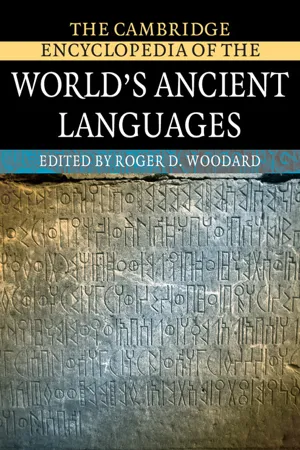
The Cambridge Encyclopedia of the World's Ancient Languages is the first comprehensive reference work treating all of the languages of antiquity. Clear and systematic in its approach, the Encyclopedia combines full linguistic coverage of all the well documented ancient languages, representing numerous language families from around the globe. Each chapter of the work focuses on an individual language or, in some instances, a set of closely related varieties of a language. Providing a full descriptive presentation, each of these chapters examines the writing system(s), phonology, morphology, syntax and lexicon of that language, and places the language within its proper linguistic and historical context. The Encyclopedia brings together an international array of scholars, each a leading specialist in ancient language study. While designed primarily for linguistic professionals and students, this work will prove invaluable to all whose studies take them into the realm of ancient language.
Information
Table of contents
- Cover
- Title
- Dedication
- Copyrighit
- Contents
- Figures
- Tables
- Maps
- Contributors
- Preface
- Abbreviations
- CHAPTER 1: Introduction
- CHAPTER 2: Sumerian
- CHAPTER 3: Elamite
- CHAPTER 4: Hurrian
- CHAPTER 5: Urartian
- CHAPTER 6: Afro-Asiatic
- CHAPTER 7: Ancient Egyptian and Coptic
- APPENDIX 1: Sign list
- CHAPTER 8: Akkadian and Eblaite
- Appendix 2: The cuneiform script
- CHAPTER 9: Ugaritic
- CHAPTER 10: Hebrew
- CHAPTER 11: Phoenician and Punic
- CHAPTER 12: Canaanite dialects
- CHAPTER 13: Aramaic
- CHAPTER 14: Ge’ez (Aksum)
- CHAPTER 15: Ancient South Arabian
- CHAPTER 16: Ancient North Arabian
- CHAPTER 17: Indo-European
- CHAPTER 18: Hittite
- CHAPTER 19: Luvian
- CHAPTER 20: Palaic
- CHAPTER 21: Lycian
- CHAPTER 22: Lydian
- CHAPTER 23: Carian
- CHAPTER 24: Attic Greek
- CHAPTER 25: Greek dialects
- CHAPTER 26: Sanskrit
- CHAPTER 27: Middle Indic
- CHAPTER 28: Old Persian
- CHAPTER 29: Avestan
- CHAPTER 30: Pahlavi
- CHAPTER 31: Phrygian
- CHAPTER 32: Latin
- CHAPTER 33: Sabellian languages
- CHAPTER 34: Venetic
- CHAPTER 35: Continental Celtic
- CHAPTER 36: Gothic
- CHAPTER 37: Ancient Nordic
- CHAPTER 38: Classical Armenian
- CHAPTER 39: Etruscan
- CHAPTER 40: Early Georgian
- CHAPTER 41: Ancient Chinese
- CHAPTER 42: Old Tamil
- CHAPTER 43: Mayan
- CHAPTER 44: Epi-Olmec
- Appendix 3: Zapotec
- CHAPTER 45: Reconstructed ancient languages
- Index of general subjects
- Index of grammar and linguistics
- Index of named linguistic laws and principles
- Index of languages
Trusted by 375,005 students
Access to over 1.5 million titles for a fair monthly price.
Study more efficiently using our study tools.
Frequently asked questions
Yes, you can cancel anytime from the Subscription tab in your account settings on the Perlego website. Your subscription will stay active until the end of your current billing period. Learn how to cancel your subscription
No, books cannot be downloaded as external files, such as PDFs, for use outside of Perlego. However, you can download books within the Perlego app for offline reading on mobile or tablet. Learn how to download books offline
Perlego offers two plans: Essential and Complete
- Essential is ideal for learners and professionals who enjoy exploring a wide range of subjects. Access the Essential Library with 800,000+ trusted titles and best-sellers across business, personal growth, and the humanities. Includes unlimited reading time and Standard Read Aloud voice.
- Complete: Perfect for advanced learners and researchers needing full, unrestricted access. Unlock 1.5M+ books across hundreds of subjects, including academic and specialized titles. The Complete Plan also includes advanced features like Premium Read Aloud and Research Assistant.
We are an online textbook subscription service, where you can get access to an entire online library for less than the price of a single book per month. With over 1.5 million books across 990+ topics, we’ve got you covered! Learn about our mission
Look out for the read-aloud symbol on your next book to see if you can listen to it. The read-aloud tool reads text aloud for you, highlighting the text as it is being read. You can pause it, speed it up and slow it down. Learn more about Read Aloud
Yes! You can use the Perlego app on both iOS and Android devices to read anytime, anywhere — even offline. Perfect for commutes or when you’re on the go.
Please note we cannot support devices running on iOS 13 and Android 7 or earlier. Learn more about using the app
Please note we cannot support devices running on iOS 13 and Android 7 or earlier. Learn more about using the app
Yes, you can access The Cambridge Encyclopedia of the World's Ancient Languages by Roger D. Woodard in PDF and/or ePUB format, as well as other popular books in Languages & Linguistics & Linguistics. We have over 1.5 million books available in our catalogue for you to explore.