Americans often assume that slave societies had little use for prisons and police because slaveholders only ever inflicted violence directly or through overseers. Mustering tens of thousands of previously overlooked arrest and prison records, John K. Bardes demonstrates the opposite: in parts of the South, enslaved and free people were jailed at astronomical rates. Slaveholders were deeply reliant on coercive state action. Authorities built massive slave prisons and devised specialized slave penal systems to maintain control and maximize profit. Indeed, in New Orleans—for most of the past half-century, the city with the highest incarceration rate in the United States—enslaved people were jailed at higher rates during the antebellum era than are Black residents today. Moreover, some slave prisons remained in use well after Emancipation: in these forgotten institutions lie the hidden origins of state violence under Jim Crow.
With powerful and evocative prose, Bardes boldly reinterprets relations between slavery and prison development in American history. Racialized policing and mass incarceration are among the gravest moral crises of our age, but they are not new: slavery, the prison, and race are deeply interwoven into the history of American governance.
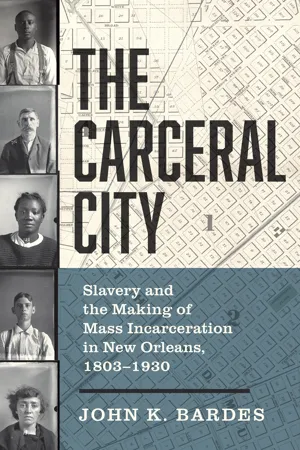
eBook - ePub
The Carceral City
Slavery and the Making of Mass Incarceration in New Orleans, 1803-1930
- 432 pages
- English
- ePUB (mobile friendly)
- Available on iOS & Android
eBook - ePub
About this book
Information
Table of contents
- Cover Page
- Title Page
- Copyright Page
- Dedication
- Contents
- List of Illustrations
- Introduction
- 1 The Problem of Incarceration in the Age of Slavery
- 2 A Line of Demarcation in Punishments: Slavery and the Penitentiary Movement, 1820–1861
- 3 Soi-Disant Libre: Travelers of Color, Free Status, and the Slave Prison
- 4 Idle and Dangerous: Poor White Workers, Freedom’s Limits, and Vagrancy Law
- 5 From Marronage to Vagrancy: Policing Freedom in Wartime Louisiana, 1862–1865
- 6 We Are All Vagrants: Reconstructing Police Power, 1865–1877
- 7 Aftershocks of Marronage: Labor Coercion in the Jim Crow City
- Epilogue
- Acknowledgments
- Notes
- Bibliography
- Index
Trusted by 375,005 students
Access to over 1.5 million titles for a fair monthly price.
Study more efficiently using our study tools.
Frequently asked questions
Yes, you can cancel anytime from the Subscription tab in your account settings on the Perlego website. Your subscription will stay active until the end of your current billing period. Learn how to cancel your subscription
No, books cannot be downloaded as external files, such as PDFs, for use outside of Perlego. However, you can download books within the Perlego app for offline reading on mobile or tablet. Learn how to download books offline
Perlego offers two plans: Essential and Complete
- Essential is ideal for learners and professionals who enjoy exploring a wide range of subjects. Access the Essential Library with 800,000+ trusted titles and best-sellers across business, personal growth, and the humanities. Includes unlimited reading time and Standard Read Aloud voice.
- Complete: Perfect for advanced learners and researchers needing full, unrestricted access. Unlock 1.5M+ books across hundreds of subjects, including academic and specialized titles. The Complete Plan also includes advanced features like Premium Read Aloud and Research Assistant.
We are an online textbook subscription service, where you can get access to an entire online library for less than the price of a single book per month. With over 1.5 million books across 990+ topics, we’ve got you covered! Learn about our mission
Look out for the read-aloud symbol on your next book to see if you can listen to it. The read-aloud tool reads text aloud for you, highlighting the text as it is being read. You can pause it, speed it up and slow it down. Learn more about Read Aloud
Yes! You can use the Perlego app on both iOS and Android devices to read anytime, anywhere — even offline. Perfect for commutes or when you’re on the go.
Please note we cannot support devices running on iOS 13 and Android 7 or earlier. Learn more about using the app
Please note we cannot support devices running on iOS 13 and Android 7 or earlier. Learn more about using the app
Yes, you can access The Carceral City by John Bardes in PDF and/or ePUB format, as well as other popular books in History & African American History. We have over 1.5 million books available in our catalogue for you to explore.