For the major poets of Osip Mandelstam's generation, poetry represented a calling in the most tangible sense. To respond to it meant to fashion from the available cultural and personal material a mythic self, one that could serve both as the organizing subject for poetry and as an object of worshipful adoration. A successful poet like Mandelstam thus became the focal point of a complex cultural phenomenon-perhaps a charismatic cult-that shaped his writings, gesture, and reception.
Gregory Freidin examines Mandelstam's legacy in this broader context and lays the groundwork for approaching modernist Russian poetry as a charismatic institution. He traces the interplay of poetic tradition, personal background, historical events, religious culture, and political developments as they entered the symbolic order of Mandelstam's art and helped determine its outlines in the reader's imagination. Many important aspects of the Mandelstam phenomenon, including the Jewish theme, the meaning of the poet's Christianity, his political stand, and, in particular, his conflict with Stalin and Stalinism, receive here a new interpretation.
A case study in the emergence of a literary cult, A Coat of Many Colors reveals how Russian poetry of the early twentieth century functioned as a charismatic institution of a distinctly modern kind. Those who belonged to it combined knowledge of the recent studies in myth, magic, and religion with the cultivation of verbal magic, mythic consciousness, and unorthodox religious beliefs. Following Mandelstam's career over its entire span (1908-1938), Freidin shows how the poet benefited from literary scholarship, comparative mythology, the history and sociology of religion at the same time he was emulating in his poetry the very subject of these academic disciplines. To account for this duality in interpreting Mandelstam's writings, Freidin draws on explanatory paradigms of contemporary human sciences, from Saussure and the Formalists to Weber, Durkheim, Freud, and Marcel Mauss.
For the major poets of Osip Mandelstam's generation, poetry represented a calling in the most tangible sense. To respond to it meant to fashion from the available cultural and personal material a mythic self, one that could serve both as the organizing su
eBook - ePub
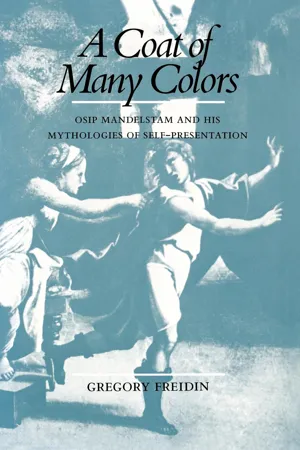
A Coat of Many Colors
Osip Mandelstam and His Mythologies of Self-Presentation
- 450 pages
- English
- ePUB (mobile friendly)
- Available on iOS & Android
eBook - ePub
About this book
Information
Table of contents
- Cover
- Title
- Copyright
- CONTENTS 1
- PREFACE
- ACKNOWLEDGMENTS
- I The Charisma of Poetry and the Poetry of Charisma
- II Mysteries of Breathing: 1909—1912
- Ill Le Nouvel Hippolyte and Phaedra-Russia 1915-1916
- IV Setting the Stage: Prolepsis in Tristia, 1915-1917
- V The Question of Return: Themes and Variations, 1918-1920
- VI Revolutions and the Poetics of a Dying Age
- VII Dying as Metaphor and the Ironic Mode: 1920-1930
- VIII History and Myth: 1930-1938
- APPENDIX I
- APPENDIX II
- NOTES
- BIBLIOGRAPHY
- INDEX
Trusted by 375,005 students
Access to over 1.5 million titles for a fair monthly price.
Study more efficiently using our study tools.
Frequently asked questions
Yes, you can cancel anytime from the Subscription tab in your account settings on the Perlego website. Your subscription will stay active until the end of your current billing period. Learn how to cancel your subscription
No, books cannot be downloaded as external files, such as PDFs, for use outside of Perlego. However, you can download books within the Perlego app for offline reading on mobile or tablet. Learn how to download books offline
Perlego offers two plans: Essential and Complete
- Essential is ideal for learners and professionals who enjoy exploring a wide range of subjects. Access the Essential Library with 800,000+ trusted titles and best-sellers across business, personal growth, and the humanities. Includes unlimited reading time and Standard Read Aloud voice.
- Complete: Perfect for advanced learners and researchers needing full, unrestricted access. Unlock 1.5M+ books across hundreds of subjects, including academic and specialized titles. The Complete Plan also includes advanced features like Premium Read Aloud and Research Assistant.
We are an online textbook subscription service, where you can get access to an entire online library for less than the price of a single book per month. With over 1.5 million books across 990+ topics, we’ve got you covered! Learn about our mission
Look out for the read-aloud symbol on your next book to see if you can listen to it. The read-aloud tool reads text aloud for you, highlighting the text as it is being read. You can pause it, speed it up and slow it down. Learn more about Read Aloud
Yes! You can use the Perlego app on both iOS and Android devices to read anytime, anywhere — even offline. Perfect for commutes or when you’re on the go.
Please note we cannot support devices running on iOS 13 and Android 7 or earlier. Learn more about using the app
Please note we cannot support devices running on iOS 13 and Android 7 or earlier. Learn more about using the app
Yes, you can access A Coat of Many Colors by Gregory Freidin in PDF and/or ePUB format, as well as other popular books in Literatura & Crítica literaria europea. We have over 1.5 million books available in our catalogue for you to explore.