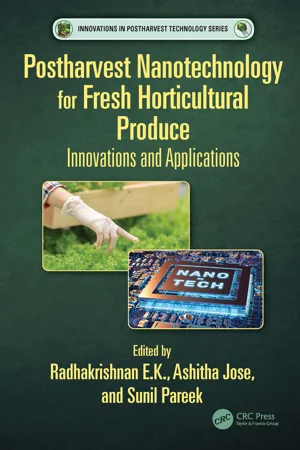
Postharvest Nanotechnology for Fresh Horticultural Produce
Innovations and Applications
- 461 pages
- English
- ePUB (mobile friendly)
- Available on iOS & Android
Postharvest Nanotechnology for Fresh Horticultural Produce
Innovations and Applications
About this book
Food scarcity and insecurity is an alarming issue throughout the world. Postharvest loss due to both mechanical damage and microbial spoilage significantly influences the shelf life and hence the availability of agricultural produce. Once initiated, the microbial spoilage can make bulk quantity of a given agricultural product unacceptable for human consumption, and several methods have already been used to try to manage this. Considering the limited success of the available methods, there is increasing interest in exploring nanotechnological methods. These methods are being considered for both the development of various platforms for antimicrobial/barrier packaging applications that minimize the contact of agricultural produce with the external environment, and also for design sensors to ensure food safety and quality.
The impact of various nano-systems developed through material engineering on the shelf-life enhancement and storage of fresh horticultural produce will have revolutionary effects on post-harvest management in the coming years. Hence, Postharvest Nanotechnology for Fresh Horticultural Produce has been edited to advance understanding of material development, intelligent selection of nanomaterials to ensure the nontoxic nature, and future perspectives of nanotechnology on postharvest produce. This includes various types of nanoparticles exploited for the postharvest management, their mechanism of action, varied applications and material engineering, along with natural products including essential oils and plant bioactives, modelling of various tailor-made materials to meet the required properties of the packed food, advancements in the nanotechnological applications for the minimally processed food, and the toxicity concerns.
Key Features:
· Describes advances in nanotechnology for postharvest management
· Includes extensive details on the applications of material engineering for post-harvest applications using nanotechnology and future aspects
· Provides extensive data on the types of nanomaterials used and the fabrication methods employed for the design of tailor-made products for the post-harvest management
This book reviews the current scientific advancements and future prospects of the nanotechnological interventions in meeting the quality and quantity standards of the horticultural produce and minimally processed food and will be a valuable reference for beginners, researchers, subject experts, and industrialists.
Frequently asked questions
- Essential is ideal for learners and professionals who enjoy exploring a wide range of subjects. Access the Essential Library with 800,000+ trusted titles and best-sellers across business, personal growth, and the humanities. Includes unlimited reading time and Standard Read Aloud voice.
- Complete: Perfect for advanced learners and researchers needing full, unrestricted access. Unlock 1.4M+ books across hundreds of subjects, including academic and specialized titles. The Complete Plan also includes advanced features like Premium Read Aloud and Research Assistant.
Please note we cannot support devices running on iOS 13 and Android 7 or earlier. Learn more about using the app.
Information
Table of contents
- Cover
- Half Title
- Series
- Title
- Copyright
- Contents
- PREFACE
- ABOUT THE EDITORS
- LIST OF CONTRIBUTORS
- 1 Introduction to Nanotechnological Applications in the Postharvest Processing of Fresh Horticultural Produce
- 2 Synthesis and Characterization Methods of Nano-Based Materials for the Postharvest Storage of Horticultural Produce
- 3 Organic Nanoparticles in Postharvest Management and the Mechanisms Involved
- 4 Cellulose Nanoparticles for Postharvest Management and the Mechanism Involved
- 5 Applications of Inorganic/Metallic Nanoparticles in Postharvest Management and the Mechanisms Involved
- 6 Mechanism of Silver Nanoparticle–Based Postharvest Technologies
- 7 Nanoclay-Based Methods for the Postharvest Processing of Horticultural Produce
- 8 Hybrid Nanomaterials for Postharvest Storage
- 9 Engineering the Nano-Based Packaging Materials for the Postharvest Storage
- 10 Advancements in the Essential Oil-Based Packaging Materials
- 11 Bioactive Nano-Based Packaging for Postharvest Storage of Horticultural Produce
- 12 Nanotechnology in Shelf-Life Enhancement of Minimally Processed Horticultural Produce
- 13 Modeling and Simulation of Gas Barrier Properties of Nanocomposites Used for Packaging Applications
- 14 Zinc-Oxide Nanoparticle–Based Methods for the Minimally Processed Horticultural Produce
- 15 Phyto-Nanocomposites for Minimally Processed Horticultural Produce
- 16 Toxicity Aspects of Nanomaterials and Their Composites Being Used in the Postharvest Nanotechnology
- 17 Life-Cycle Assessment: A Tool to Evaluate the Environmental Impact of Nanomaterials Used in Packaging
- 18 Global Status of Nanotechnology Policies in the Packaging Sector
- 19 Future Scope of Nano-Based Methods for the Improvement of Postharvest Technologies and Increased Shelf Life of Minimally Processed Food
- 20 Nano-Based Methods for the Improvement of Postharvest Technologies and Increased Shelf Life of Minimally Processed Food
- INDEX