Why are the economic interests and priorities of lower- and middle-class Americans so often ignored by the U.S. Congress, while the economic interests of the wealthiest are prioritized, often resulting in policies favorable to their interests? In Hijacking the Agenda, political scientists Christopher Witko, Jana Morgan, Nathan J. Kelly, and Peter K. Enns examine why Congress privileges the concerns of businesses and the wealthy over those of average Americans. They go beyond demonstrating that such economic bias exists to illuminate precisely how and why economic policy is so often skewed in favor of the rich.
The authors analyze over 20 years of floor speeches by several hundred members of Congress to examine the influence of campaign contributions on how the national economic agenda is set in Congress. They find that legislators who received more money from business and professional associations were more likely to discuss the deficit and other upper-class priorities, while those who received more money from unions were more likely to discuss issues important to lower- and middle-class constituents, such as economic inequality and wages. This attention imbalance matters because issues discussed in Congress receive more direct legislative action, such as bill introductions and committee hearings. While unions use campaign contributions to push back against wealthy interests, spending by the wealthy dwarfs that of unions.
The authors use case studies analyzing financial regulation and the minimum wage to demonstrate how the financial influence of the wealthy enables them to advance their economic agenda. In each case, the authors examine the balance of structural power, or the power that comes from a person or company's position in the economy, and kinetic power, the power that comes from the ability to mobilize organizational and financial resources in the policy process. The authors show how big business uses its structural power and resources to effect policy change in Congress, as when the financial industry sought deregulation in the late 1990s, resulting in the passage of a bill eviscerating New Deal financial regulations. Likewise, when business interests want to preserve the policy status quo, it uses its power to keep issues off of the agenda, as when inflation eats into the minimum wage and its declining purchasing power leaves low-wage workers in poverty. Although groups representing lower- and middle-class interests, particularly unions, can use their resources to shape policy responses if conditions are right, they lack structural power and suffer significant resource disadvantages. As a result, wealthy interests have the upper hand in shaping the policy process, simply due to their pivotal position in the economy and the resulting perception that policies beneficial to business are beneficial for everyone.
Hijacking the Agenda is an illuminating account of the way economic power operates through the congressional agenda and policy process to privilege the interests of the wealthy and marks a major step forward in our understanding of the politics of inequality.
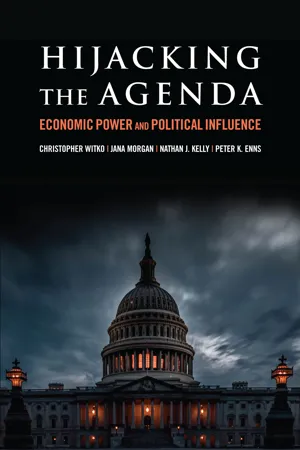
eBook - ePub
Hijacking the Agenda
Economic Power and Political Influence
- 416 pages
- English
- ePUB (mobile friendly)
- Available on iOS & Android
eBook - ePub
Hijacking the Agenda
Economic Power and Political Influence
About this book
Information
Table of contents
- Cover Page
- Title Page
- Copyright Page
- Dedication
- Table of Contents
- List of Illustrations
- About the Authors
- Acknowledgments
- Chapter 1. Forgotten: How Congress Ignores the Lower and Middle Classes
- Chapter 2. Power and the Policy Agenda
- Chapter 3. Congressional Attention to Economic Issues
- Chapter 4. Economic Interests and the Economic Agenda in Congress
- Chapter 5. Empowering Wall Street: Congressional Concern for Financial Deregulation
- Chapter 6. Financial Re-regulation? Economic Crisis and Shifting Power Dynamics
- Chapter 7. Ignoring Main Street: Congressional Disinterest in the Minimum Wage
- Chapter 8. Concluding Thoughts on Economic and Political Hierarchy
- Appendix
- Notes
- References
- Index
Trusted by 375,005 students
Access to over 1.5 million titles for a fair monthly price.
Study more efficiently using our study tools.
Frequently asked questions
Yes, you can cancel anytime from the Subscription tab in your account settings on the Perlego website. Your subscription will stay active until the end of your current billing period. Learn how to cancel your subscription
No, books cannot be downloaded as external files, such as PDFs, for use outside of Perlego. However, you can download books within the Perlego app for offline reading on mobile or tablet. Learn how to download books offline
Perlego offers two plans: Essential and Complete
- Essential is ideal for learners and professionals who enjoy exploring a wide range of subjects. Access the Essential Library with 800,000+ trusted titles and best-sellers across business, personal growth, and the humanities. Includes unlimited reading time and Standard Read Aloud voice.
- Complete: Perfect for advanced learners and researchers needing full, unrestricted access. Unlock 1.5M+ books across hundreds of subjects, including academic and specialized titles. The Complete Plan also includes advanced features like Premium Read Aloud and Research Assistant.
We are an online textbook subscription service, where you can get access to an entire online library for less than the price of a single book per month. With over 1.5 million books across 990+ topics, we’ve got you covered! Learn about our mission
Look out for the read-aloud symbol on your next book to see if you can listen to it. The read-aloud tool reads text aloud for you, highlighting the text as it is being read. You can pause it, speed it up and slow it down. Learn more about Read Aloud
Yes! You can use the Perlego app on both iOS and Android devices to read anytime, anywhere — even offline. Perfect for commutes or when you’re on the go.
Please note we cannot support devices running on iOS 13 and Android 7 or earlier. Learn more about using the app
Please note we cannot support devices running on iOS 13 and Android 7 or earlier. Learn more about using the app
Yes, you can access Hijacking the Agenda by Christopher Witko,Jana Morgan,Nathan J. Kelly,Peter K. Enns in PDF and/or ePUB format, as well as other popular books in Política y relaciones internacionales & Gobierno estadounidense. We have over 1.5 million books available in our catalogue for you to explore.