A groundbreaking history of why governments do—and don't—tax the rich
In today's social climate of acknowledged and growing inequality, why are there not greater efforts to tax the rich? In this wide-ranging and provocative book, Kenneth Scheve and David Stasavage ask when and why countries tax their wealthiest citizens—and their answers may surprise you.
Taxing the Rich draws on unparalleled evidence from twenty countries over the last two centuries to provide the broadest and most in-depth history of progressive taxation available. Scheve and Stasavage explore the intellectual and political debates surrounding the taxation of the wealthy while also providing the most detailed examination to date of when taxes have been levied against the rich and when they haven't. Fairness in debates about taxing the rich has depended on different views of what it means to treat people as equals and whether taxing the rich advances or undermines this norm. Scheve and Stasavage argue that governments don't tax the rich just because inequality is high or rising—they do it when people believe that such taxes compensate for the state unfairly privileging the wealthy. Progressive taxation saw its heyday in the twentieth century, when compensatory arguments for taxing the rich focused on unequal sacrifice in mass warfare. Today, as technology gives rise to wars of more limited mobilization, such arguments are no longer persuasive.
Taxing the Rich shows how the future of tax reform will depend on whether political and economic conditions allow for new compensatory arguments to be made.
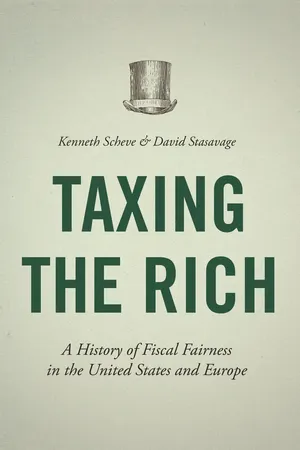
eBook - ePub
Taxing the Rich
A History of Fiscal Fairness in the United States and Europe
- 288 pages
- English
- ePUB (mobile friendly)
- Available on iOS & Android
eBook - ePub
Taxing the Rich
A History of Fiscal Fairness in the United States and Europe
About this book
Information
Publisher
Princeton University PressYear
2016Print ISBN
9780691178295
9780691165455
eBook ISBN
9781400880379
PART ONE
DEBATING TAXATION
CHAPTER ONE
WHY MIGHT GOVERNMENTS TAX THE RICH?*
When and why do countries tax the rich? It’s hard to think of a timelier question today or one for which there are more sharply colliding views. We know that taxes on the rich today aren’t what they were half a century ago, but how did we get from there to here? We know even less about how those high taxes of the twentieth century happened in the first place. Was it the effect of democracy, or a response to rampant inequality? Much of what is written today about taxing the rich takes the form of advocacy that is focused above all on the present. We do something different by taking a step back and showing what the long history of taxing the rich can teach us about our current situation.
What a country decides about taxes on the rich has profound consequences for its future economic growth and the distribution of economic resources and opportunities. Given the stakes, it’s surprising how few comparative studies exist of taxation of the rich over the long run. Many people have asked this question only for recent decades, or for a single country. The last book to treat the question extensively was published more than a century ago, by Edwin Seligman.
We argue that societies do not tax the rich just because they are democracies where the poor outnumber the rich or because inequality is high. Nor are beliefs about how taxes influence economic performance ultimately decisive. Societies tax the rich when people believe that the state has privileged the wealthy, and so fair compensation demands that the rich be taxed more heavily than the rest.
When it comes to thinking of what tax policy is best, few would disagree with the notion that governments should be—in part—guided by fairness. It is a term used frequently by those on both the political left and right.1 How can this be? History suggests that the concept of fairness is up for grabs. Standards of fairness in taxation vary greatly across countries, over time, and from individual to individual.
When scholars write about fairness and taxation they most often adopt a normative point of view; that is, they ask what governments should do. But fairness isn’t just a normative standard; it also matters for what governments do in practice because it influences the policy opinions of citizens. Ordinary people are more likely to support heavy taxation of the rich if it adheres to the fairness standards that they themselves hold. While many theories of politics assume people are concerned only with maximizing their own income, there is abundant evidence that humans are also concerned about issues of equity and fairness. These concerns don’t mean that people aren’t also concerned about self-interest—no one likes paying taxes—or even that self-interest isn’t their prime concern. Individuals may also care about the efficiency of a tax system and whether it taxes people so heavily that they stop producing at all. Opinions about tax policy can be informed by both self-interest and efficiency, as well as fairness.
Political support for taxing the rich is strongest when doing so ensures that the state treats citizens as equals. Treating citizens as equals means treating them with “equal concern and respect,” to use the phrase adopted by Ronald Dworkin.2 The idea that people should be treated as equals is, of course, part of the bedrock of modern democracy. This criterion narrows the field for what counts as an effective fairness justification for a tax. It cannot be an argument that refers to how people are inherently different or how some are inherently more worthy than others. Nor, of course, can it refer to pure self-interest. Even so, simply saying that people should be treated “as equals” or “with equal concern and respect” does not allow us to proceed deductively to identify the precise tax policies that satisfy this criterion. There are multiple ways to plausibly treat people as equals in taxation, and this is what debating tax fairness is all about. We take an inductive approach and focus on the three arguments that have been the most common and the most persuasive in political debate: equal treatment, ability to pay, and compensatory arguments. We refer to these arguments as three ways to treat people as equals.
The greatest political support for taxing the rich emerges when compensatory arguments can be credibly applied in policy debates. This happens when it is clear that taxing the rich more heavily than the rest serves to correct or compensate for some other inequality in government action. Compensatory arguments are most likely to emerge in democracies precisely because the very idea of democracy is that citizens should be treated as equals. If the rich have been privileged by some government intervention while others have not, then it is fair that they should be taxed more heavily to compensate for this advantage. Symmetrically, if the state has asked others to sacrifice while the rich have not borne the same burden, then again taxation of the rich can compensate. Compensatory arguments push policy toward heavier taxation of the rich, but in many cases the straightest route to fairness is to remove the initial privilege in the first place. Therefore, compensatory arguments are most powerful in cases when a government is obliged to take an unequal action that somehow favors the rich.
The compensatory theory is not the only fairness-based argument for taxing the rich. Over the past few centuries, the most common fairness-based argument for taxing the rich has been the ability to pay doctrine. According to this doctrine, a dollar in taxes for someone earning a million dollars a year represents less of a sacrifice than it does for someone earning a more average salary.3 Ability to pay arguments have existed since at least the sixteenth century, and they underpin the contemporary theories of optimal taxation most favored by economists.
For many, the ability to pay doctrine suffices as a reason to tax the rich more heavily than the rest. Others object to this notion. They may question how the ability to pay doctrine can be applied in practice. How much more should a rich person pay? They may also ask why ability to pay says nothing about how disparities in income or wealth emerged in the first place. Maybe the rich were just more talented or exerted more effort than others? People who criticize the ability to pay doctrine do not deny that a dollar in taxes represents less of a sacrifice for a rich person than for someone else; they simply do not accept that this is the right criterion by which to judge fairness.
In the face of doubts about ability to pay, a salient alternative is to suggest that the fairest system involves equal treatment for all. Both rich and poor should pay the same tax rate—a “flat tax.” We use the phrase “equal treatment” to refer to fairness arguments suggesting that the same exact policy be adopted for all. Since the sixteenth century, opponents of progressive taxation have suggested that the basis of a republic is equal treatment for all, as illustrated by the norm of one person one vote. Therefore the same exact policy should be applied to taxation. The logic that equal treatment requires a flat tax is not perfect; having all pay a lump-sum tax, where each person pays the same amount, would also respect equal treatment, yet many today would consider such a tax unfair. Nevertheless, arguments based on equal treatment have carried great power in debates about taxing the rich.
Some of the earliest examples of compensatory arguments involve suggestions that the rich ought to pay a higher rate of income tax because the poor bear the brunt of indirect taxes on common consumption goods. The idea is that to maintain themselves, the poor must consume a greater share of their income each year. However, over the last two centuries the most powerful compensatory arguments have involved a different sort of tax—military conscription. This one simple fact goes a long way toward explaining both the rise of heavy taxation of the rich in the early and mid-twentieth century and the subsequent move away from this policy over the last several decades. The mass wars of the twentieth century were fought in a way that had a strong economic rationale but which privileged the rich along two dimensions. First, labor was conscripted to fight while capital was not. Second, owners of capital benefited from high wartime demand for their products. Heavy taxation of the rich (owners of capital) became a way to mitigate these effects and to restore at least some degree of equality of treatment by the government. This was what those on the political left claimed and what those on the right were forced to concede. It was a powerful new argument for progressive forms of taxation, and it shifted mass and elite opinion on the question of taxing the rich in a leftward direction. Other scholars before us have investigated the effect of war on tax fairness, particularly in the United States and the United Kingdom. We show that this war effect can be explained by the compensatory theory of progressive taxation and that it is a more general phenomenon across countries and time.4
Compensatory arguments are less credible in the case of more limited wars of the sort that the United States has fought of late. If the bulk of the population is not sacrificing for war, then how is it credible to ask the rich to pay a special sacrifice as compensation?
Finally, the choice between limited war or mass mobilization has been dependent on the state of military and related technologies. In the twentieth century the advent of the railroad made mass mobilization possible. When mass mobilization did eventually occur in 1914, compensatory arguments for taxing the rich emerged. In the twenty-first century the advent of precision weapons and drone technology means that mass armies are no longer necessary and may even be undesirable. Therefore, we are unlikely to see a repeat of the twentieth-century forces that led to heavy taxation of the rich. The compensatory theory explains why it was the wars of the early and mid-twentieth century that brought heavy taxation of the rich and not prior or subsequent wars.
Over the last two centuries, when circumstances have made compensatory arguments less credible, debates about taxation of the rich have boiled down to a conflict between the two competing visions of ability to pay and equal treatment, as well as efficiency. The outcome of this conflict has generally been for the rich to not be taxed much more heavily than the rest of the population. But, when circumstances have allowed for wartime compensatory arguments to be made, opinion has shifted in favor of taxing the rich. While those who adhere to ability to pay have continued to support taxing the rich, many of those who have preferred equal treatment have thought that the compensatory argument must be taken into account to achieve this goal. In such situations political parties of the left have used compensatory arguments to reinforce their arguments for taxing the rich. Political parties of the right have been forced to cede ground in order to remain electable.
It is also the case that political parties can and have used compensatory arguments instrumentally. If you personally are already convinced by the ability to pay rationale for taxing the rich, you may gain greater support for your proposal by making compensatory arguments that win broader support. Once external circumstances change and compensatory arguments lack credibility, then debates about taxing the rich return to a conflict between the competing notions of equal treatment, efficiency, and ability to pay.
THE RISE (AND DEMISE?) OF TAXES ON THE RICH
We can learn a great deal by studying changes in taxation over the long run. A look at broad trends can help us tease out the most important factors at play. To do this we, and the research assistants who helped us, have collected information on taxation in twenty countries, located principally in North America and Western Europe, over a period of two centuries.5 We focus on these countries for feasibility in data collection, but the conclusions we draw apply more generally.6 In an ideal world we would know all taxes due by a rich person and an average person in each year for each of the cases; unfortunately this is not possible. For most countries, even statutory rates of taxation are not widely published and must instead be verified by consulting original legislation. This is a time-consuming process.
We have been able to construct a unique database tracking statutory top marginal rates of income and inheritance taxation across the twenty countries. By statutory top marginal rates we mean the tax rate that would apply by law on the last dollar of income (or wealth) for someone in the highest tax bracket. This information is mostly drawn from original legislation. The top marginal rate provides an indication of what a rich person would be likely to pay. However, a focus on top statutory rates alone can provide misleading conclusions, and to deal with this problem we have also collected much additional information. First, we have the full schedules of tax rates (i.e., not just those at the top) for half of the countries. This shows whether an increase in the top rate represented a move to tax just the rich or whether it was just part of a move to tax everyone more heavily. A look at these schedules also reveals something more specific about who was being taxed. Rather than simply referring to “the rich” and “the rest,” we can refer to individuals earning incomes or having fortunes of a specific size relative to the national average. What do we mean ...
Table of contents
- Cover
- Title Page
- Copyright Page
- Dedication Page
- Epigraph
- Contents
- Figures and Tables
- Acknowledgments
- Part One – Debating Taxation
- Part Two – When have Governments Taxed the Rich?
- Part Three – Why have Governments Taxed the Rich?
- Notes
- References
- Index
Trusted by 375,005 students
Access to over 1.5 million titles for a fair monthly price.
Study more efficiently using our study tools.
Frequently asked questions
Yes, you can cancel anytime from the Subscription tab in your account settings on the Perlego website. Your subscription will stay active until the end of your current billing period. Learn how to cancel your subscription
No, books cannot be downloaded as external files, such as PDFs, for use outside of Perlego. However, you can download books within the Perlego app for offline reading on mobile or tablet. Learn how to download books offline
Perlego offers two plans: Essential and Complete
- Essential is ideal for learners and professionals who enjoy exploring a wide range of subjects. Access the Essential Library with 800,000+ trusted titles and best-sellers across business, personal growth, and the humanities. Includes unlimited reading time and Standard Read Aloud voice.
- Complete: Perfect for advanced learners and researchers needing full, unrestricted access. Unlock 1.5M+ books across hundreds of subjects, including academic and specialized titles. The Complete Plan also includes advanced features like Premium Read Aloud and Research Assistant.
We are an online textbook subscription service, where you can get access to an entire online library for less than the price of a single book per month. With over 1.5 million books across 990+ topics, we’ve got you covered! Learn about our mission
Look out for the read-aloud symbol on your next book to see if you can listen to it. The read-aloud tool reads text aloud for you, highlighting the text as it is being read. You can pause it, speed it up and slow it down. Learn more about Read Aloud
Yes! You can use the Perlego app on both iOS and Android devices to read anytime, anywhere — even offline. Perfect for commutes or when you’re on the go.
Please note we cannot support devices running on iOS 13 and Android 7 or earlier. Learn more about using the app
Please note we cannot support devices running on iOS 13 and Android 7 or earlier. Learn more about using the app
Yes, you can access Taxing the Rich by Kenneth Scheve,David Stasavage in PDF and/or ePUB format, as well as other popular books in Politics & International Relations & Economic Policy. We have over 1.5 million books available in our catalogue for you to explore.