- 369 pages
- English
- ePUB (mobile friendly)
- Available on iOS & Android
eBook - ePub
About this book
"A fascinating set of ideas . . . Politicians of all stripes should take note. And so should the people who vote for them." —
Financial Times
We know that our world is undergoing seismic change—but how can we emerge from the crisis as a better society?
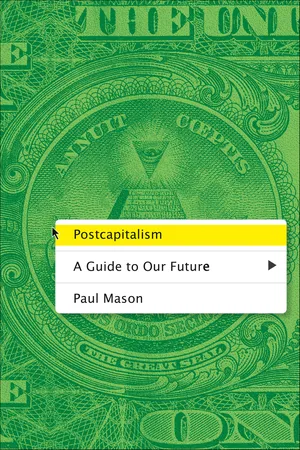
Over the past two centuries or so, capitalism has undergone profound changes—economic cycles that veer from boom to bust—from which it has always emerged transformed and strengthened. Surveying this turbulent history, Paul Mason's Postcapitalism argues that we are on the brink of a change so big and so profound that this time capitalism itself, the immensely complex system within which entire societies function, will mutate into something wholly new.
At the heart of this change is information technology, a revolution that is driven by capitalism but, with its tendency to push the value of much of what we make toward zero, has the potential to destroy an economy based on markets, wages, and private ownership. Almost unnoticed, in the niches and hollows of the market system, swaths of economic life are beginning to move to a different rhythm. Vast numbers of people are changing how they behave and live, in ways contrary to the current system of state-backed corporate capitalism. And as the terrain changes, new paths open.
In this bold and prophetic book, Mason shows how, from the ashes of the crisis, we have the chance to create a more just and sustainable economy. Although the dangers ahead are profound, he argues that there is cause for hope. This is the first time in human history in which, equipped with an understanding of what is happening around us, we can predict and shape the future.
"Absorbing and provocative." — Publishers Weekly
"An original, engaging, and bracingly articulated vision of real alternatives. It is sure to spark many vigorous debates, and they are precisely the ones we should be having." —Naomi Klein, New York Times–bestselling author of Doppelganger
We know that our world is undergoing seismic change—but how can we emerge from the crisis as a better society?
Over the past two centuries or so, capitalism has undergone profound changes—economic cycles that veer from boom to bust—from which it has always emerged transformed and strengthened. Surveying this turbulent history, Paul Mason's Postcapitalism argues that we are on the brink of a change so big and so profound that this time capitalism itself, the immensely complex system within which entire societies function, will mutate into something wholly new.
At the heart of this change is information technology, a revolution that is driven by capitalism but, with its tendency to push the value of much of what we make toward zero, has the potential to destroy an economy based on markets, wages, and private ownership. Almost unnoticed, in the niches and hollows of the market system, swaths of economic life are beginning to move to a different rhythm. Vast numbers of people are changing how they behave and live, in ways contrary to the current system of state-backed corporate capitalism. And as the terrain changes, new paths open.
In this bold and prophetic book, Mason shows how, from the ashes of the crisis, we have the chance to create a more just and sustainable economy. Although the dangers ahead are profound, he argues that there is cause for hope. This is the first time in human history in which, equipped with an understanding of what is happening around us, we can predict and shape the future.
"Absorbing and provocative." — Publishers Weekly
"An original, engaging, and bracingly articulated vision of real alternatives. It is sure to spark many vigorous debates, and they are precisely the ones we should be having." —Naomi Klein, New York Times–bestselling author of Doppelganger
Frequently asked questions
Yes, you can cancel anytime from the Subscription tab in your account settings on the Perlego website. Your subscription will stay active until the end of your current billing period. Learn how to cancel your subscription.
No, books cannot be downloaded as external files, such as PDFs, for use outside of Perlego. However, you can download books within the Perlego app for offline reading on mobile or tablet. Learn more here.
Perlego offers two plans: Essential and Complete
- Essential is ideal for learners and professionals who enjoy exploring a wide range of subjects. Access the Essential Library with 800,000+ trusted titles and best-sellers across business, personal growth, and the humanities. Includes unlimited reading time and Standard Read Aloud voice.
- Complete: Perfect for advanced learners and researchers needing full, unrestricted access. Unlock 1.4M+ books across hundreds of subjects, including academic and specialized titles. The Complete Plan also includes advanced features like Premium Read Aloud and Research Assistant.
We are an online textbook subscription service, where you can get access to an entire online library for less than the price of a single book per month. With over 1 million books across 1000+ topics, we’ve got you covered! Learn more here.
Look out for the read-aloud symbol on your next book to see if you can listen to it. The read-aloud tool reads text aloud for you, highlighting the text as it is being read. You can pause it, speed it up and slow it down. Learn more here.
Yes! You can use the Perlego app on both iOS or Android devices to read anytime, anywhere — even offline. Perfect for commutes or when you’re on the go.
Please note we cannot support devices running on iOS 13 and Android 7 or earlier. Learn more about using the app.
Please note we cannot support devices running on iOS 13 and Android 7 or earlier. Learn more about using the app.
Yes, you can access Postcapitalism by Paul Mason in PDF and/or ePUB format, as well as other popular books in Politics & International Relations & Consumer Behaviour. We have over one million books available in our catalogue for you to explore.
Information
Table of contents
- Cover
- Title Page
- Copyright Notice
- Dedication
- Introduction
- Part I
- Part II
- Part III
- Notes
- Acknowledgements
- Index
- Also by Paul Mason
- A Note About the Author
- Newsletter Sign-up
- Contents
- Copyright